Key Facts
- The S&P IPSA fell 0.70% to 10,947.38 on Thursday, extending its retreat from the 52-week high as broad-based selling hit blue chips.
- SQM-B was the session’s biggest weight, sinking 2.7% with heavy turnover of $39m as lithium names faced a sudden bout of profit-taking.
- The Chilean peso weakened 0.22% to close at 924.00 per dollar, slipping in tandem with the equity market despite a slightly firmer tone on Wall Street.
- Retail and bank names were uniformly soft, with Cencosud down 1.7% and Falabella losing 0.4% on modest volume, signalling local caution.
- The move came with a thin 1:10 advance-decline ratio on the blue-chip board, underlining that the session was a deliberate broad-market retreat rather than a single-stock event.
Today’s Focus
Chile’s S&P IPSA slipped 0.70% to 10,947.38 on Thursday, with the index trading in a tight intraday band of 10,920 to 11,039. The decline was remarkably broad — the blue-chip board posted 10 decliners against just 1 advancer, making it a clear session-wide risk reduction.
SQM-B led the retreat with a sharp 2.7% drop on turnover of $39m, which accounted for a disproportionate share of the day’s total volume. The lithium giant’s slide lacked an obvious company-specific catalyst, suggesting traders were locking in profits after the stock’s recent strength, which Reuters had linked to upbeat broker commentary on lithium demand.
Retail and financial names added to the malaise. Cencosud fell 1.7%, while Falabella dipped 0.4% on thin volume. The banking trio of BCI, CHILE, and ITAUCL showed declines of 2.6%, 0.3%, and a flat 0.1% gain respectively, painting a picture of domestic fund managers trimming cyclical exposure.
What matters today. A universally weak session without a local panic trigger points to pre-weekend positioning and underlying nervousness about commodity-linked names, making the broad advance-decline line the most honest read on the day.
01 The session in one read
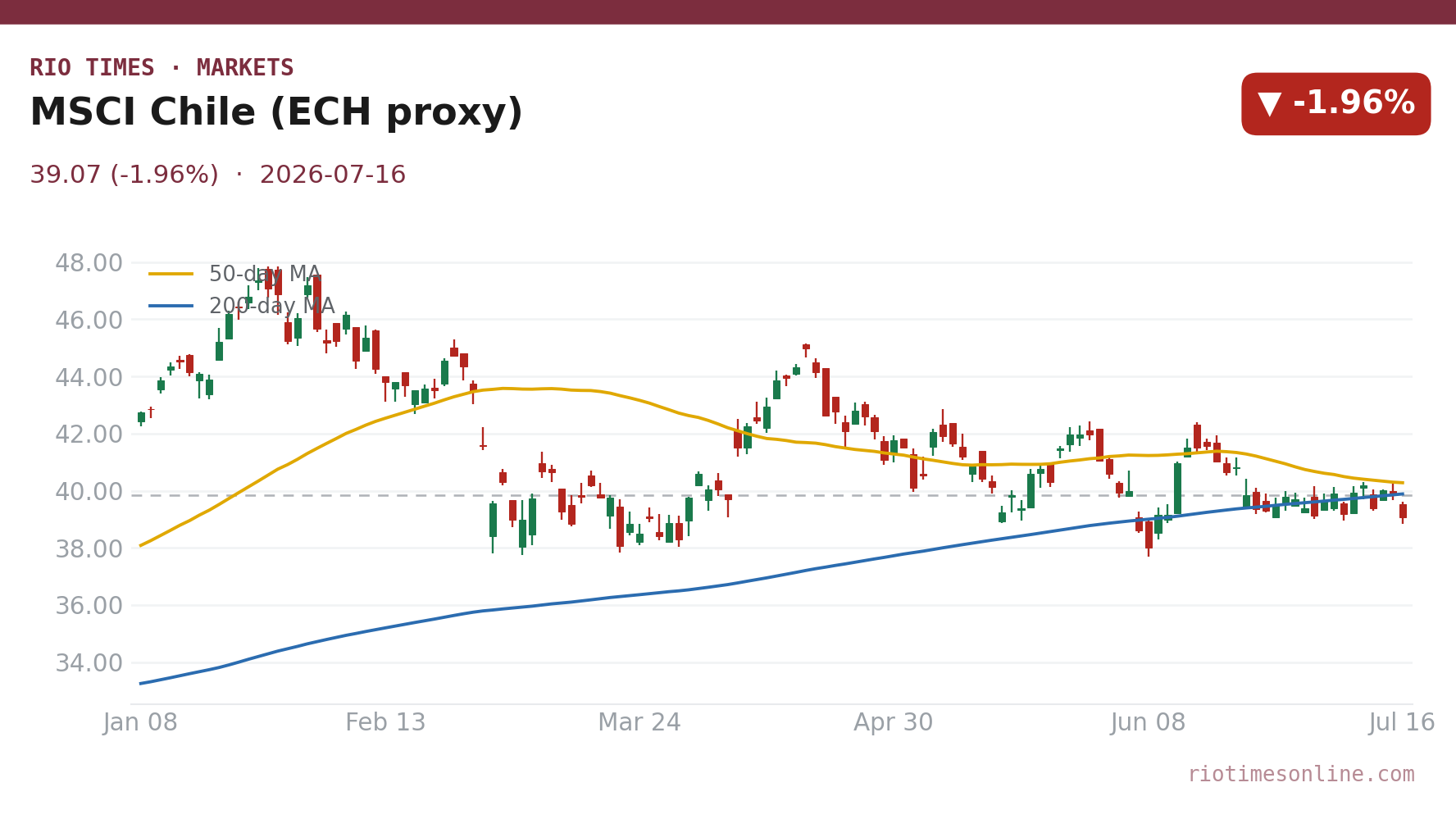
The Santiago bourse ended Thursday firmly in the red, with the S&P IPSA shedding 76.62 points to close at 10,947.38 — a clean 0.70% decline that erased the week’s tentative gains. The index moved within a narrow 119-point range, never threatening to break above the 11,039 mark, and spent the final hours of trading grinding near the session low of 10,920.
The breadth was punishing. Only one name on the 11-stock blue-chip board managed to advance, while 10 declined — a 1:10 ratio that tells you this was not a story-driven sell-off but a methodical, broad-based reduction of Chilean equity risk.
SQM-B was the undisputed drag, falling 2.7% on heavy volume of $39m. The lithium producer has been a standout outperformer in recent weeks after Scotiabank reiterated a bullish view on lithium demand, but Thursday’s price action showed large sellers taking chips off the table.
Financials were not spared. BCI fell 2.6%, Banvida dropped 2.6%, and the heavyweight banking trio of Banco de Chile, Santander Chile, and Itaú Chile all traded in the red. The peso slipped 0.22% to 924.00 per dollar, completing the picture of a session where local investors wanted less exposure to everything Chilean.
The 0.70% drop in the IPSA sits awkwardly against a firmer S&P 500, which was up 0.38% on the day. The divergence and the lopsided advance-decline ratio suggest the selling was locally driven and likely mechanical — end-of-week book-squaring in names that had recently outperformed, particularly SQM-B. The peso’s parallel 0.22% dip reinforces the sense of a light risk-off adjustment rather than a fundamental re-rating. The key variable to watch is whether SQM-B stabilises near current levels in the next session; a further 2% drop would shift the tone from orderly profit-taking to a potential re-pricing of lithium exposure.
02 The day’s numbers
| Measure | Level | Change | Read |
|---|---|---|---|
| S&P IPSA | 10,947.38 | −0.70% | Session range 10,920–11,039; 52-week high 11,628 |
| USD/CLP | 924.00 | −0.22% | Peso weaker; 52-week range 851.67–973.62 |
| S&P 500 (Wall St) | 7,572.40 | +0.38% | Diverged positively from Chilean equities |
| Advance/Decline (IPSA) | 1 / 10 | — | Extremely lopsided — universal selling |
The IPSA’s 0.70% decline took it to 5.8% below its 52-week high of 11,628, a peak reached during the index’s powerful rally from the mid-5,400s. The session range of 10,920 to 11,039 was remarkably contained for a day with such weak breadth, hinting at steady, unpanicked distribution rather than capitulation.
The peso’s 0.22% dip to 924.00 kept it comfortably within its recent trading band, still roughly 5% stronger than its 52-week low of 973.62. The slight softening alongside equities suggests spot flows were biased towards dollar demand, though without any sense of strain in the local FX market. Rio Times · Live Market Intelligence
Live Market IntelligenceChile — Live Market Board
Chile — Live Market Board
Instrument Last Change YoY Prev. High Low Volume
IPSA
10,970.29
-0.01%
—
10,971.88
11,210
10,984
1,513,213,483
USD/CLP
913.98
+0.04%
-5.67%
913.65
915.11
906.68
—
COPPER
6.61
+0.03%
+46.70%
6.61
6.71
6.61
39,543
SQM-B
65,305
-0.84%
+49.03%
65,860
66,949
64,978
76,539
COPEC
5,964
-1.09%
-11.70%
6,030
6,100
5,960
634,331
BSANTANDER
78.37
-2.28%
+35.94%
80.20
81.69
78.34
36,288,711
FALABELLA
6,334
-1.48%
+23.28%
6,429
6,450
6,300
26,085,814
ENELAM
87.09
+0.10%
-10.13%
87.00
87.40
86.50
13,106,417
CENCOSUD
1,946
-2.19%
-35.30%
1,990
2,010
1,945
966,528
CMPC
1,020
-1.96%
-29.10%
1,040
1,050
1,015
3,526,677
BANCO CHILE
184.96
-1.01%
+32.87%
186.85
189.99
184.33
18,101,240
LATAM AIR
24.08
-1.11%
+16.61%
24.35
24.59
23.88
573,612,753
SOUTHERN COPPER
193.97
-0.26%
+104.01%
194.48
199.36
192.59
367,102
03 Why it moved — broad local profit-taking meets a quiet macro day
No single macro shock landed on Santiago desks Thursday. The session’s dominant feature was a broad, locally initiated unwind of positions that had been built up over recent weeks, with SQM-B the clearest example. The stock’s 2.7% slide on $39m turnover — the highest on the board by a wide margin — suggests institutional accounts were actively reducing weight in the lithium giant, which had rallied into early July on the back of upbeat demand narratives.
The decision to sell was not ring-fenced to lithium. Every corner of the IPSA felt the draft: Cencosud fell 1.7%, Copec’s parent Empresas Copec ended at 6,210.00 pesos with an intraday low of 6,014.50, and even the utilities — normally defensive in Chilean markets — saw Enel Américas slip 1.1%.
The divergence from a firmer Wall Street is telling. With the S&P 500 up 0.38%, there was no external trigger to blame. Instead, the selling looks like a pre-weekend de-risking move amplified by the index’s heavy concentration in commodity-linked and consumer-discretionary names — sectors that local traders view as vulnerable to global growth wobbles.
The global backdrop provided no offset. While the scan does not provide a live copper print for the session, the red metal’s recent price action has been a persistent macro anchor for Chilean assets, and any softness in London or Shanghai would have reinforced the cautious mood. Without a fresh copper bid, local funds had little incentive to hold risk into the weekend.
04 The day’s movers
| Driver | Level / Move | Change | Note |
|---|---|---|---|
| SQM-B | Turnover $39m | −2.7% | Session’s biggest drag; heavy institutional selling |
| LTM | Turnover $20m | +2.0% | Rare advancer on strong volume; possible defensive rotation |
| BCI | Turnover $9m | −2.6% | Second-worst blue-chip; mirroring broad bank sell-off |
| CENCOSUD | Turnover $6m | −1.7% | Retail under pressure; light volume |
| FALABELLA | Turnover $5m | −0.4% | Modest decline on thin trade |
| ENELAM | Turnover $5m | −1.1% | Utility weakness defies defensive label |
The day’s most-traded table reveals a session where selling was concentrated in the names that usually attract the most foreign and institutional flow. SQM-B’s $39m turnover was nearly double the next most active stock, LATAM Airlines, which managed a 2.0% gain — the session’s only real bright spot — on $20m in volume. That suggests some rotation into the airline as a domestic demand proxy, though the move was not enough to lift the broader index.
The bank names were uniformly soft. BCI fell 2.6% on $9m in turnover, Banco de Chile shed 0.3%, and Itaú Chile barely clung to a 0.1% gain. The sector has been under gentle pressure for several sessions, and Thursday’s declines fit the pattern of local funds trimming exposure to rate-sensitive financials ahead of the weekend.
05 The regional scoreboard
| Index | Country | Change |
|---|---|---|
| S&P IPSA | Chile | −0.70% |
| Ibovespa | Brazil | — |
| MERVAL | Argentina | — |
| S&P/BMV IPC | Mexico | — |
| COLCAP | Colombia | — |
The regional scoreboard is sparse for Friday’s wrap, with only the Chilean close confirmed from the proprietary scan. The live market board embedded above carries the latest closes for the other Latin American benchmarks, which are not captured in Thursday’s RT feed. Chile’s 0.70% decline was notable for its pace against a Wall Street that managed a 0.38% gain, hinting that local factors — not a regional or global shock — drove the session.
In recent sessions, the IPSA has often traded in sympathy with Brazil’s Ibovespa, particularly when commodity prices move. Without a verified print for the Ibovespa or the MERVAL, the Chile-specific nature of Thursday’s selling stands out. The peso’s 0.22% dip also suggests the move was more about local equity positioning than a broad emerging-market currency swing.
06 The technical picture
The IPSA’s close at 10,947.38 leaves it firmly below the psychologically important 11,000 level, a threshold that had offered support earlier in the week. The session low of 10,920 is now the immediate floor to watch — a break below that in the next session would open the path to the 10,750 area, where the index found buyers in late June.
On the upside, the 11,039 intraday high from Thursday now acts as the first resistance point, with the 52-week high of 11,628 remaining the medium-term target that bulls need to recapture. The index is sitting 5.8% below that peak, a gap that has widened from roughly 3% just two weeks ago. The gradient of the recent pullback — shallow but persistent — suggests an orderly consolidation rather than a sharp reversal, but traders will want to see the advance-decline line improve before calling a bottom.
07 What to watch
- SQM-B stabilisation: Whether the lithium giant can hold above its late-June levels in the next session will set the tone for the whole IPSA; another 2% drop would signal a bigger rotation out of materials.
- Copper price in London: Not captured in Thursday’s scan but the red metal remains the macro anchor for Chilean assets — any sharp move ahead of the weekend will directly hit the IPSA futures open.
- Friday US data deluge: Industrial production, Michigan sentiment, and housing starts all land today and could shift the dollar and rate expectations, rippling through USD/CLP and EM equity flows.
- Weekend positioning flows: With the IPSA already on the back foot, any late-day selling into the Friday close would signal deeper institutional caution and extend the losing streak into next week.
Background: Chile Targets India, Philippines, ASEAN and EU in 2026 Export Push.
Background: A Chilean-Backed Importer Wants a Tenth of the US Grape Market.
More: Chile news in English, every day from The Rio Times.
Frequently Asked Questions
Why did Chile’s stock market fall on Thursday?
Broad-based profit-taking across the IPSA blue chips, with SQM-B leading the decline at −2.7%. The 1:10 advance-decline ratio shows the sell-off was universal rather than driven by a single event.
What happened to SQM-B?
The lithium giant dropped 2.7% on turnover of $39m, the session’s highest volume, suggesting institutional investors were reducing exposure after the stock’s recent rally tied to positive lithium-demand commentary from Scotiabank.
How did the Chilean peso perform?
The peso weakened 0.22% to 924.00 per US dollar, in line with the soft equity tone and reflecting light demand for dollars in the local spot market without any sign of FX stress.
Was this a global or local move?
Primarily local. The S&P 500 rose 0.38% on the day, so the IPSA’s 0.70% decline was a Santiago-driven decision to reduce risk, likely amplified by pre-weekend book-squaring in commodity-linked names.
This article was produced by The Rio Times’ automated newsroom system. How we use AI · Report an error · Editorial responsibility: Matthias Camenzind, Editor-in-Chief
LatAm Markets: Live Signals → — real-time movers, turnover leaders and FX across Latin America.