Chile Court Strikes Last Pollution Insurance Clause, Clearing Kast Reform

POLITICS · CHILE
Key Facts
- —The country Chile, where President José Antonio Kast’s National Reconstruction law, known as the “megarreforma”, passed Congress in August and needed clearance from the Constitutional Court (TC) before signing.
- —What happened On 2 October the TC struck three provisions, including the last article of the scheme critics call the “pollution insurance”. Its core, articles 12 and 13, fell on 13 August.
- —Who is involved Opposition senators and deputies filed the three August challenges. The October ruling came in the court’s automatic review. Mayors split over it on 2 October; Defendamos Patagonia hailed it on 4 October.
- —What it means for you Investors keep the corporate tax cut and tax stability, neither touched by the October ruling. Firms lose any state payout if a court annuls their environmental permit.
- —Still open As of 4 October no promulgation date had been announced. The government said on 2 October it would study the ruling. Signing is expected in the coming week.
Chile’s Constitutional Court has removed the last piece of the so-called pollution insurance from President José Antonio Kast’s flagship reconstruction law. The ruling, issued on Friday 2 October, closes the court’s review and leaves the law ready to be signed.
The scheme would have obliged the state to compensate companies whose environmental permits were annulled by the courts. Environmental campaigners celebrated on Sunday, while the government stressed that its reform survives largely intact.
How the Pollution Insurance Was Struck in Two Steps
The first blow came on 13 August. Ruling on three challenges from opposition senators and deputies, the court declared articles 12 and 13 unconstitutional in full, 24horas reported.
Those articles let a project owner claim compensation if a final court ruling annulled its Environmental Qualification Resolution (RCA), Chile’s main environmental permit. The Rio Times covered that August ruling at the time.
The senators argued the scheme paid firms without proof of state negligence, Pauta reported. It also handed the amount to an arbitration panel and shielded the officials responsible.
One linked article survived because the challenges had targeted only articles 12 and 13. It let a company contest the payout before the Santiago Court of Appeals, El Desconcierto and CNN Chile reported. On 2 October the court struck it too, ruling it meaningless without the core scheme.
Municipal Funding Rules Also Fall
The court also removed conditions attached to compensating councils for a new property tax exemption for over-65s. Councils would have had to report staffing monthly and cut permit times by 30% against 2023–2025.
The judges said tying the money to targets broke the solidarity role of the Common Municipal Fund (FCM). It moves revenue from richer to poorer districts. Compensation must now be paid in full, BioBioChile reported.
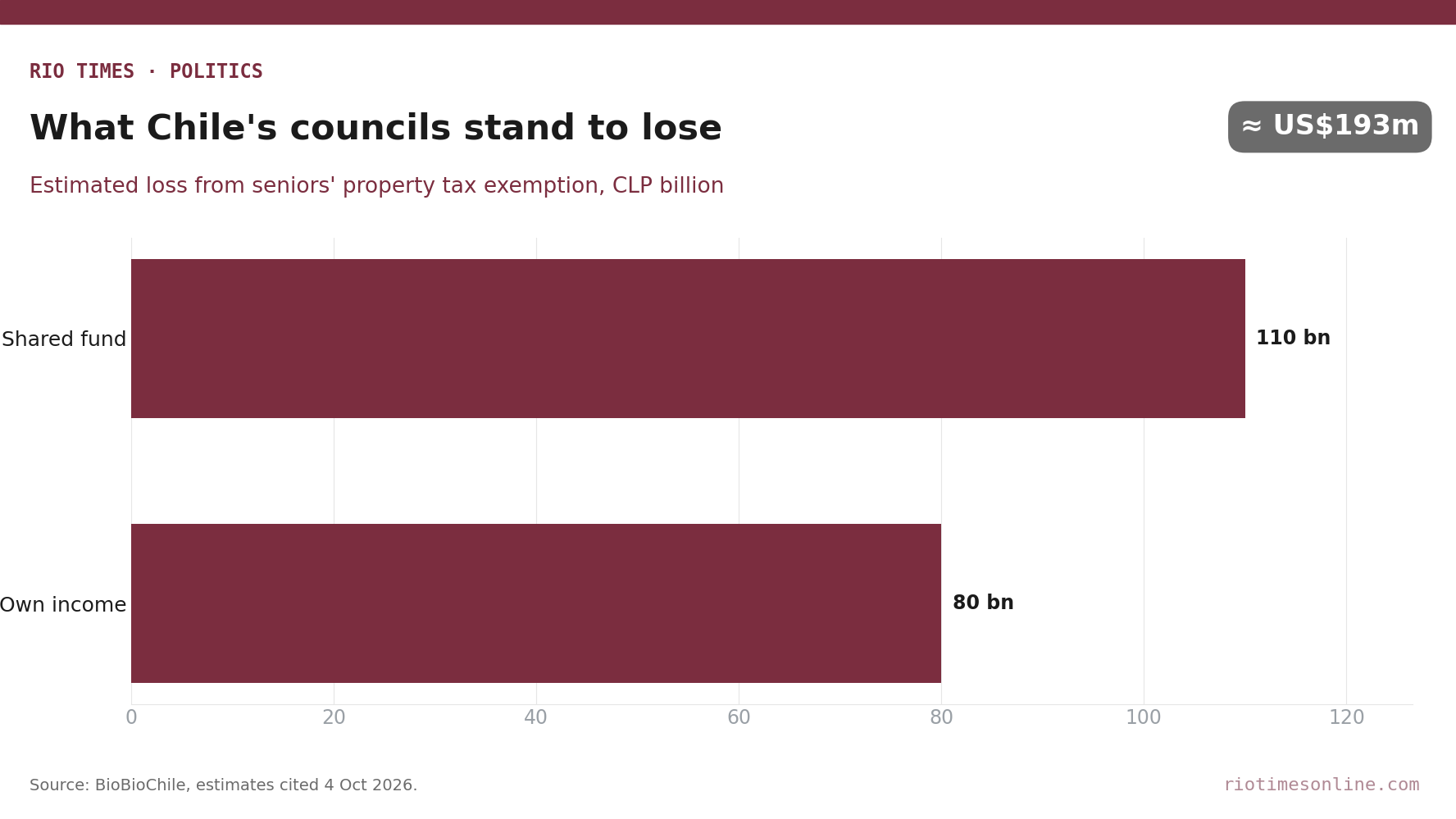
During the bill’s passage, the exemption was estimated to cost the FCM about CLP 110 billion (about US$112 million). Councils’ own income would lose a further CLP 80 billion (about US$81 million), at CLP 982 per US$ on 2 October.
A third provision fell as well. It let councils keep extra 2027–2028 business licence and refuse fee income out of the FCM. In practice it favoured Santiago, Providencia, Las Condes and Vitacura.
Celebration and Criticism
The campaign Defendamos Patagonia called it a “historic day for Chile”, El Ciudadano reported on 4 October. It said the pollution insurance had been “buried for good”.
Punta Arenas mayor Claudio Radonich called the municipal ruling “an act of justice”, BioBioChile reported. Santiago mayor Mario Desbordes said he regretted it, telling Emol his district is not rich despite high income.
What Survives for Investors
The reform’s economic core stands. The corporate tax cut and the tax stability regime for large investments come through the October ruling intact, CNN Chile reported. August’s ruling had narrowed that regime.
Interior undersecretary Máximo Pavez said the key point was that the law can now be promulgated. He said the government hopes it will restore growth and legal certainty. The Rio Times reported in August when the reform cleared Congress.
What Is Not Yet Known
No date for Kast to sign the law had been announced as of Sunday evening. Officials expect it in the coming week, EFE reported. The vote count on the 2 October ruling was not reported by the outlets reviewed.
It is also unclear how quickly the Treasury will pay councils in full. Maipú mayor Tomás Vodanovic has called for a new municipal revenue law to settle council funding.
Sources: El Ciudadano (4 October 2026); BioBioChile (4 October 2026); El Desconcierto (2 October 2026); CNN Chile (2 October 2026); Emol (2 October 2026); 24horas (13 August 2026); Pauta (6 August 2026); EFE (3 October 2026).
This article was produced by The Rio Times’ automated newsroom system. How we use AI · Report an error · Editorial responsibility: Matthias Camenzind, Editor-in-Chief
Read More from The Rio Times