Guides · Costa Rica
Key Facts
- Foreigners may buy Costa Rican property in their own name, on the same terms as citizens, outside the coastal Maritime Zone.
- Ley 6043 defines that zone as the 200-metre strip measured from the ordinary high-tide line on both coasts.
- The first 50 metres is public land, and Article 20 says it may not be occupied under any title.
- Article 47 refuses a maritime concession to any foreigner who has not lived in Costa Rica for five years.
- Property transfer tax is 1.5 percent of the sale price or the tax value of the property, whichever is higher.
- The luxury home tax starts in 2026 above a construction value of 143,000,000 colones (about US$316,000).

What foreign buyers may own
Costa Rica property may be bought by foreigners in their own name, with full registered title. That title carries the same rights to sell, let and bequeath that a Costa Rican owner has.
No residency permit and no citizenship are needed. Houses, flats and land are all filed at the Registro Nacional, the national registry, as for any Costa Rican buyer.
One stretch of the country is different. Along both coasts the state owns the land outright, and it is let rather than sold.
The Maritime Zone under Ley 6043
Ley 6043, the Ley sobre la Zona Marítimo Terrestre of 2 March 1977, governs that coastal land. Article 9 defines the zone as a 200-metre strip measured from the ordinary high-tide line.
Article 10 splits it in two. The first 50 metres form the public zone, and the remaining 150 metres form the restricted zone.
Article 20 is blunt about the public zone. It may not be occupied under any title in any case, and nobody may claim a right over it.
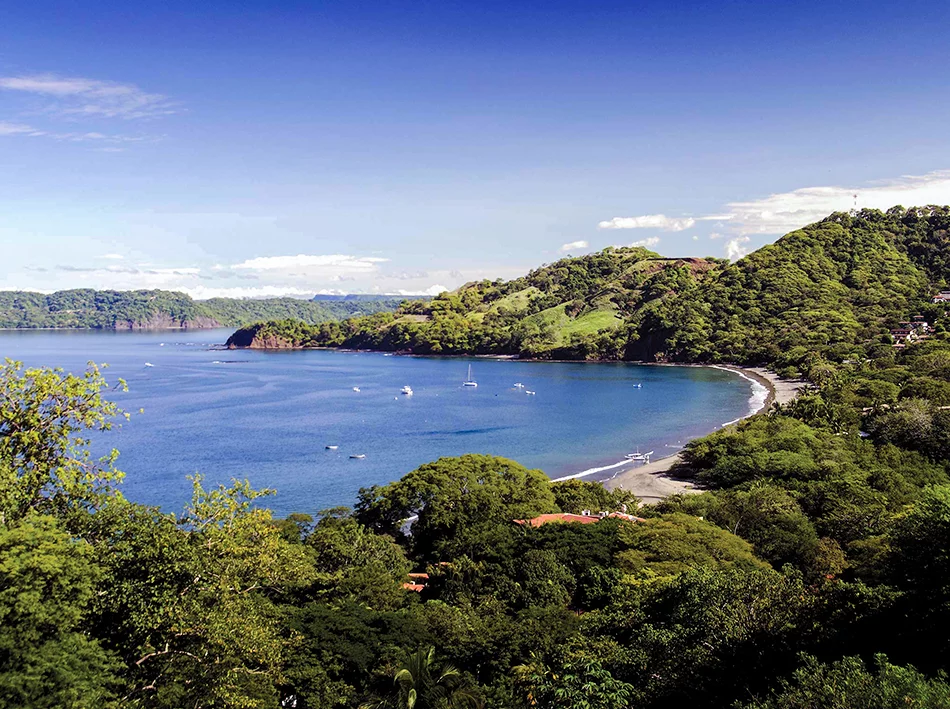
Concessions exist only in the restricted zone. Under Articles 39 to 41 only the municipality may grant one, and only for the use of a defined plot.
Article 48 fixes the term at no less than five years and no more than twenty. The concession fee, the canon, takes the place of the property tax.
Article 50 allows successive renewals on the same terms. Article 42 adds that in tourist areas the Instituto Costarricense de Turismo, the state tourism board, must approve the grant.
Who may hold a maritime concession
Article 47 is the provision foreign buyers most often misread. No concession shall be granted to a foreigner who has not lived in the country for at least five years.
That is a bar, not a cap on a shareholding. The same article also refuses concessions to companies domiciled abroad and to companies formed in Costa Rica by foreigners.
It refuses them as well to any entity whose shares, quotas or capital belong more than half to foreigners. Transfers of shares to foreigners in a concession-holding company are void.
Article 45 adds a further lock. A concession may not be assigned, transferred or mortgaged without the express consent of both the municipality and the tourism board.
Checking title at the Registro Nacional
The Registro Nacional records Costa Rican property titles. A search by finca number returns the registered owner, mortgages, liens and any pending annotation.
Maritime concessions are registered there too. Article 82 of the regulation to Ley 6043 makes the Registro General de Concesiones a section of the Registro Nacional.
The point matters at closing. A concession contract has no legal effect until it is entered in that register.
What Homes Cost
As of June 2026, the median asking price for a home in Costa Rica was US$295,000, based on 14,680 residential listings in a frozen dataset published by Untera. The figure is the middle value of advertised prices, converted to US dollars at snapshot-time exchange rates after duplicate listings were removed.
These are asking prices, not completed sales, and they mix apartments and houses in cities and rural areas across the country. They do not include transfer tax, notary fees or registration costs, and a national median says nothing about what a specific property is worth.
Nor do the figures show rental yields, today’s prices or the ownership and residency rules described in this guide. Untera itself notes that online listings over-represent cities and the more liquid parts of the market.
Other sources show how much the answer depends on the segment. Houses advertised on the classified site Encuentra24 averaged US$1,021 per square metre at the start of 2025 across 74 cantons, according to an analysis by El Financiero.
Broker figures sit far higher. Coldwell Banker Costa Rica’s review of 2025, published in January 2026, put the median list price at US$618,147 in the Central Valley, US$1,130,210 on the Central and South Pacific coast and US$1,332,551 in Guanacaste and the Nicoya Peninsula.
Sources: Untera (Global Home Price Index, June 2026, CC BY 4.0), frozen dataset “Untera Global Property Price Datasets, June 2026”, licence CC BY 4.0; El Financiero, analysis of Encuentra24 listings, 2025; Coldwell Banker Costa Rica, December 2025 Report & Trends, 13 January 2026.
The notary, the deed and the tariff
A Costa Rican notary is a practising lawyer, and only a notary may draw up and authorise the escritura pública. Nothing else can be filed at the Registro Nacional to change the owner.
Colón figures here convert at a rate of 451.86 to the US dollar. That is the Banco Central de Costa Rica reference selling rate for 23 September 2026, as published by the finance ministry.
Notary fees are not freely negotiated. Decreto Ejecutivo 41457-JP, published on 1 February 2019, sets a minimum tariff that no notary may undercut.
Its general scale charges 2 percent on the first 11,000,000 colones (about US$24,000). The rate then steps down to 1 percent on everything above 33,000,000 colones (about US$73,000).
The floor for any notarial act is 60,500 colones (about US$134). Professional fees also carry value-added tax at the standard rate of 13 percent.
Transfer tax and what is left of the stamps
The Impuesto de Traspaso de Bienes Inmuebles is charged at 1.5 percent. The base is the sale price or the tax value of the property, whichever is higher.
Registration stamp duty adds about 0.5 percent of the value of the deed, according to Deloitte. Mandatory government charges on a purchase therefore come to roughly 2 percent of the declared price.
The stamp picture changed in 2024. Ley 10586 of 5 November 2024 repealed the Fiscal Code articles behind the old timbre fiscal.
That repeal reaches documents which are not filed at the Registro Nacional, PwC notes. A property deed is filed there, so ask the notary for an itemised closing sheet.
Holding the property through a company
Many owners put Costa Rica property into a sociedad anónima or an SRL, for estate planning and for liability. Shares can then change hands without a fresh deed.
The saving is smaller than it looks. Transfer tax is also triggered by an indirect transfer, when control of the entity that holds the property changes, PwC reports.
A company brings its own paperwork. Legal entities must disclose their ultimate beneficial owners every year, Deloitte notes in its Costa Rica tax summary.
Annual property tax and the luxury home tax
Every owner pays an annual property tax of 0.25 percent of the value registered with the municipality. It falls on Costa Ricans and foreigners alike, on land and buildings together.
Owners are expected to keep that declared value current. Municipalities collect the tax and pursue arrears themselves.
A second charge, the Impuesto Solidario, falls on higher-value homes. It is tested on the fiscal value of the construction, including fixed and permanent installations.
For 2026 the exempt figure is 143,000,000 colones (about US$316,000). Decreto Ejecutivo 45358-H set it, published in La Gaceta on 19 December 2025 and in force from 1 January 2026.
Above that line the decree applies a rising scale. It starts at 0.25 percent up to 359,000,000 colones (about US$794,000) and reaches 0.55 percent at the top.
Due diligence that prevents disputes
The commonest mistake in a Costa Rica property purchase is trusting the seller instead of the register. The second is buying land whose plano catastrado, the survey plan, does not match the fence line.
Occupation by third parties is the third. A possession claim may not appear as a registered lien until proceedings have actually been filed.
A workable sequence is simple enough. Registry search, lien search, cadastral check and a walk of the boundaries, all before any money moves.
How Panama compares
Buyers often weigh Costa Rica property against Panama. On a sale of real estate Panama levies a 2 percent transfer tax plus a 3 percent income-tax advance, PwC reports.
The annual burden differs as well. Panama charges immovable property tax at between zero and 1 percent, depending on the value and the use of the property.
More: Costa Rica news in English, every day from The Rio Times.
Frequently Asked Questions
Can foreigners buy property in Costa Rica?
Yes, foreigners can buy most types of real estate in Costa Rica, including houses, condos, and land, with fee-simple title and the same ownership rights as citizens. No residency or citizenship is required. The main exception is the coastal Maritime Zone, where special concession rules apply.
What is the Maritime Zone rule in Costa Rica?
The Maritime Zone is a 200-metre strip measured inland from the ordinary high-tide line. The first 50 metres are public and cannot be owned or occupied by anyone. The remaining 150 metres can be used only through a municipal concession, not fee-simple ownership. Article 48 of Ley 6043 grants it for between five and twenty years.
Can foreigners own property in the Maritime Zone?
Article 47 of Ley 6043 refuses a concession to a foreigner who has not resided in Costa Rica for five years. It also refuses concessions to companies domiciled abroad and to companies formed in Costa Rica by foreigners. Any entity more than half owned by foreigners is barred as well.
What taxes apply when buying property in Costa Rica?
The property transfer tax is 1.5 percent of the higher of the tax value or the sale price. Registration stamp duty adds about 0.5 percent of the value of the deed, so mandatory government charges come to roughly 2 percent. The notary’s fee is set by an official tariff and carries value-added tax at 13 percent.
What is the annual property tax in Costa Rica?
Costa Rica imposes an annual property tax of 0.25 percent of the property’s registered value with the local municipality. This tax applies to all property owners, whether Costa Rican or foreign. A separate luxury home tax falls on higher-value homes. For 2026 it starts above a construction value of 143,000,000 colones (about US$316,000).
How do I check a property’s title in Costa Rica?
You can verify ownership, liens, and encumbrances by searching the property’s finca number at the Registro Nacional, the central public registry. Maritime Zone concessions are recorded there too, in the Registro General de Concesiones de la Zona Marítimo Terrestre. A concession contract has no legal effect until it is registered.
| Item | Rate or term | Source |
|---|---|---|
| Property transfer tax | 1.5 percent of the sale price or the tax value, whichever is higher | PwC Costa Rica tax summary; Deloitte Costa Rica Highlights |
| Registration stamp duty | about 0.5 percent of the value of the deed | Deloitte Costa Rica Highlights |
| Notary fee | 2 percent on the first 11,000,000 colones (about US$24,000), 1 percent above 33,000,000 colones (about US$73,000) | Decreto Ejecutivo 41457-JP, 1 February 2019 |
| Annual property tax | 0.25 percent of the value registered with the municipality | PwC Costa Rica tax summary |
| Luxury home tax, 2026 | exempt up to a construction value of 143,000,000 colones (about US$316,000) | Decreto Ejecutivo 45358-H, La Gaceta, 19 December 2025 |
| Maritime concession | five to twenty years, granted by the municipality | Ley 6043, Articles 40 and 48 |
Sources: Ley 6043 and its regulation, published by the Instituto Costarricense de Turismo; Decreto Ejecutivo 45358-H in Alcance 164 to La Gaceta 239 of 19 December 2025; Decreto Ejecutivo 41457-JP in Alcance 23 to La Gaceta of 1 February 2019; Ley 10586 in Alcance 195 to La Gaceta 227 of 3 December 2024; PwC Worldwide Tax Summaries for Costa Rica and Panama; Deloitte Costa Rica Highlights; the finance ministry indicator publishing the Banco Central de Costa Rica reference rates.
More from the Latin America section — guides, analysis and country briefings from The Rio Times.
This article was produced by The Rio Times’ automated newsroom system. How we use AI · Report an error · Editorial responsibility: Matthias Camenzind, Editor-in-Chief
Expat Guide to Costa Rica
What The Rio Times publishes for foreigners who live in or move to Costa Rica.
Start here
- Fer De Lance Snake Facts and Safety Tips
- Best Places to Live in Costa Rica for Expats 2026
- Costa Rica Income Tax Bill Would Charge Residents 15% on Five Kinds of Foreign Investment Income
- Costa Rica Permanent Residency and Citizenship: How the Rules Work
City guides
Coming up in Costa Rica
- Rosario Flores brings Gira 2026 to San José 24 Oct
- Reggae giants Cultura Profética play Belén 25 Oct 25 Oct
- Def Leppard Costa Rica Concert Set for 27 October 27 Oct
- Ozuna Plays Costa Rica on 31 October 31 Oct
Understand Costa Rica