Brazilian Real Opens at R$5.89 to USD Amid Fiscal Concerns and Global Trade Tensions
This morning, the Brazilian real (BRL) opened at R$5.89 per US dollar (USD), reflecting a slight stabilization after recent volatility.
The exchange rate has been influenced by a combination of domestic fiscal uncertainties and global geopolitical developments over the past 24 hours. Yesterday, the real weakened marginally, closing at R$5.9157 after a 0.50% daily increase.
Market participants cited renewed concerns over Brazil’s fiscal trajectory as a key driver. Investors remain wary of the government’s spending priorities, which lack a clear debt stabilization strategy.
Brazil’s widening current account deficit, reported at $8.66 billion in January, has further underscored structural economic challenges. Additionally, rising unemployment, now at 6.5%, has added to the pressure on the currency.
Global factors also played a significant role in shaping the BRL/USD dynamics. President Trump’s announcement of higher tariffs on imports from China, Mexico, and Canada fueled risk aversion in global markets, strengthening the dollar as a safe-haven currency.
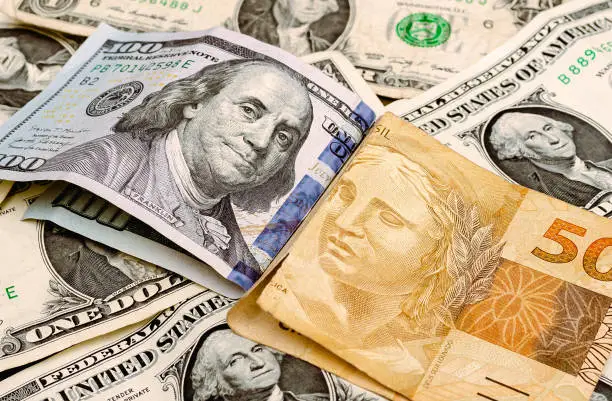
The dollar index rose to 107.6 points yesterday, marking a 0.9% weekly gain. Despite these headwinds, some analysts see potential support for the real from China’s expected economic measures this week.
Brazilian Real Faces Pressure Amid ETF Outflows
The Chinese government is anticipated to announce new fiscal and monetary stimulus policies, which could improve growth prospects for emerging markets like Brazil.
Trading volumes remained steady across forex markets, with investors closely monitoring technical levels for the BRL/USD pair. Analysts identified key resistance at R$5.93 and support around R$5.85. A break above R$5.93 could push the pair toward R$6.00 in the near term.
ETF flows have also highlighted investor sentiment toward Brazilian assets. Outflows from Brazilian equity-focused ETFs continued as global investors reassessed their exposure to emerging markets amid heightened uncertainty.
Looking ahead, market participants will watch for U.S. economic data, including ISM Services PMI figures, as well as updates on Brazil’s fiscal policies and inflation trajectory.
While short-term pressures persist, some analysts believe that improving external conditions could provide relief for the real in the medium term. For now, the real remains under pressure as both domestic and international factors weigh heavily on investor confidence.
This article was produced by The Rio Times’ automated newsroom system. How we use AI · Report an error
LatAm Markets: Live Signals → — real-time movers, turnover leaders and FX across Latin America.
Read More from The Rio Times