Analysis: Brazil uses only 31% of its navigable rivers for transport; spends more on truck freight
RIO DE JANEIRO, BRAZIL – A CNT (National Confederation of Transport) study released in 2019 points out that Brazil uses only 30.9% of the 63,000 kilometers of navigable rivers for cargo and passenger transportation. Experts point out that little has changed since the study was released.
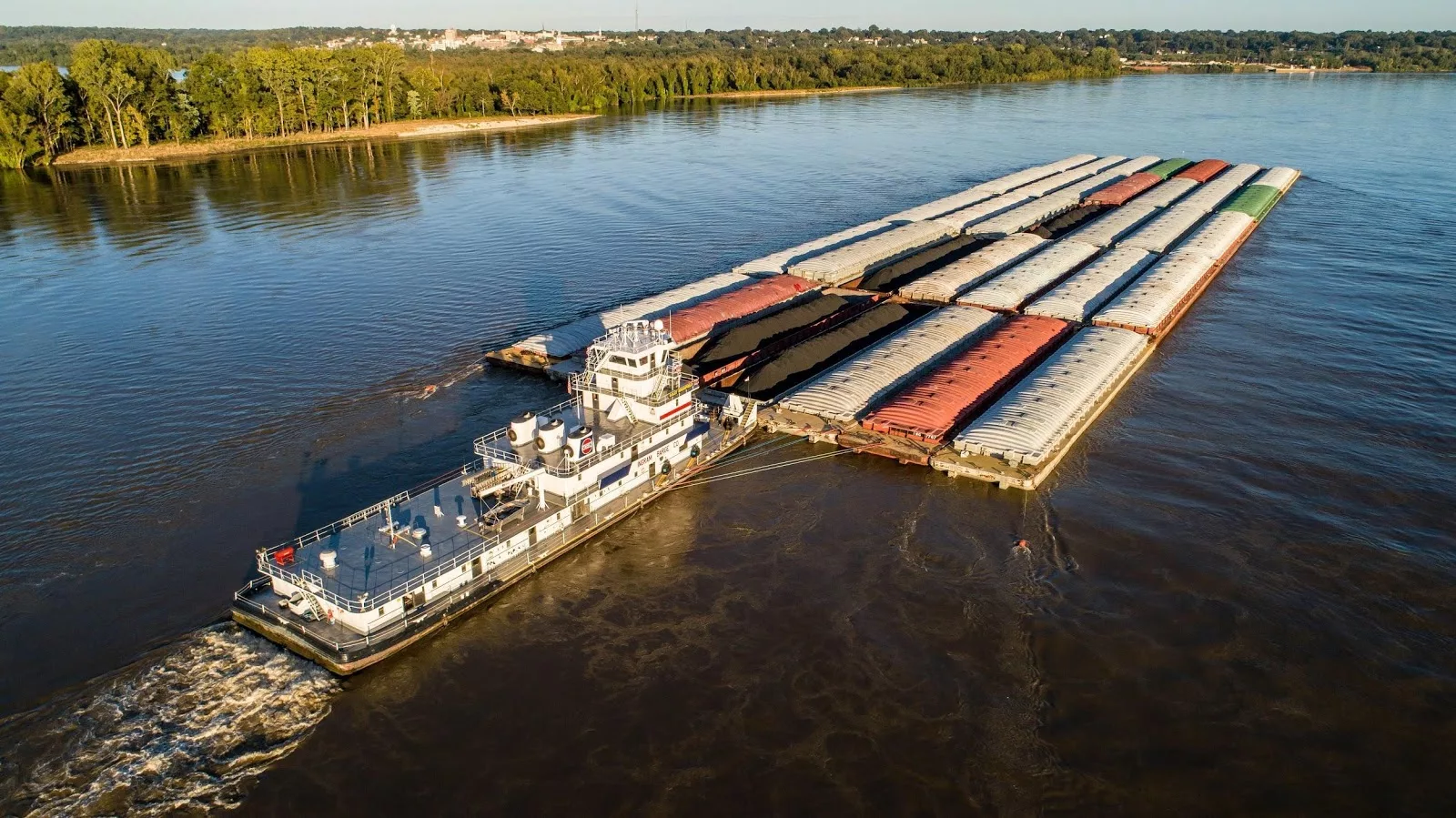
The importance of rivers lies in the fact that they lower transport costs, which could translate into a discount for the end consumer. Cargo shipped by river costs 60% less than by truck. According to experts, three main reasons explain the waste of the country’s potential for river navigation: lack of infrastructure, planning, and political willingness. Details can be seen below:
1. Lack of work to enable navigation
Although Brazil has a significant number of rivers with navigation potential, they are not ready to be used. To be converted into navigable waterways, rivers require dredging and signaling works, for instance.
“For Brazil’s rivers to become waterways, many investments are required. Nowadays, navigation is very difficult. All there is is private initiative,” said Raimundo Holanda, president of FENAVEGA (National Federation of Waterway Navigation Companies)
Another CNT study, the 2018 Transport and Logistics Plan, showed that the minimum required investment for fluvial navigation totaled R$166.4 (US$31.6) billion in 367 projects. Improvements included dredging, signaling, and construction of waterway terminals.
2. Planning did not include river navigation
Another problem is that river navigation was not included in the planning for projects such as the construction of hydroelectric plants.
Now rivers with navigation potential often have dams, which requires the construction of locks so that barges may pass. A lock functions as a boat elevator, which carries a vessel between a lower and higher part of a river.
“The country would not need to make this investment had it planned in the past. It would be much simpler if the locks were already in place. It borders on incompetence,” said Lauro Valdivia, from NTC&Logística (National Association of Cargo Transport and Logistics)
Valdivia says that the scenario is not exclusive to river navigation. Highways and railroads would also require more investments.
“The truth is that historically, governments have never invested in transportation infrastructure. There is a shortage of railroads, highways and everything else,” Valdivia says.
3. Does encouraging river navigation garner votes?
There is also a political component in the equation. Raimundo Holanda points out that there may be no electoral motivation for governments, in general, to invest in river navigation.
“Navigation doesn’t bring votes. There is no political willingness, so there is no investment,” says Raimundo Holanda.
Vinícius Picanço, a professor at Insper, points out that this type of investment is long-term, that is, it involves actions by different governments, both state and federal, for decades.
According to him, when in the past there was a bet on highways, several economic sectors, from civil construction to the automobile industry, organized themselves around this decision. Now, changing routes is not that simple, says the professor.
“The productive and economic sectors organize themselves around these strategic decisions, and end up having a direct and indirect influence on future decisions. Directly because the pressure on the government is intense, and indirectly because politicians do the math and look at how much these sectors employ, their role in society. This does not mean that change is impossible, only that it is more difficult to achieve,” says Vinícius Picanço.
How rivers are used in other countries
The Insper professor compares the way Brazil uses river navigation with the practice in other countries with a large territorial dimension, such as China and the USA.
In both cases, river transport has a greater weight: according to the CNT survey, China has 11.5 kilometers of economically usable inland waterways (rivers) for every 1,000 km2 of area; the USA has 4.2 kilometers; and Brazil has only 2.3 kilometers.
If the country’s potential were fully exploited, there would be 7.4 kilometers of economically viable rivers per 1,000 km2 in Brazil.
“In China and the USA, we see a much larger representation of this modal [river navigation] in cargo transportation. This favors intermodality, i.e., the shipment of cargo from one means of transport to another [from rivers to highways or railroads, for example],” says Vinícius Picanço.
Cheaper products for consumers
The use of various types of transport could lower logistical costs and potentially reduce the price of products for consumers.
To achieve this, cargo would have to be distributed according to the “vocation” of each means of transportation. Trucks, for example, are not considered the appropriate vehicle for long-distance cargo transportation.
River transport is mainly destined for large loads, such as grains or ore. According to CNT, a convoy with four barges can carry the equivalent of 172heavy trucks or 86 train wagons.
As a result, freight is cheaper: the cost of river transport is 60% lower than that of road transport, and 30% lower than that of rail transport.
“The incentive to river navigation is linked to the country’s competitiveness, to strategic sectors. It will be difficult to escape the famous Brazil cost if we don’t diversify modes, providing companies with more transportation options,” said Vinícius Picanço.
Federal Government is considering an incentive project
In a statement, the Ministry of Infrastructure said it acknowledges the potential of waterway transport, and believes it is essential within the strategy to rebalance the country’s transport matrix. The body also said that it has R$1.1 billion in investments for the sector, and that it is working on “a number of projects” as priorities. Among them are the annual dredging plan for the Madeira River and the Lourenço rockfalls, on the Tocantins River, and Nova Avanhandava, on the Tietê River.
The Ministry is also preparing a bill to encourage river navigation, called BR dos Rios. The bill was expected to be presented to Congress at the start of the year, but now the government says it is still being considered, in a phase of analysis and market talks.
One of the options being considered is the concession of some rivers to the private sector, which would include charging tolls to finance investments.
More: Brazil news in English, every day from The Rio Times.
This article was produced by The Rio Times’ automated newsroom system. How we use AI · Report an error · Editorial responsibility: Matthias Camenzind, Editor-in-Chief