El Salvador has invested over US$2 million in its army in one year of war against gangs
By Alberto López
The president of El Salvador, Nayib Bukele, in his war against gangs, has favored the modernization of the Army’s equipment and armament.
He has invested, out of the institution’s annual budget, around US$2.1 million.
This happened within the framework of the emergency regime applied last year, a constitutional provision extendable every 30 days that allows the suppression of some guarantees.
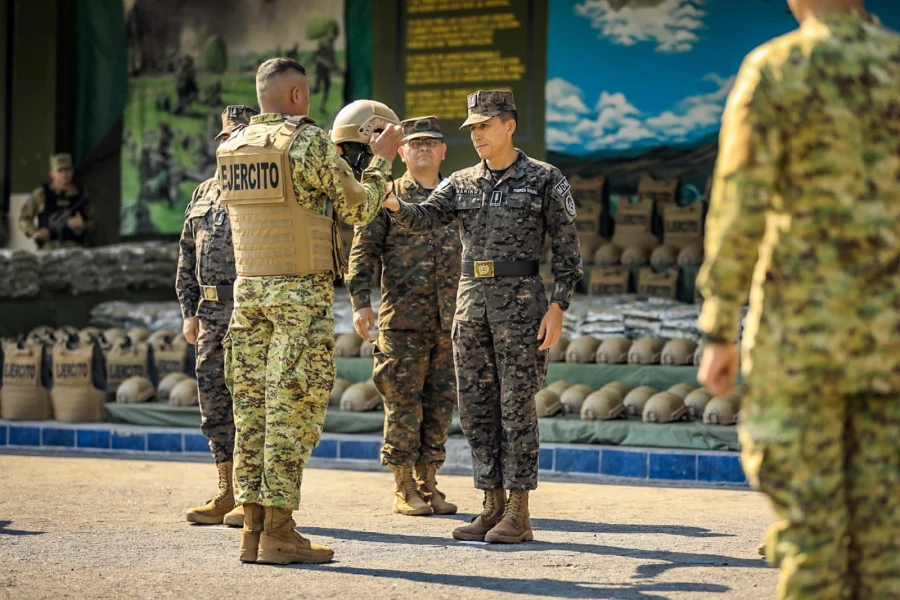
Since the emergency regime began, the military has been provided with ballistic vests, helmets, trucks, uniforms, and all-terrain vehicles.
The effectiveness of this regime has been reflected in the capture of almost 68,000 gang members, 16,000 cell phones, 3,500 vehicles, and 2,600 firearms.
According to a report presented by the heads of the Security Cabinet to the Legislative Assembly’s Commission on Security and Combating Drug Trafficking, the investment comprised:
- US$396,000 for 900 ballistic vests,
- US$234,000 for 780 ballistic helmets,
- US$391,851 for 14 2.5-ton trucks,
- US$228,636 for 2,530 uniforms with special designs and characteristics,
- and US$933,644 for 15 all-terrain vehicles.
The 15 MRZR D4 all-terrain vehicles, Polaris brand, were the last equipment delivered to the troops of the Naval Force and the Task Force of the Sumpul Command.
The Minister of Defense, Vice Admiral René Merino, pointed out that “the vehicles will be used in border points that are difficult to access, also in tasks such as exploration, local patrolling, blockade maneuvers, pursuit, medical evacuation, transportation, and logistical support.”
He detailed that these vehicles are known as “ultra-light tactical vehicles,” and their capacity is all-terrain, making them suitable for moving on any surface.
Merino explained that “these vehicles have modern technology and are the same as those used by the US Marine Corps.
The vehicles will also be used by the Navy as well as to provide security support at the surfing tournament.
With information from Infodefensa
Read More from The Rio Times