As Brazil’s Economy Moves Sideways, Household Debts Continue to Grow
SÃO PAULO, BRAZIL – Fernando Albuquerque, 32 years old, has been looking for a permanent job for the past eighteen months. While he looks, Albuquerque continues to accept odd jobs at construction sites or remodeling firms. As his bills pile up, Albuquerque is one of the thousands of Brazilians who are indebted, a number that, according to officials, continues to grow in Brazil.

“The year 2019 has been frustrating the expectations that there would be a consolidation in the process of economic recovery with positive reflection in the daily lives of consumers. Although interest rates are lower and inflation is on target, unemployment is still high and ends up reducing both households’ ability to pay and shopping appetite,” says José Cesar da Costa, president of the National Confederation of Shopkeepers (CNDL).
According to the National Confederation of Trade in Goods, Services, and Tourism (CNC), the percentage of Brazilian households with debts reached 64.1 percent in July, an increase from the 64 percent registered in June, the highest level of indebtedness since July 2013.
According to the National Credit Protection Service (SPC), four out of ten consumers, the equivalent of 37 percent, who defaulted on their debts in the first two weeks in August owe up to R$500. Most (53 percent) have debts that, all together, do not exceed R$1,000. Nonetheless, for a population which in its majority received up to five minimum wages, the debt volume is significant.
“Five hundred reais may seem little to some, but it’s almost half of a minimum monthly wage,” says SPC Brazil President Roque Pellizzaro Junior.
The most frequent type of household debt continues to be credit cards, with 71.2 percent, followed by installment plans, with 15.8 percent.
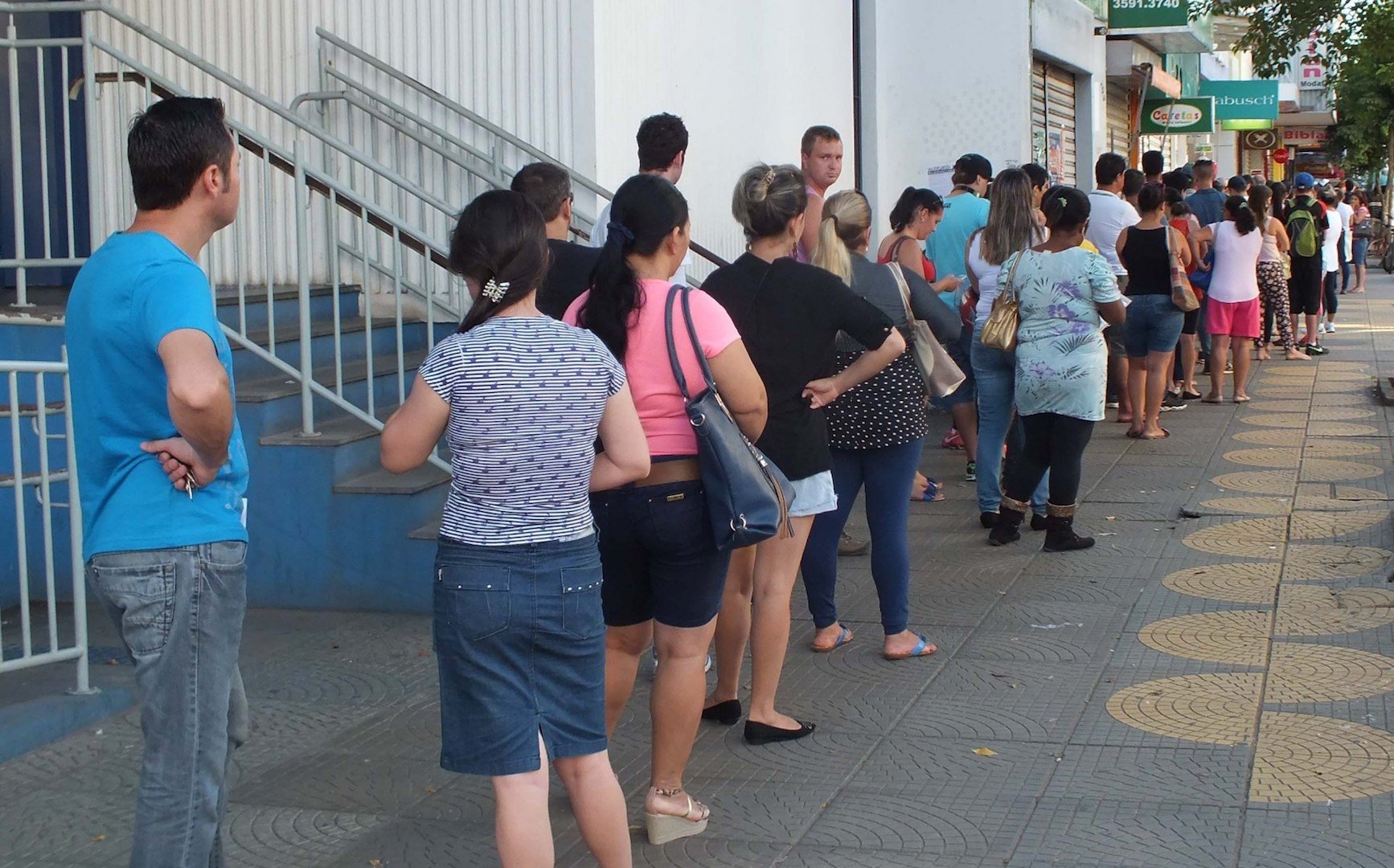
According to analysts at the Federation of Trade in Goods, Services, and Tourism of the State of São Paulo (FecomercioSP) the growth of the installment mode as a modality of payment indicates that banks have reduced access to credit, causing consumers to resort to installment plan purchases directly with stores.
The use of overdraft checks, which totaled 7.7 percent of all debt categories in July, should also be noted. Although overdraft checks carry one of the highest interest rates of all incurred debts, July’s result is the highest level for this category in a year. For FecomercioSP, this data is an indication that consumers are reaching out for any possible way to supplement income.
Albuquerque was one of the many Brazilians forced to turn to use his overdraft to pay for utilities. “My bank manager keeps telling me that the overdraft checks have a lot of interest, but what else can I do? I can’t leave my family in the dark or without water,” concludes the family man.
By far the most populous state in Brazil, São Paulo, with 45 million inhabitants, has today over 2.2 million households with some debt, and more than 792,000 with overdue debts, according to FecomercioSP.
But some positive data is being registered in Brazil. Numbers from the CNDL and the SPC show that the growth of consumer defaults and late payment of debts are showing signs of slowing down. The volume of delayed debt payments in the first half of 2019 grew by 0.9 percent compared to the end of last year, the second smallest change in late payments since 2012. That means that although still indebted, the number of Brazilians who have defaulted on their debt payments has decreased.
However, analysts warn that the current high rates of unemployment and sub-utilization of the labor force may result in an expansion of loans which could, in turn, mean an increase in delinquency rates in the short-term.
“The recovery is slower than expected and forecasts show that we will continue to have a “shy” second semester for Brazil’s finances, even with the advance of structural reforms, whose effects are felt in the long run. The expectation is that default (of debts) will start to decline only in 2020,” adds Costa.
More: Brazil news in English, every day from The Rio Times.
Editorial responsibility: Matthias Camenzind, Editor-in-Chief · Editorial standards · Report an error