Brazil Markets: Ibovespa & the Real — July 20, 2026
Key Facts
- The Ibovespa closed at 173,714 points, a marginal drop of 0.06% as gains in oil giant Petrobras neutralised a sharp sell-off across the banking sector.
- Petrobras shares jumped more than 2.5% providing crucial support to the index, with preferred shares alone moving R$257m in turnover.
- Brazil’s big banks acted as the session’s main anchor led by a 1.4% slide in Itaú Unibanco and a 1.3% fall in Banco do Brasil.
- The Brazilian real weakened slightly to R$5.11 per US dollar a modest 0.07% dip that kept the currency inside its recent tight trading range.
- Trading volumes were inflated by the expiry of stock options pushing the total financial volume on the B3 exchange to R$23.86 billion.
Today’s Focus
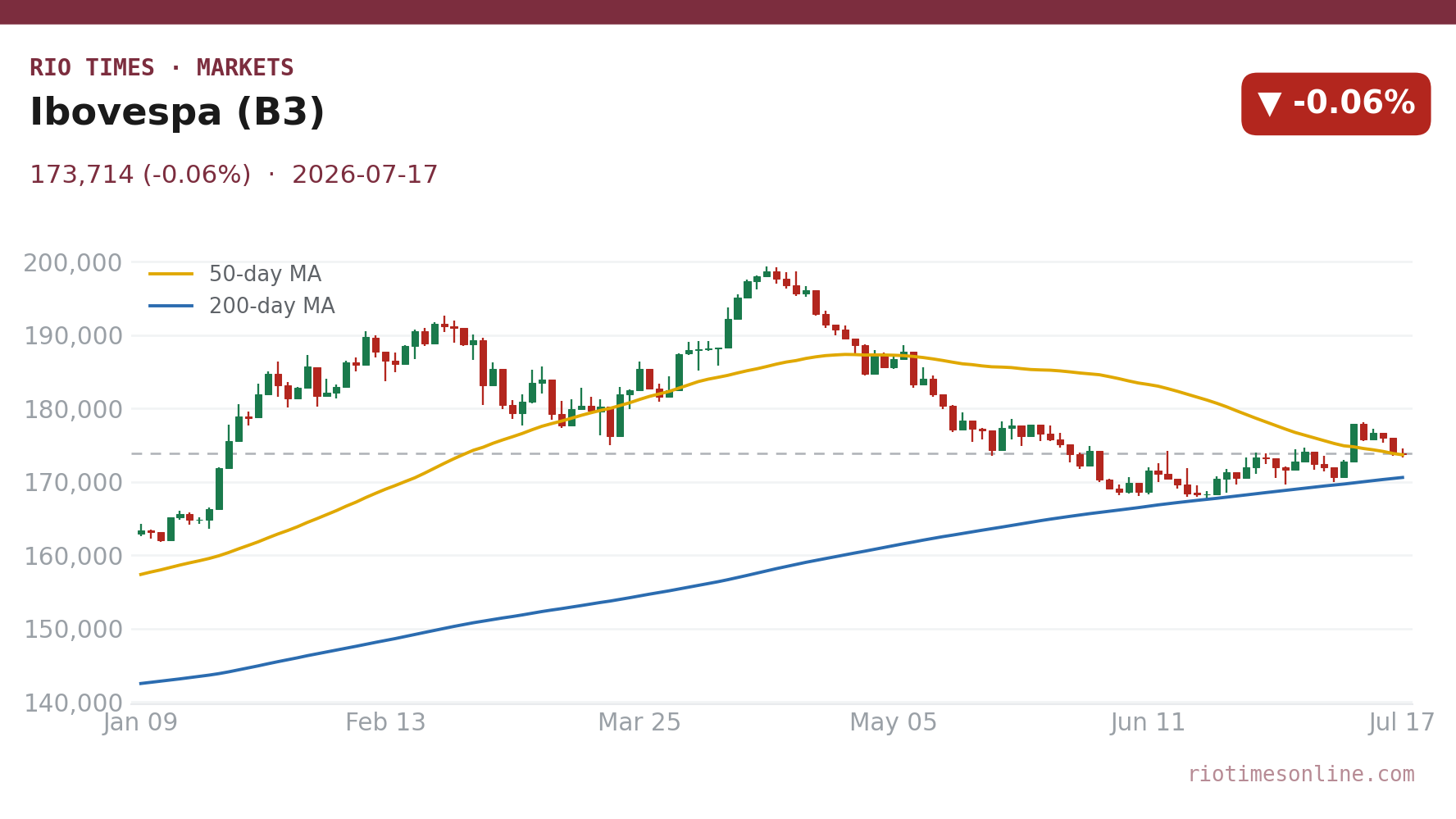
Brazil’s main stock index, the Ibovespa, closed the final session of the week almost exactly where it started, dipping a negligible 0.06% to 173,714 points. The flat finish masked a fierce tug-of-war beneath the surface between commodity exporters and financial firms.
A strong rally in state-controlled oil producer Petrobras — its common and preferred shares climbing more than 2.5% — single-handedly offset a broad decline among the nation’s largest banks. Without Petrobras’s push, the index would have ended the day firmly in the red.
The session’s volume was amplified by the monthly expiry of stock options on the B3 exchange, which often injects extra volatility and turnover as institutional traders close out or roll forward their hedging positions.
What matters today. Petrobras’s outsize rally masked a deeply defensive session where traders rotated out of domestic-focused financials, a signal that local rate concerns are still weighing heavily on sentiment.
01 The session in one read
Friday’s trading on Avenida Faria Lima was a classic stalemate. The Ibovespa — Brazil’s benchmark stock index, a barometer that tracks about 85 companies — closed at 173,714.08 points, a decline so slim (-0.06%) that it barely registers as a loss. But the placid headline number concealed a battle between the energy sector and financial stalwarts.
Petrobras, the state-controlled petroleum producer whose tickers (PETR3 and PETR4) are among the most heavily weighted on the index, surged by 2.6% and 2.5% respectively. That bullish energy was entirely consumed by a sell-off in the large-cap banks, which fell in unison: Itaú Unibanco, Brazil’s largest private lender, slid 1.4%.
Banco do Brasil lost 1.3% and Bradesco dropped 0.7%, a trifecta of declines that kept the index pinned near the flatline. The real, Brazil’s currency, barely moved, ticking up 0.07% to close at R$5.1146 per US dollar in what felt like a footnote to the equity skirmish.
The session was also technically charged, marked by the expiration of stock options — derivatives that give traders the right to buy or sell shares at a set price. These expiry days routinely bloat trading volumes, and Friday was no exception, with R$23.86 billion changing hands on the B3 exchange.
The session revealed a market dependent on a narrow base of commodity giants for stability. The banking sector’s decline — consistent across private and state-owned lenders — reinforces a pattern our market coverage has tracked for weeks: traders are increasingly wary about credit growth, margin compression, or lingering fiscal concerns that disproportionately affect domestic-facing stocks. The real’s negligible 0.07% dip to R$5.11 per dollar did little to redirect the equity narrative, keeping the focus firmly on sector-specific stories. The crucial variable to monitor is whether Petrobras can continue to carry the index while financials bleed, or if the Ibovespa finally breaks decisively below the 173,000-point floor that held on Friday.
02 The day’s numbers
| Measure | Level | Change | Read |
|---|---|---|---|
| Ibovespa (Brazil stocks) | 173,714 | −0.06% | Flat; banks offset Petrobras rally |
| USD/BRL (Brazilian real) | 5.11 | +0.07% | Real weakened slightly against the dollar |
| 52-week index position | −12.8% below high | — | Still far below the 199,355 peak |
| S&P 500 (US stocks) | 7,458 | −1.01% | Wall Street offered no support |
The Ibovespa’s close at 173,714 points keeps it firmly in its summer doldrums, a full 12.8% below the 52-week high of 199,355. The index has struggled to mount a sustainable rally back towards the 180,000 level, a psychological barrier that has capped upside attempts for weeks.
The real’s move against the dollar was essentially a rounding error, with the USD/BRL pair rising by just 0.07% to R$5.11. This left the currency comfortably within its well-worn channel, still about 8.5% stronger than its 52-week low of R$5.5901 per dollar. Rio Times · Live Market Intelligence
Live Market IntelligenceBrazil — Live Market Board
Brazil — Live Market Board
Instrument Last Change YoY Prev. High Low Volume
IBOV
205,429.42
-0.52%
+21.85%
206,495.23
168,310
167,142
—
USD/BRL
5.16
+0.01%
-5.13%
5.16
5.18
5.14
—
SELIC
14.00%
—
—
—
—
—
PETR4
41.64
-0.05%
+35.19%
41.66
41.97
41.15
41,499,400
VALE3
72.97
+0.83%
+30.75%
72.37
73.54
72.66
17,658,000
ITUB4
38.60
-1.03%
+4.57%
39.00
39.34
38.39
29,487,800
BBDC4
16.85
+0.36%
+3.50%
16.79
16.90
16.67
19,416,900
BBAS3
19.37
+0.47%
+0.73%
19.28
19.44
19.16
11,069,200
B3SA3
14.26
-0.21%
+12.73%
14.29
14.47
14.11
33,037,800
ABEV3
14.89
-0.80%
+21.91%
15.01
15.07
14.81
16,453,100
WEGE3
47.59
+0.49%
+29.99%
47.36
48.08
47.36
3,364,600
PRIO3
59.14
-0.19%
+50.67%
59.25
59.81
58.74
3,325,600
SUZB3
41.33
+2.35%
-23.55%
40.38
41.48
40.35
3,914,900
RENT3
34.68
-0.09%
+0.84%
34.71
34.96
34.35
7,979,100
AZZA3
15.89
-2.63%
-53.76%
16.32
16.42
15.82
1,330,300
CSNA3
4.30
+0.47%
-42.65%
4.28
4.41
4.26
10,076,100
GGBR4
24.69
+2.19%
+51.38%
24.16
24.85
24.18
7,047,600
ENEV3
24.21
-1.38%
+70.49%
24.55
24.64
23.99
9,297,000
Live Company IntelligencePetroleo Brasileiro Petrobras SA ADR — the full investor dossier
Wall Street view
Valuation & profitability
Price & risk
$10.7852-wk high
$26.12
Revenue trend · 6y
Ownership
Dividend
03 Why it moved — Petrobras strength meets banking fatigue
Behind the index’s flat finish was a simple but powerful divergence. Petrobras advanced on the back of a supportive global crude oil backdrop, benefiting from a view that the state-controlled producer remains a cash-generating machine in an environment of still-elevated commodity prices. Investors often treat Petrobras as a direct proxy for oil, and Friday’s session reflected that classic correlation.
Conversely, the banking sell-off exposed a persistent local anxiety. Large lenders like Itaú and Banco do Brasil are exquisitely sensitive to the health of Brazil’s domestic economy. When traders dump these stocks en masse, as they did on Friday, it typically signals concern about future interest-rate policy — the Selic, Brazil’s benchmark rate — or loan-book quality.
With the Selic rate as the chief mechanism to control inflation, any perceived delay in future monetary easing crushes bank stocks, since high rates for longer can choke off credit demand and increase default risks. Friday’s moves suggest that this fear outweighed the buoyant mood in energy markets, threatening to drag the Ibovespa lower until Petrobras bulls stepped in.
Adding texture to the session was the options expiry on B3, which forced institutional traders to adjust their positions. These mechanical flows can amplify moves in the most liquid names — precisely the large banks and Petrobras — lending the day a sharper, more kinetic feel.
04 The day’s movers
| Driver | Level / Move | Change | Note |
|---|---|---|---|
| PETR4 (Petrobras PN) | R$40.90 | +2.5% | R$257m turnover; oil strength offset banks |
| ITUB4 (Itaú Unibanco PN) | R$41.96 | −1.4% | R$161m turnover; heaviest bank drag |
| BBDC4 (Bradesco PN) | R$18.29 | −0.7% | R$197m turnover; fell in sympathy with sector |
| BBAS3 (Banco do Brasil ON) | R$20.49 | −1.3% | State-owned lender joined the bank sell-off |
| VALE3 (Vale ON) | R$74.51 | +0.7% | Iron-ore giant stabilised after prior losses |
| LREN3 (Lojas Renner ON) | R$13.42 | −1.7% | Consumer retail under clear pressure |
Petrobras was the session’s undisputed engine, with its preferred shares (PETR4) trading R$257m in volume and its common shares (PETR3) adding R$11m in a powerful show of institutional support. Itaú Unibanco, by contrast, was the index’s heaviest millstone, its 1.4% decline translating to R$161m in turnover as sellers dominated the tape.
Away from the heavyweights, consumer names clearly struggled. Lojas Renner, one of the country’s largest apparel retailers, slid 1.7%, reflecting a broader softening in discretionary spending appetite. The outlier was Usiminas, the steelmaker, which topped the domestic gainers’ list with a 4.2% jump, though its thinner liquidity means the move had minimal impact on the headline index.
05 The regional scoreboard
| Index | Country | Change |
|---|---|---|
| Ibovespa | Brazil | −0.06% |
| IPC | Mexico | +0.39% |
| IPSA | Chile | −0.56% |
| Merval | Argentina | +0.46% |
| COLCAP | Colombia | +0.58% |
Across Latin America, the performance was a mixed bag with no single unifying theme. Mexico’s IPC eked out a 0.39% gain, while Chile’s IPSA lost half a percent, and Colombia’s COLCAP rose 0.58%, all on generally moderate volumes.
Brazil’s flat finish placed it squarely in the middle of the regional pack. The absence of a strong directional cue from Wall Street — where the S&P 500 dropped a more decisive 1.01% — left Latin American markets to trade on their own domestic narratives rather than a synchronised global risk-on or risk-off signal.
06 The technical picture
The 173,000-point region is shaping up as a critical floor for the Ibovespa. Friday’s ability to bounce off this level, thanks almost exclusively to Petrobras, suggests it is a demand zone that traders are actively defending. A clean break below it would likely trigger a new wave of mechanical selling.
On the upside, the index remains capped by the 180,000-point marker, a level it hasn’t seen in sustained fashion for several weeks. The real’s technical posture is clearer: R$5.11 per dollar sits right in the middle of a descending channel, and the currency’s direction from here will largely hinge on the next US Federal Reserve policy signal or a domestic fiscal headline.
07 What to watch
- Bank sector resilience: If Itaú and Bradesco continue to bleed, even a strong Petrobras may not save the Ibovespa from a daily loss; watch Monday for a potential catch-up sell-off or a swift reversal.
- Oil price trajectory: Petrobras is the index’s lifeline; any sudden pullback in Brent crude would remove the market’s main support beam, exposing the index to a sharp drop.
- Selic rate expectations: The BCB Focus weekly survey will be watched closely for any shifts in the year-end Selic forecast; a higher projected rate path would deepen the bank-stock rout.
- US tech spillover: Friday’s 1% drop in the S&P 500 sets a cautious global tone; further weakness on Wall Street could test the real and add pressure to Brazil’s commodity exporters.
Background: Brazil’s Braskem Tender Offer Advances Amid Sinking Crisis.
the real, Brazil’s currency, barely moved, ticking up 0.07% to close at R$5.11 per US dollar
More: Brazil news in English, every day from The Rio Times.
Frequently Asked Questions
What is the Ibovespa?
The Ibovespa is Brazil’s main stock market index, tracking about 85 of the most-traded companies on the B3 exchange in São Paulo. It is the primary yardstick used to measure the health of Brazilian equities.
Why did Petrobras rise while banks fell?
Petrobras mirrored strength in global oil prices, making it attractive as a commodity play. The banks fell because traders are nervous about Brazil’s domestic economic outlook and the possibility that high interest rates — known as the Selic rate — will persist, hurting bank lending profits.
What is the Selic rate?
The Selic is Brazil’s benchmark interest rate, set by the central bank to control inflation. When the Selic is high, it raises the cost of borrowing and can slow the economy, which is generally negative for bank stocks.
What are B3 and options expiry?
B3 is the São Paulo-based stock exchange where Brazilian shares are traded. An options expiry is a pre-scheduled date when derivative contracts mature, usually leading to higher trading volumes as institutional investors adjust large hedging positions.
This article was produced by The Rio Times’ automated newsroom system. How we use AI · Report an error · Editorial responsibility: Matthias Camenzind, Editor-in-Chief
LatAm Markets: Live Signals → — real-time movers, turnover leaders and FX across Latin America.