Airline Giants Look to Brazil and Latin America for Global Boost
RIO DE JANEIRO, BRAZIL – The American and European skies have become small for the ambition of the major airlines on both sides of the Atlantic.
With low-cost companies dominating a significant share of the short and medium-sized cake in both the US and the Old Continent, and the possibilities for expansion constrained by the very maturity of the market, the big companies have turned their eyes to Latin America – according to industry figures, the third fastest-growing market in the next two decades, behind Asia and the Middle East- to try to ensure their longer-term growth.

The first to move the fixed market was Delta, which began by buying Aeroméxico shares in 2017 and gradually increased its stake to the current 49 percent, the legal maximum allowed in Mexico.
Concurrently, the US company invested in Chile/Brazil Latam (it took over a fifth of its capital) to boost its continental position and exclude it from Oneworld, a rival alliance.
More recently, Iberia’s IAG group has redoubled its share in the region with the purchase of Air Europa, which will consolidate Madrid-Barajas as the main entry point to Central and South America, with almost a third of arrivals. All these operations have one common denominator: they have Latin America as their major target.
The appetite for the Latin American air market contrasts with vital signs that have been emerging for months in several countries of the subcontinent, both political – protesting, with inequality as a central target- and economic – a recurrent growth rate below the average of emerging economies.
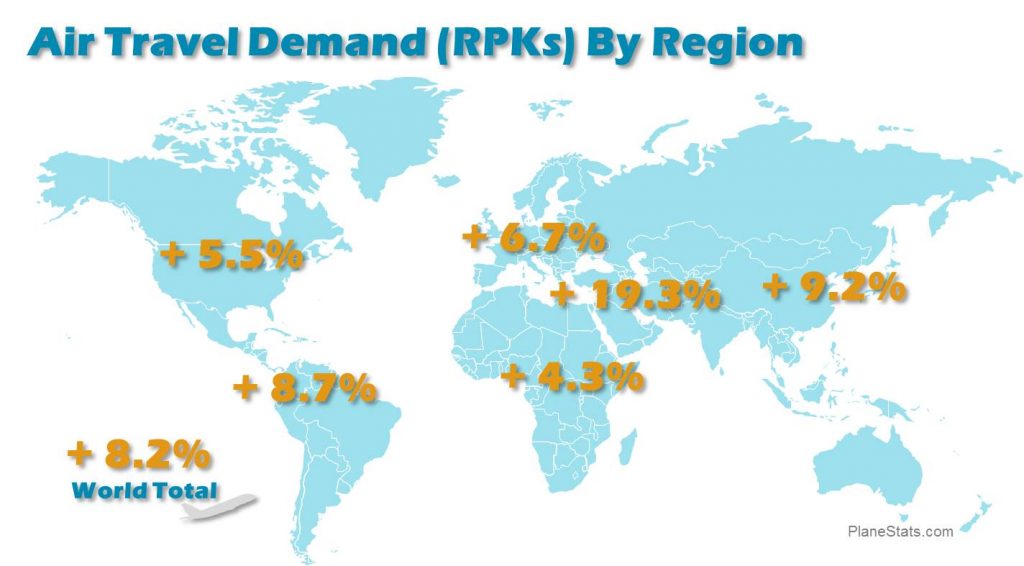
The skies, however, seem oblivious to this reality: for five decades, the regional air market has been doubling on average every 12 years, and the annual growth in the number of aircraft users has more than doubled the rate of GDP in that period.

“We are on the way to 16 successive years with positive growth rates, something that not all sectors can show,” says Luis Felipe de Oliveira, director of the Latin American and Caribbean Air Transport Association (ALTA). “The markets of origin are in a mature stage and Latin America offers several decades of good growth,” he says in Panama.
“As a result of major consolidation and corporate restructuring, the major air groups in North America and Europe continue to prosper while Latin American operators face difficulties. This has created purchasing opportunities for companies like Delta to take advantage of the growth in the Latin American market,” concludes Jonathan Berger, director of Alton Aviation, one of the industry’s leading consultants.
The interest of international airlines in the region “was already there but clearly increased a lot,” summarize Victor Nomiyama and Flavia Bedran, aviation experts at S&P’s rating agency.
It’s logical: the potential for future growth is much greater than in their home markets. Although the industry’s prospects are worse in the short term than in other regions, the world’s leading companies do not want to lose their piece of the cake in a market that is perceived as fundamental in the coming decades: with a very weak (and even non-existent) railway infrastructure, an insufficient road network and long distances to cover, often only crossed by air, the plane travels in the best possible ecosystem.
Brazil is one of the clearest examples of how the air sector is one of the few mobility options in the region: a huge country – with an area comparable (though smaller) to that of China and the United States -, a very scattered population of over 200 million people, and a feeble (and very extensive) overland transportation network, in which ploughing the skies is the only possible solution for most travel.
However, only half of Brazil’s population now travels by air, a factor that further paves the way for new and old market players.
Something similar is happening in Mexico, where the expansion “of increased purchasing power, with the recent increase of the minimum wage, raises the interest in an under-exploited market,” notes Miguel Mujica, professor at the Aviation Academy, linked to the University of Amsterdam, who recalls that last year – not exactly the best for Mexico in macro terms (it went into recession) – air passenger traffic grew by five percent.
The immigration variable is important: with more than 40 million people of Mexican origin (born in the Latin American country or with parents or grandparents from there), both traditional and low-cost airlines are taking advantage of the business option of connecting both countries.

To this range of factors must be added the sustained growth of the middle class and the drop in fares with the popularization of the low-cost model, says independent consultant Brendan Sobie.
The statistics place almost half the Latin American population in this social group, a figure that, if projections are met, should rise to about 70 percent by the middle of the century.
“And as the middle-class increases, so do the business opportunities for airlines. The potential is enormous and foreign groups are positioning themselves for when the boom comes,” said Peter Cerdá, vice president of the International Air Transport Association (IATA) for the Americas, one of the region’s aviation powers.
The industry expects that by 2035 the airplane will be the means of transport of choice for more than 650 million travelers a year in Latin America and the Caribbean, with an annual growth forecast of around six percent by then, more than one point above the global average.

Although recent investor moves have focused on the traditional airline segment, they are not the only ones.
The low-cost segment, which has reduced the market share of former flag carriers in markets such as Brazil, Mexico, Colombia and, in recent years, Argentina – the region’s four largest economies, which account for over 70 percent of total GDP – has also attracted the attention of European and Latin American airline groups and investment funds: United owns eight percent of Brazil’s Azul; Air France-KLM, just over one percent of Gol and the Indigo venture capital fund (owner of Frontier in the US) controls Volaris and JetSmart, and has just closed the purchase of Norwegian’s business in Argentina also through JetSmart.
Away from spotlights and virtually noiseless, a colossal low-cost segment was born in the region.
More: Brazil news in English, every day from The Rio Times.
This article was produced by The Rio Times’ automated newsroom system. How we use AI · Report an error
Read More from The Rio Times