A South American Brexit? What to Make of Brazil’s Threat to Leave Mercosur?
RIO DE JANEIRO, BRAZIL – Jair Bolsonaro has never been a fan of Mercosur, the ‘Southern Common Market,’ consistently maintaining it disadvantages Brazil’s productive sector. But he has recently gone so far as to suggest Brazil could leave the union entirely.
In what effectively amounted to a blatant attempt to interfere in the domestic affairs of a neighboring nation, President Bolsonaro suggested Brazil might exit the Mercosur if the opposition party wins Argentina’s upcoming presidential elections.

Echoing these sentiments, Economic Minister, Paulo Guedes, speaking to investors at an event hosted in São Paulo by Santander bank, claimed Brazil would leave if Argentina was to adopt protectionist policies:
“Mercosur is, of course, a vehicle of Brazil´s insertion into international markets. But what if Cristina Kirchner enters and closes her economy? If they want to close it, we will leave Mercosur.”
The threats were elicited by the results of the Argentinian presidential primaries, held on August 11, where Alberto Fernandez, whose vice presidential candidate is former President Cristina Fernandez Kirchner (2007-2015), achieved a 48 to 32 percent victory over incumbent Mauricio Macri, the right-wing ally of President Bolsonaro.
Indeed, Brazil’s President responded almost immediately to the Argentine outcome, declaring:
“Argentina is sinking into chaos. Argentina begins to follow the course of Venezuela because, in the presidential primaries, the left-wing bandits began to return to power.”
Referring explicitly to Alberto Fernández, Bolsonaro announced: “If he creates any problems, then Brazil will leave Mercosur.” Evidently unconcerned about the ongoing Argentine economic crisis, Minister Guedes was equally dismissive of Brazil’s third largest trading partner, asking rhetorically: “Since when has Brazil needed Argentina to grow?” Brazil, he went on to say, “is a continental economy and we need to recover our own momentum for growth. We do not depend so much on others.”
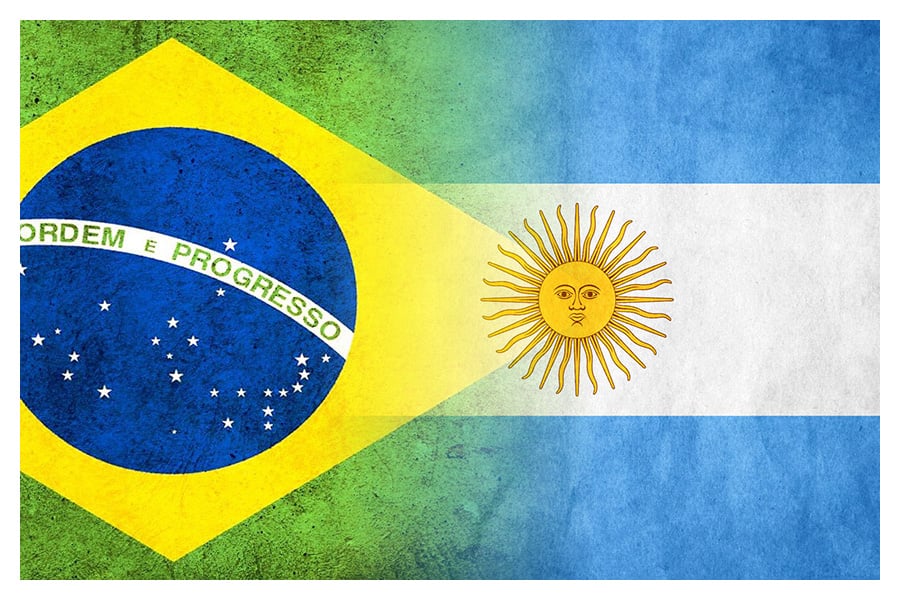
A Brazilian exit would certainly be a major setback for the Mercosur customs union. Full members Brazil, Argentina, Uruguay and Paraguay (Venezuela has been suspended since late 2016) have, after 20 years of talks, recently negotiated a Free Trade Agreement with the European Union. A Brazilian departure would likely throw this agreement into crisis.
Conversely, whatever the domestic expediency of an anti-internationalist populism, the Brazilian economy has consistently been the beneficiary of its trading relationship with the other Mercosur nations.
Over the last 10 years, Brazil has recorded a trade surplus of US$87 billion with its three (full) Mercosur partners – an amount greater than that over either China or the European Union during the same time. Brazil’s surplus with Argentina alone is approximately US$8.5 billion per year.
In fact, Minister Guedes’ assurances notwithstanding, Brazil and Argentina’s economies are intertwined in critical ways. Argentina is one of the few countries that buy Brazil’s value-added products – and not just its commodities. Manufactured products or sourced from its automotive sector comprise almost half of Brazil’s exports to Argentina.
In turn, Brazil depends on Argentine wheat – half of the grain consumed domestically is imported from Argentina, currently free of duty and export taxes. Likewise, a recent study published by the Getulio Vargas Foundation suggests that Argentina’s economic problems have a direct impact on Brazil, potentially reducing economic growth by as much as 0.5 percent this year alone.
So, how serious is the President? Could Brazil really leave the Mercosur?
Just as Britain has discovered in the course of its ongoing attempt to leave the European Union, there are significant bureaucratic, commercial, and practical obstacles to making a clean break from a complicated trade union.
Unlike the UK and the EU, there is little domestic dissatisfaction with Brazil’s membership in the Mercosur. On departure, Brazil would relinquish common external tariffs as well as the visa and passport free travel it currently shares with its neighbors. So, it’s quite possible that leaving the Mercosur could become a politically unpopular proposition.
It’s difficult to make an accurate prediction concerning the potential consequences of a ‘Brexit’ from Mercosur but it seems very likely – given the current state of the Brazilian economy – that the downsides of departure would far outweigh the benefits of remaining. Withdrawal would likely have significant ramifications in terms of both jobs and trade for an economy that is already in recession.

In other words, the President and the Minister of Economy’s threats are probably just empty – though potentially reckless – rhetoric. It’s also unlikely they will have much effect on the outcome of the Argentine election or the fortunes of President Macri.
In fact, recent polls show him falling even further behind his opposition, prompting some observers to wonder if South America’s political pendulum is poised for a swing back to the left.
It may be that their real objective is to create the context for a debate about making the current trade bloc more flexible – with the aim of enabling members to form their own bilateral agreements, for instance with the USA.
The threat of departure may be just an opening gambit in a longer scheme. If so, it seems like a remarkably clumsy negotiating strategy. Time will tell how effective it is.
More: Brazil news in English, every day from The Rio Times.
Read More from The Rio Times