Africa to Outpace Asia by 2026, Reshaping Global Trade
Rio Times · Analysis
Key Facts
—The structural shift UN and IFI forecasts suggest Africa’s aggregate growth may outpace Asia’s for the first time in recent history by 2026, marking a fundamental reordering of the global growth map.
—East Africa’s powerhouse Eastern Africa is consolidating as the continent’s fastest-growing region, with GDP growth near 5.8 per cent, driven by Kenya’s diversified economy and Ethiopia’s demographic scale.
—West Africa’s consumer boom West Africa is stabilising after reforms, with new oil and gas production in Senegal and Niger, a US$28 billion logistics market forecast to reach US$45 billion by 2035, and Nigeria’s entry into BRICS as a partner country.
—North Africa’s quiet strain Despite beating global targets on extreme poverty reduction, North Africa faces a US$104.9 billion annual financing gap and a fragile growth trajectory that holds lessons for Latin America’s social models.
—Trade corridors in play South Africa posted a R31.9 billion trade surplus in March 2026, while West Africa’s informal food trade alone is worth an estimated US$10 billion annually, much of it supplied by South American feedstuffs.
—Latin America read-through From Brazilian agribusiness feeding African livestock demand to the strategic implications of a Nigeria–Brazil BRICS axis, the continent’s rise presents Latin America with both competition and partnership it cannot ignore.
A structural shift in global growth geography is under way—one that places Africa, not Asia, as the world’s fastest-growing region by 2026—and it demands Latin America’s full strategic attention.
The Forecast That Changes the Map
For decades, the story of the Global South has been told with Asia at its centre: Chinese industrial might, Indian demographic weight, Southeast Asian supply chains. That story is being rewritten, quietly but decisively, by data emerging from African institutions and multilateral forecasters.
According to the UN Economic Commission for Africa, Eastern Africa is outpacing the rest of the continent, with growth rates close to 5.8 per cent, comfortably above the African average of 4.1 per cent. The same analysis points to a projection that would have been unthinkable a decade ago: Africa’s aggregate growth could overtake Asia’s for the first time in recent history by 2026.
This is not a prediction built on a single bumper harvest or a commodity spike. It reflects a confluence of structural forces—demographic depth, urbanisation, technology leapfrogging, and a belated but real improvement in macroeconomic management from Nairobi to Dakar.
For Latin America, a region that has long defined itself in relation to Asian demand for its commodities and Chinese infrastructure finance, the implications are profound. A new growth pole in the South means new competition for capital, new markets for exporters, and a new diplomatic geometry in forums like the G20 and BRICS.
The numbers are not yet a headline-grabbing inversion—Africa’s per capita income remains a fraction of Asia’s—but the direction of travel is unmistakable. Serious Latin American policymakers and business leaders need to start reading African economic data as closely as they have long read China’s PMI figures.
East Africa: The Engine Room
The African Development Bank has long flagged that East Africa is the continent’s fastest-growing region, averaging 5.3 per cent growth per year between 2014 and 2024, compared with 3.3 to 3.4 per cent for Africa overall. Even during the Covid-19 pandemic, the region avoided recession, posting 0.7 per cent growth in 2020.
Kenya sits at the heart of this story. It is now Sub-Saharan Africa’s fourth-largest economy, with a nominal GDP estimated at about US$147.3 billion in 2026, and has built a diversified economic base spanning agriculture, tourism, financial services and a globally recognised ICT sector.
Ethiopia, with a nominal GDP of about US$121.5 billion, provides demographic heft and a complementary growth model.
Together, Kenya and Ethiopia account for roughly half of East Africa’s purchasing-power-parity GDP, estimated at around US$1.7 trillion. The East African Community trade policy framework shows that while agriculture remains a key driver, the services sector is now the main contributor to GDP across member states.
The challenge, and it matters for Latin American investors weighing entry, is that strong aggregate growth masks widening economic disparities within the region. UNECA warns of rising social pressures, increasing dependence on mineral exports, and an integration project that risks leaving the poorest behind.
Still, the resilience is real. East Africa has absorbed multiple shocks—COVID-19, geopolitical ruptures, climate stresses—and kept growing.
For Latin American economies that have struggled to sustain even 2 per cent growth, there is a sobering lesson here about structural reform and regional integration done differently.
West Africa: From Stabilisation to Consumer Boom
If East Africa is the engine, West Africa is the market that Latin American exporters and logistics firms should be watching most closely. PwC’s West Africa Economic Outlook puts regional GDP growth at 4.4 per cent in 2025, driven by new oil and gas production in Senegal and Niger, and projects 4.2 per cent in 2026.
Nigeria, the demographic giant of the region, saw GDP growth hit roughly 3.98 per cent in the third quarter of 2025, driven by services including finance, insurance, mining and ICT. Ghana reached 5.5 per cent in the same period, powered by agriculture and services.
Both countries have seen easing inflation, resumed interest-rate cuts, and stabilising currencies.
The West African freight and logistics market was valued at US$28 billion in 2025 and is projected to reach US$45 billion by 2035, a compound annual growth rate of 6.1 per cent. This is infrastructure being built in real time—ports, cold chains, road corridors—and it is opening space for external players.
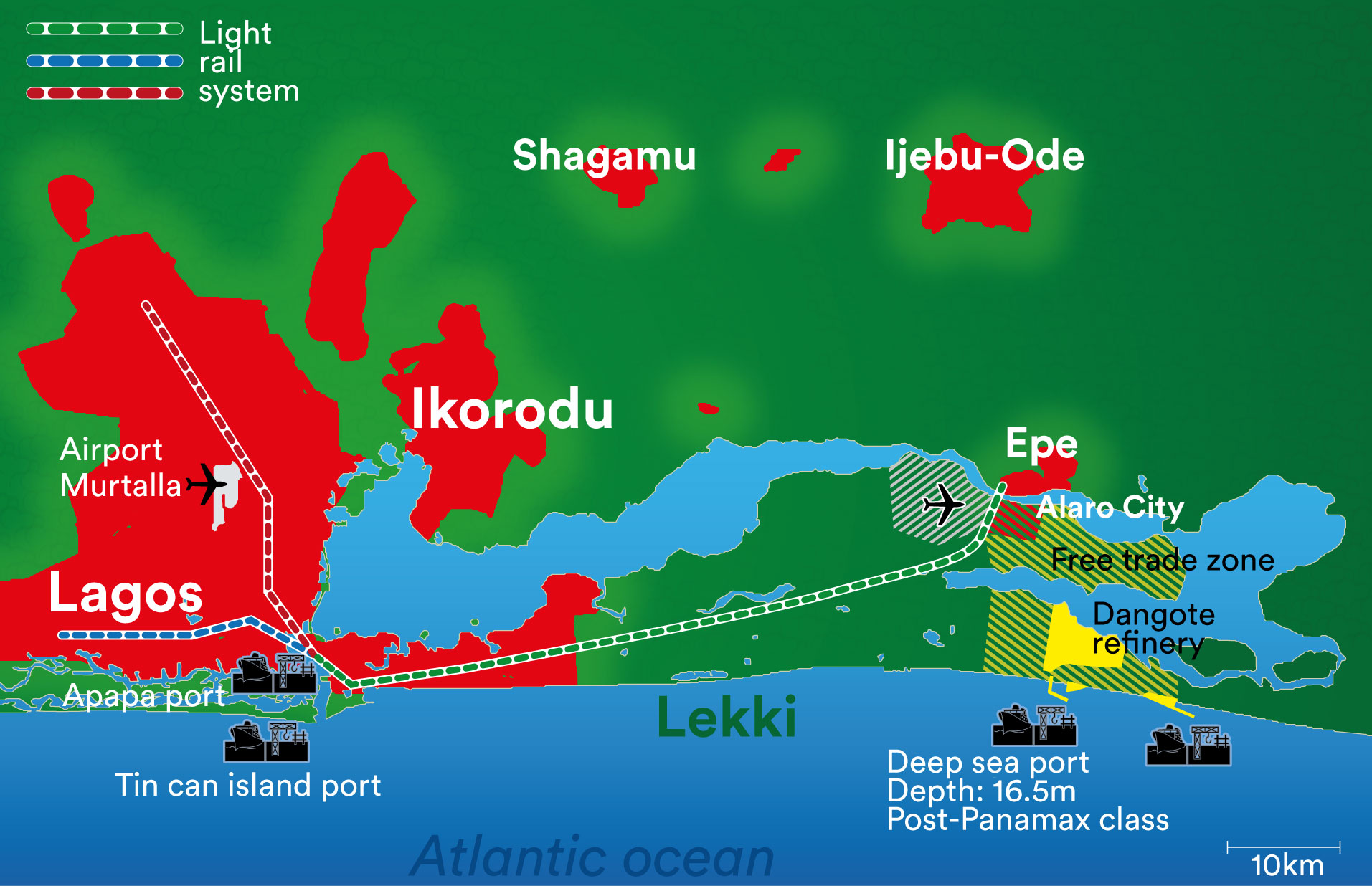
Nigeria’s fast-moving consumer goods sector alone is estimated at US$28 to 32 billion, with potential to expand to US$50 billion, according to Maersk. The Lekki Deep Sea Port and new cold-chain networks are transforming supply chains that were once a barrier to entry.
The political signal is equally significant: Nigeria has joined BRICS as a partner country, drawing closer to full members such as Brazil and South Africa. For Latin America, this is not a distant diplomatic abstraction; it is a reconfiguration of the institutions through which South–South trade, investment and standards-setting will flow in the coming decade.
The Atlantic Corridor: Latin America’s Gateway
Geography gives Latin America an underappreciated advantage in the emerging African growth story: the Atlantic Ocean is narrower than the Indian, and the sea lanes from Santos, Buenos Aires and Cartagena to Lagos, Tema and Dakar are shorter and more established than many realise.
South Africa’s trade data offer a glimpse of what is already moving. In March 2026, SARS reported a preliminary trade surplus of R31.9 billion, with exports of R187.9 billion and imports of R156 billion.
Within Africa, South Africa’s main partners include Namibia, Botswana, Nigeria and Mozambique, each taking a roughly 12 to 13 per cent share of continental trade.
The real scale of West African trade, however, is far larger than official statistics capture. The OECD estimates that intra-regional food trade in West Africa—recorded and unrecorded—is worth around US$10 billion annually, at least six times higher than official figures.
Nigeria dominates this trade, with key products including live animals, cereals and processed foods.
This informal trade is where Latin American agribusiness is already present, often invisibly. A US Grains and BioProducts Council market profile notes that compound feed production across Africa remains low, so feed suppliers from the United States, Europe and South America dominate the market.
Brazilian and Argentine soy and maize are feeding West Africa’s livestock boom.
The opportunity now is to move from being a raw-input supplier to a partner in logistics, processing and cold-chain development. The Lekki Deep Sea Port is a physical symbol of the new Atlantic Africa; Latin American shipping lines and port operators should be studying its example and charting the routes that connect it to the Southern Cone.
North Africa: The Quiet Strain and Its Lessons
North Africa tells a different, subtler story—one of social-policy success that has run ahead of economic dynamism, creating vulnerabilities that will feel eerily familiar to Latin American readers. The region halved extreme poverty five years ahead of the 2015 Millennium Development Goal deadline, with the share of people living on less than US$1.25 a day falling from 5 per cent in 1990 to under 1 per cent in 2015.
Yet this poverty reduction was achieved less through high growth than through social policies, cultural factors and political regimes, as an Economic Research Forum paper argues—a model the authors warn is not sustainable without higher growth and more inclusive governance. The parallels with Latin America’s own conditional cash-transfer successes and subsequent fiscal strains are striking.
The fragility is measurable. UNECA describes North African economic growth as fragile, with real GDP expanding by only 1.9 per cent in 2024.
The African Development Bank calculates an annual financing gap of US$104.9 billion if North African countries are to achieve structural transformation goals by 2030—a shortfall between the required US$134.8 billion annually and currently available resources.
Demographic pressure compounds the strain. North Africa’s population is approximately 277.6 million and growing at about 1.34 per cent annually, driven by high fertility.
Egypt alone has over 118 million people, more than 90 per cent of whom live along the Nile Valley and Delta—an area comprising only about 5 per cent of the country’s total land.
For Latin America, North Africa is both a mirror and a warning. The region shows that social policy can dramatically reduce poverty, but without robust growth and job creation, the achievement is fiscally and politically brittle.
That is a lesson Brazil, in particular, should absorb as it debates the future of its own social-protection architecture.
The BRICS Factor: Brazil, Nigeria and a New Geometry
Nigeria’s accession to BRICS is the institutional expression of Africa’s rising weight in the global economy. The grouping—originally a Goldman Sachs acronym for large emerging markets—now includes Brazil, Russia, India, China, and South Africa, with partner countries such as Nigeria in a widening outer circle.
For Brazil, the entry of Africa’s largest economy and most populous nation into the same diplomatic club alters the calculus. BRICS is no longer a loose coalition of geographically dispersed large economies; it is becoming an Atlantic–Indian Ocean axis with genuine potential to coordinate on trade standards, development finance and commodity-market governance.
The New Development Bank, the BRICS financial arm, gains a natural constituency in Africa with Nigeria aboard, complementing South Africa’s role. Brazilian construction, agribusiness and fintech firms should be examining what this means for project finance, procurement rules and political risk insurance in West Africa.
There is also a competitive dimension. China’s Belt and Road Initiative has already poured billions into African infrastructure, often tied to Chinese contractors and materials.
Brazil, with its own infrastructure expertise and a less geopolitically charged profile, may find openings that Beijing’s more assertive posture closes off.
The BRICS dimension also matters for Latin America’s own internal debates. As Argentina under Javier Milei distances itself from the bloc, Brazil’s leadership within BRICS becomes more pronounced. The question is whether Brasília will use that platform to build strategic bridges with Africa, or let the opportunity drift while Asia and Europe deepen their own African footholds.
Energy, Food and the Geopolitics of Supply
Africa and Latin America are both commodity-exporting regions, and their relationship to global energy and food markets is shifting in ways that create both competition and complementarity. West Africa’s new oil and gas production—Senegal and Niger are the names to watch—is entering a global market where Latin American producers like Brazil and Guyana are also ramping up output.
The European Union’s scramble for non-Russian energy since 2022 has reshaped both regions’ export strategies. North African gas pipelines and LNG terminals are feeding Southern Europe; Latin American crude and LNG are heading to the same markets.
The two regions are, in effect, competing for the same European energy-security premium.
In food, the picture is more complementary. West Africa’s rapidly growing population and booming livestock sector are generating demand for animal feed that domestic production cannot meet. South American soy, maize and feed additives already dominate parts of this market, a position that can be deepened if logistics and trade finance keep pace.
The OECD’s finding that informal food trade in West Africa is six times larger than official figures suggests a market that is vast, dynamic, and largely outside the purview of formal trade agreements. Latin American grain exporters and agribusiness giants need to understand this dual structure—formal and informal—if they are to operate profitably and at scale.
Climate change adds a final layer. Both regions are exposed to extreme weather, from drought in the Sahel and the Brazilian cerrado to flooding in Mozambique and Peru.
The food-security strategies of Africa and Latin America are converging in ways that make joint research, crop adaptation and early-warning systems a logical area for South–South cooperation.
What Latin America Should Do Now
The data points to a conclusion that is uncomfortable for a region accustomed to looking north and east: Latin America needs an Africa strategy. Not a set of goodwill diplomatic communiqués, but a coherent framework linking trade, investment, logistics and people-to-people ties.
The building blocks are already in place. Brazilian agribusiness feeds West African livestock; South African mining houses operate in Latin America; both regions share membership in BRICS and a stake in reforming multilateral finance.
What is missing is a deliberate effort to connect these dots into a sustained competitive advantage.
Concrete steps would include: mapping the Atlantic shipping routes that could carry Brazilian food products and manufactured goods to West and Southern African markets; negotiating double-taxation and investment-protection agreements with key African economies; and creating a Brazil–Africa business council with real private-sector leadership, not just government ribbon-cutting.
The demographic window matters too. Africa’s youth bulge is producing a labour force that will need jobs, food and digital services for decades to come.
Latin America, with its own experience of demographic transition and urbanisation, has expertise in areas like conditional cash transfers, urban planning and fintech that African governments and firms are actively seeking.
Above all, Latin American capitals need to internalise that Africa’s growth surge is not a statistical curiosity or a charity case. It is a structural reordering of the global economy, and the regions that recognise it early—building relationships, supply chains and institutional links—will be the ones that benefit when the 2026 forecasts become the new normal.
More: Kenya news in English, every day from The Rio Times.
Connected Coverage
- Ebola Death Toll Passes 1,000 in DR Congo as Rare Strain Spreads
- US Hits Nigeria With a 12.5% Forced-Labour Tariff
- AU Water Infrastructure Push Taps BRICS Bank Funding
- Migrant Deaths Off West Africa Deepen Sahel-Atlantic Crisis
- BCEAO Holds Key Rate at 3.00% as WAEMU Faces Deflation and Political Risk
- East Libya bans entry for 4 African nations
- Morocco High-Speed Rail Gets $234 Million African Bank Loan
- Africa Intelligence Brief — Thursday, July 23, 2026
Explore the cluster: Africa · World · Asia
This article was produced by The Rio Times’ automated newsroom system. How we use AI · Report an error · Editorial responsibility: Matthias Camenzind, Editor-in-Chief
LatAm Markets: Live Signals → — real-time movers, turnover leaders and FX across Latin America.
Horn of Africa and the Red Sea
- Horn of Africa 2026: Why It Matters and Who Backs Whom
- Ethiopia’s Neighbors Explained, Ports, Eritrea, Somalia
- Eritrea Explained 2026, a Red Sea Country Guide
- Somalia Explained: Al-Shabaab, Somaliland, the Ports and the Fight Over a 2026 Vote
Frequently Asked Questions
Is Africa really going to grow faster than Asia?
UN and IFI forecasts suggest aggregate African growth could outpace Asia’s by 2026, driven by East Africa’s near-6 per cent expansion and West Africa’s stabilisation. This does not mean Africa will match Asia’s per-capita wealth, but the direction of growth leadership is shifting.
Why does this matter for Latin America?
A new growth pole in the Global South means new competition for capital, new markets for Latin American exporters, and a reconfiguration of South–South forums like BRICS where Brazil and now Nigeria sit at the same table.
Which sectors offer the most immediate Latin American opportunity?
Agribusiness and animal feed are already dominant, while logistics, cold chains, fintech and digital services are the next frontier. West Africa’s US$28–45 billion logistics market and Nigeria’s US$28–50 billion FMCG sector are the most concrete near-term targets.
Sources: sars.gov.za, un.org, insights.aib.world