Oil Wrap: Hormuz Blockade Lifts Brent, WTI on Friday
Key Facts
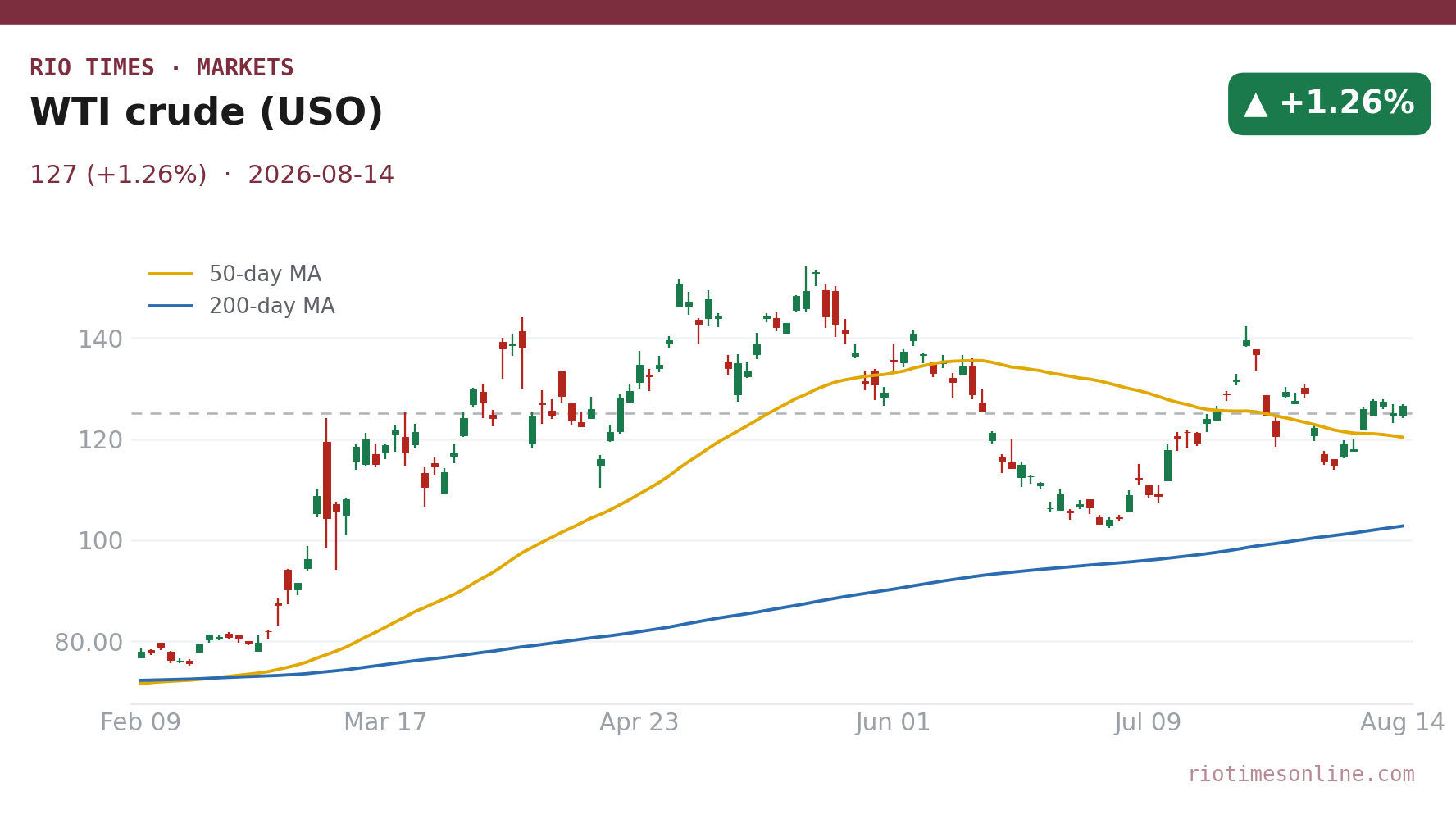
- USO, the fund tracking WTI crude, closed at US$126.60 up 1.26% on Friday, August 14, after Washington threatened tighter economic isolation of Iran over the closed Strait of Hormuz.
- Brent crude ended the week near US$88 a barrel a rebound that erased earlier losses and put the global benchmark on track for a weekly gain of about 5%.
- YPF rose 1.21% to US$50.05 reflecting how sustained Brent prices improve the economics of Argentina’s Vaca Muerta shale play.
- Petrobras slipped 0.06% to US$17.88 a flat finish even as the Brent-linked pre-salt producer stands to benefit from Atlantic Basin supply anxiety.
- Guyana’s Stabroek partners have recovered about US$55 billion in investment triggering a larger share of oil for the state just as Yellowtail ramps toward full capacity.
- Somali pirates hijacked three tankers in the Gulf of Aden as the Hormuz crisis pushes hundreds of commercial ships onto longer routes around Africa.
Today’s Focus
Friday’s oil session was a geopolitical trade, not a demand story. The United States threatened tighter economic isolation of Iran, which has kept the Strait of Hormuz — the world’s most important chokepoint for Gulf crude — closed, and prices jumped.
The USO fund, a proxy for WTI, settled at US$126.60, up 1.26%. Brent, the global benchmark more relevant to Latin American exporters, climbed back toward US$88 a barrel and looked set for a weekly gain near 5%.
For Latin America, the rise is a tailwind for Brazil’s pre-salt, Argentina’s Vaca Muerta, Mexico’s Pemex and Guyana’s offshore boom, all of which sell into Brent-linked markets now fretting over redirected flows around Africa.
Yet the region’s equities did not all cheer. Petrobras was nearly flat at US$17.88, down 0.06%, while YPF rallied 1.21% to US$50.05, showing investors are still picking winners by balance-sheet strength and export exposure.
What matters today. The Hormuz closure is keeping a risk premium under oil prices, and that premium is resetting how investors value every Atlantic Basin producer from Brazil to Guyana.
01 The session in one read
Oil rose on Friday, August 14, after Washington threatened tighter economic isolation of Iran over the closed Strait of Hormuz. The news erased the previous day’s losses and refocused the market on the risk that Gulf barrels cannot reach buyers.
The USO fund, a proxy for front-month WTI futures, closed at US$126.60, up 1.26% on the day. Brent, the more relevant benchmark for Latin American crude, pushed back toward US$88 a barrel and looked set to finish the week roughly 5% higher.
The move came despite a bigger-than-expected build in US crude inventories and signs of softer demand, which had dragged prices earlier in the week. The rally was supply-risk not consumption-driven.
Friday was about war risk, not refinery runs. With Iran keeping the Strait of Hormuz shut and Washington threatening tighter sanctions — and fresh hijackings off Somalia lengthening routes around Africa — a geopolitical premium is doing the work, not demand. For Atlantic Basin producers from Brazil to Guyana that premium is a tailwind, but one that can drain quickly if the strait reopens.
02 The board
Latin America’s oil equities were split. YPF, Argentina’s state-controlled producer, rose 1.21% to US$50.05, the clearest expression of how a high Brent price supports hard-currency valuations for shale developers.
Petrobras was essentially flat, closing down 0.06% at US$17.88, while Colombia’s Ecopetrol eased 0.23% to US$17.17. Neither moved with the enthusiasm of the underlying commodity, a signal that investors remain cautious about fiscal and political risks.
| Asset | Level | Change |
|---|---|---|
| WTI crude (USO) | US$126.60 | +1.26% |
| Petrobras | US$17.88 | -0.06% |
| Ecopetrol | US$17.17 | -0.23% |
| YPF | US$50.05 | +1.21% |
Source: RT close, 2026-08-14. Where a commodity has no spot feed, an exchange-traded tracker or leading producer is shown as a labelled proxy.
Live Market IntelligenceThe live market board
Rio Times · Live Market Intelligence
Latin America — Cross-Market Board
| Instrument | Last | Change | YoY | Prev. | High | Low | Volume |
|---|---|---|---|---|---|---|---|
| IBOV | 166,934.20 | -0.10% | +21.85% | 167,100.95 | 168,310 | 167,142 | — |
| IPSA | 11,042.67 | +0.39% | — | 11,000.07 | 11,210 | 10,984 | 1,513,213,483 |
| IPC MEX | 64,573.59 | -0.39% | +12.17% | 64,826.39 | 66,121 | 65,405 | 108,886,187 |
| MERVAL | 2,947,349 | -1.77% | +30.51% | 3,022,485 | 3,042,365 | 2,991,150 | — |
| COLCAP | 2,452.46 | +0.84% | — | 9.04 | 9.05 | 9.02 | 4,133 |
| BVL PERÚ | 58,104.31 | +0.40% | — | — | — | — | — |
| USD/BRL | 5.16 | +0.01% | -5.13% | 5.16 | 5.18 | 5.14 | — |
| EUR/BRL | 5.95 | +1.01% | -5.83% | 5.89 | 5.98 | 5.94 | — |
| USD/MXN | 17.06 | -0.24% | -8.58% | 17.10 | 17.08 | 17.01 | — |
| USD/CLP | 913.98 | +0.04% | -5.67% | 913.65 | 915.11 | 906.68 | — |
| USD/COP | 3,140 | +0.03% | -22.04% | 3,139 | 3,141 | 3,105 | — |
| USD/PEN | 3.36 | -0.66% | -4.82% | 3.38 | 3.38 | 3.35 | — |
| USD/ARS | 1,493 | +0.10% | +12.96% | 1,491 | 1,494 | 1,480 | — |
| USD/UYU | 40.27 | +1.24% | +1.80% | 39.77 | 40.27 | 40.23 | — |
| USD/PYG | 5,939 | +1.68% | -19.54% | 5,841 | 5,939 | 5,925 | — |
| USD/BOB | 11.64 | -0.76% | +72.04% | 11.73 | 11.72 | 11.64 | — |
| USD/DOP | 58.34 | +1.25% | -3.44% | 57.62 | 58.34 | 58.04 | — |
| USD/CRC | 445.92 | +0.89% | -9.71% | 441.97 | 448.50 | 445.92 | — |
03 What moved it
The Strait of Hormuz is the narrow waterway through which roughly a fifth of the world’s seaborne crude normally passes. The prolonged closure of the Strait means tankers must take longer routes around Africa, tightening the effective supply of prompt barrels.
That rerouting is already creating chaos beyond the Gulf. Somali pirates hijacked three tankers in the Gulf of Aden, exploiting the surge in traffic off East Africa, and Asian refiners have been buying more US crude as an alternative to blocked Middle Eastern grades.
Baker Hughes data on Friday showed US drillers added one oil rig, bringing the active oil count to 455. That is a modest supply response, but still far from enough to offset the loss of chokepoint capacity.
04 The Latin American read
For Brazil, the Brent rebound is a direct lift for pre-salt export revenue, since most of those cargoes price against the global benchmark and sail to China and Europe. Petrobras remains the main listed proxy, though its flat close shows the market is weighing domestic politics as heavily as crude prices.
Guyana is the region’s standout supply story. ExxonMobil and partners Hess and CNOOC have now recovered about US$55 billion in Stabroek investment, which means the state is entitled to a larger share of oil under the production-sharing contract.
In Argentina, YPF’s 1.21% gain reflects Vaca Muerta’s improved economics at current Brent levels. In Mexico, Pemex exports Gulf crude into the same Atlantic market, but its high debt keeps the benefit muted. Venezuela remains largely sidelined by sanctions, leaving latent capacity off the market and amplifying the price impact of the Hormuz disruption.
05 The names to watch
USO is the cleanest read on WTI moves, and its 1.26% rise to US$126.60 captures the geopolitical premium without company-specific noise.
YPF at US$50.05 is the regional equity most leveraged to sustained Brent strength, because shale drilling economics improve almost one-for-one with higher prices.
Petrobras at US$17.88 is the test case for whether foreign investors are willing to pay for Brazil’s pre-salt exposure amid local political uncertainty.
Ecopetrol at US$17.17 is the regional laggard worth monitoring, as Colombia’s fiscal and regulatory debates offset the country’s crude-quality advantages.
06 The outlook
The market will spend the coming week asking whether the Hormuz blockade is a durable policy or a negotiating posture. If talks between Washington and Tehran remain stalled, the risk premium in Brent is likely to harden, supporting Latin American export prices.
The wildcard is demand. A large US inventory build and softer consumption signals could cap the upside, so the next move probably hinges on whether geopolitical risk outlasts the physical surplus. For Latin America, that means watching Brent’s hold near US$88 a barrel more than any single day’s move.
07 What to watch
- US-Iran talks: Any resumption of direct negotiations could deflate the Hormuz risk premium quickly and reset Latin American crude assumptions.
- Somali piracy off the Horn of Africa: More hijackings on the longer African route would add freight costs and delays, acting as a second supply squeeze.
- Guyana’s production ramp-up: Yellowtail’s path toward full capacity will show whether the non-OPEC supply cushion can blunt the geopolitical rally.
- Petrobras price reaction: If Brent gains do not lift Petrobras shares, it signals that domestic politics, not oil, is the binding constraint for foreign investors.
Frequently Asked Questions
Why did oil rise on Friday, August 14, 2026?
Iran kept the Strait of Hormuz closed as Washington threatened tighter economic isolation, cutting the movement of Gulf crude and pushing Brent back toward US$88 a barrel while the WTI-tracking USO fund rose 1.26% to US$126.60.
How does the Hormuz blockade affect Latin American oil producers?
The blockade reroutes tankers around Africa and tightens Atlantic Basin supply, which tends to lift Brent-linked revenue for Brazil’s pre-salt, Guyana’s Stabroek, Mexico’s Pemex and Argentina’s Vaca Muerta.
Why did Petrobras not rally with oil prices?
Petrobras closed nearly flat at US$17.88, down 0.06%, because investors are weighing Brazilian domestic politics and fiscal risk against the benefit of higher Brent export values.
What is different about Guyana’s oil boom in 2026?
Guyana’s Stabroek partners have recovered about US$55 billion in investment, entitling the state to a larger share of oil just as the Yellowtail project ramps production toward full capacity.
This article was produced by The Rio Times’ automated newsroom system. How we use AI · Report an error
LatAm Markets: Live Signals → — real-time movers, turnover leaders and FX across Latin America.
Read More from The Rio Times