Zinc Slips as Nexa Drops 2.76%; Buenaventura Steady Amid Hormuz Fears
Key Facts
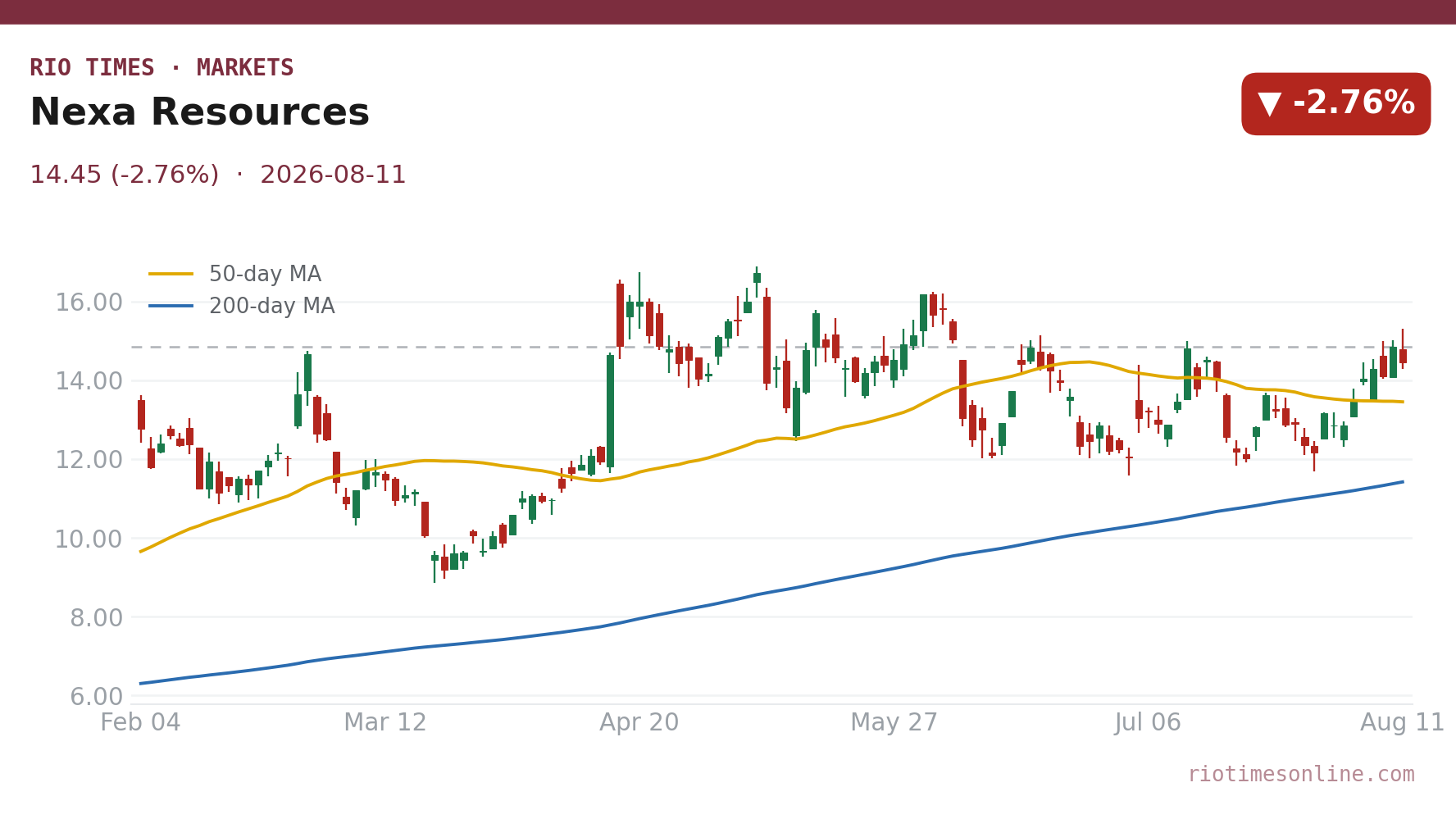
- Nexa Resources closed at US$14.45, down 2.76% LatAm’s largest zinc miner retreated sharply as industrial metal buyers pulled back on construction demand fears.
- Buenaventura settled at US$34.80, gaining 0.64% The Peruvian precious-and-base-metals miner decoupled from zinc weakness, supported by gold’s sustained hold above US$4,400.
- Gold held above US$4,400 as Iran tensions worsened Bullion’s flight-to-safety bid deepened, acting as a mechanical lifeline for polymetallic miners with gold exposure.
- Oil prices spiked on Hormuz escalation fears Rising Brent costs threatened global growth assumptions, punishing shares tied to galvanised-steel intensive industries.
- Broader equity futures edged lower during the session A risk-off tilt amplified the sell-off in cyclical names, hitting zinc proxies disproportionately.
- Gold touched a two-month high before retreating The brief spike confirmed a persistent haven rotation that sidelined pure industrial plays like zinc.
Today’s Focus
Zinc-linked equities diverged sharply on Tuesday, August 11, as Nexa Resources tumbled 2.76% to US$14.45 while Buenaventura added 0.64% to reach US$34.80. The split reflected a market consumed by deteriorating geopolitics in the Strait of Hormuz, which propelled gold above US$4,400 and sent oil prices jumping.
Industrial metals faced a punishing macro environment because soaring energy costs and equity-market softness darkened the outlook for heavy construction and galvanised-steel demand across the Americas. Nexa, as a pure-play zinc producer with operations in Peru and Brazil, bore the brunt of that industrial angst.
Buenaventura sidestepped the sell-off entirely because investors treated its precious-metals portfolio as a safety valve. With gold hovering near a two-month high, the Lima-based miner attracted defensive positioning even as its base-metal output contributed meaningfully to the revenue mix.
The session delivered a clear message: in a day ruled by Hormuz headlines and increasing Iranian risk premiums, zinc exposure required a gold hedge to hold its ground.
What matters today. Gold’s haven bid insulated Buenaventura while pure industrial zinc exposure via Nexa was punished as Hormuz tensions spiked oil and darkened construction demand.
01 The session in one read
Latin America’s two publicly traded zinc proxies took opposite paths on Tuesday, August 11, as a spiralling security crisis in the Strait of Hormuz elevated energy costs and supercharged the safe-haven appetite for gold. Nexa Resources, the Peruvian-Brazilian zinc heavyweight, dropped 2.76% to settle at US$14.45, capturing a sharp retreat in industrial confidence.
Buenaventura, which pairs zinc and silver output with a significant gold stream, closed 0.64% higher at US$34.80. The miner was carried by bullion’s stubborn hold above US$4,400, a level reinforced by worsening Iran tensions and a two-month high touched before a late-session pullback.
The decisive divergence between Nexa Resources and Buenaventura confirms that, for Latin American resource equities, zinc’s fate on Tuesday was tightly shackled to the absence or presence of precious-metals revenue. With Iranian tensions escalating and gold holding above the psychologically critical US$4,400 line, pure industrial miners were treated as unhedged cyclical risk. Watch whether galvanised-steel PMI prints from China and Brazil later this week can arrest the commodity’s slide, or if the geopolitical risk premium continues to drain appetite for construction-linked base metals.
02 The board
The verified board told a clean bifurcation story: pure base-metal exposure bled, while precious-metals linkage provided a cushioning floor. Nexa’s 2.76% decline was among the largest single-session drawdowns for a zinc-tracking equity during a summer Tuesday thinned by risk-off moves in broader equity futures.
Buenaventura’s 0.64% uptick to US$34.80 looked modest but was significant in a session where industrial commodities fought oil-price spikes and deteriorating global-growth optics. Gold’s perseverance above US$4,400 ultimately served as the mechanical differentiator that spared Buenaventura from the washout.
| Asset | Level | Change |
|---|---|---|
| Nexa Resources | US$14.45 | -2.76% |
| Buenaventura | US$34.80 | +0.64% |
Source: RT close, 2026-08-11. Where a commodity has no spot feed, an exchange-traded tracker or leading producer is shown as a labelled proxy.
Live Market IntelligenceThe live market board
Rio Times · Live Market Intelligence
Latin America — Cross-Market Board
| Instrument | Last | Change | YoY | Prev. | High | Low | Volume |
|---|---|---|---|---|---|---|---|
| IBOV | 183,476.86 | -0.27% | +21.85% | 183,965.91 | 168,310 | 167,142 | — |
| IPSA | 11,255.90 | -0.39% | — | 11,299.82 | 11,210 | 10,984 | 1,513,213,483 |
| IPC MEX | 64,992.23 | +1.13% | +12.17% | 64,264.16 | 66,121 | 65,405 | 108,886,187 |
| MERVAL | 2,893,751 | -1.57% | +30.51% | 3,022,485 | 3,042,365 | 2,991,150 | — |
| COLCAP | 2,584.72 | -0.95% | — | 9.04 | 9.05 | 9.02 | 4,133 |
| BVL PERÚ | 59,934.37 | +1.27% | — | — | — | — | — |
| USD/BRL | 5.16 | +0.01% | -5.13% | 5.16 | 5.18 | 5.14 | — |
| EUR/BRL | 5.95 | +1.01% | -5.83% | 5.89 | 5.98 | 5.94 | — |
| USD/MXN | 17.06 | -0.24% | -8.58% | 17.10 | 17.08 | 17.01 | — |
| USD/CLP | 913.98 | +0.04% | -5.67% | 913.65 | 915.11 | 906.68 | — |
| USD/COP | 3,140 | +0.03% | -22.04% | 3,139 | 3,141 | 3,105 | — |
| USD/PEN | 3.36 | -0.66% | -4.82% | 3.38 | 3.38 | 3.35 | — |
| USD/ARS | 1,493 | +0.10% | +12.96% | 1,491 | 1,494 | 1,480 | — |
| USD/UYU | 40.27 | +1.24% | +1.80% | 39.77 | 40.27 | 40.23 | — |
| USD/PYG | 5,939 | +1.68% | -19.54% | 5,841 | 5,939 | 5,925 | — |
| USD/BOB | 11.64 | -0.76% | +72.04% | 11.73 | 11.72 | 11.64 | — |
| USD/DOP | 58.34 | +1.25% | -3.44% | 57.62 | 58.34 | 58.04 | — |
| USD/CRC | 445.92 | +0.89% | -9.71% | 441.97 | 448.50 | 445.92 | — |
03 What moved it
An acute flare-up in US-Iran friction centred on the Strait of Hormuz drove the entire commodity complex. Crude prices spiked, gold surged to a two-month high before easing, and equities edged lower, stealing bids from zinc-consuming sectors like construction and galvanised steel.
For zinc specifically, the macroeconomic fear channel hit through input costs and steel demand. When oil spikes on supply-choke fears, heavy manufacturing margins compress and infrastructure projects face cost-review delays, directly undercutting the galvanising market in Peru, Brazil and Mexico. Traders also positioned defensively ahead of a critical US inflation data print due in the coming days, adding another layer of pressure to risk-sensitive base-metal equities.
04 The Latin American read
From Lima to São Paulo, the session was read as a cautionary tale for industrial miners lacking a gold backstop. Peru and Mexico, both major zinc producers, saw their mining sectors’ fortunes bifurcate in real time. Nexa’s fall matters for Brazilian and Peruvian institutional portfolios precisely because it is the most liquid zinc pure-play across the region’s exchanges.
Bolivia’s state-dominated zinc output did not trade on the board, but the commodity’s direction directly influences fiscal planning in La Paz. Across the three producer nations, Tuesday’s signal was unmistakeable: when geopolitical chaos threatens free passage through Hormuz, the construction-supply chain from rebar to galvanised roofing sheet immediately gets priced for disruption, and Latin America’s base-metal exporters pay the premium.
05 The names to watch
Nexa Resources remains the primary listed zinc vehicle for investors allocating to Latin American base metals. Its 2.76% slide reflected concentrated selling in a stock that typically amplifies underlying zinc price moves because of its pure exposure to smelting and mining margins in Peru and Brazil.
Buenaventura demonstrated that precious-metals diversification works as a volatility dampener. The 0.64% gain, delivered in the teeth of an industrial-metal sell-off, underscores why fund managers often pair Peruvian zinc plays with gold royalties or silver-output streams. Construction-sector exchange-traded funds and Mexican galvanised-steel producers also merit observation because their order-book health ultimately determines the premium buyers are willing to pay for zinc units.
06 The outlook
The immediate outlook hinges on whether the Hormuz risk premium stabilises or escalates further. If gold continues to orbit above US$4,400, Buenaventura is likely to maintain its defensive premium, while Nexa will need a concrete easing of oil prices or a surprisingly strong construction-demand print to reverse the Tuesday sell-off. A durable shift in US inflation expectations could also reset the entire base-metals trade by altering the dollar’s trajectory and the pace of global infrastructure spending.
07 What to watch
- US inflation data: The imminent CPI print will either validate the stagflation narrative crushing zinc or offer relief by cooling rate-hike expectations.
- Strait of Hormuz tanker traffic: Escalation in Iran tensions is the primary variable lifting gold above US$4,400 and punishing industrial demand for galvanised steel.
- China construction PMI: August steel-intentions data from China will confirm whether the world’s largest zinc consumer is absorbing or shedding inventories.
- Nexa daily volume: An uptick in Nexa’s traded volume will signal whether institutional sellers are capitulating or long-only funds are stepping in to buy the dip.
Frequently Asked Questions
Why did Nexa drop while Buenaventura rose?
Nexa is a pure zinc play and suffered from broad industrial selling; Buenaventura owns substantial gold exposure, which rallied as bullion held above US$4,400 on Iran fears.
What does the Strait of Hormuz have to do with zinc?
Hormuz escalation spiked oil prices and crushed risk appetite, hurting construction and galvanised-steel demand expectations that directly set the floor for zinc.
Which Latin American countries are most exposed?
Peru, Brazil and Mexico are major zinc producers and consumers of galvanised steel, making them sensitive to the commodity’s rout.
Is this a long-term shift or a one-session move?
Tuesday was a geopolitically driven session; the durability of the shift depends on whether Iran tensions de-escalate and US inflation data disrupts the stagflation trade.
This article was produced by The Rio Times’ automated newsroom system. How we use AI · Report an error
LatAm Markets: Live Signals → — real-time movers, turnover leaders and FX across Latin America.
Read More from The Rio Times