Vamos Earnings: Profit Halves Despite Record EBITDA
Vamos (VAMO3) Q4 2025 profit fell 52.6% to R$77.7 million as record revenue and 13.2% EBITDA growth were crushed by a 33% surge in financial expenses...

Vamos Q4 2025 Earnings: What Happened
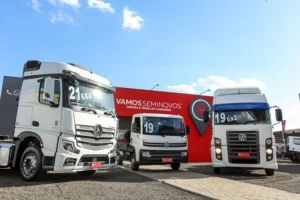
Vamos Locação de Caminhões, Máquinas e Equipamentos S.A. (VAMO3) is Brazil’s largest truck, machinery, and heavy equipment leasing company, operating approximately 45,000 assets across 76 locations in 12 states. A subsidiary of the Simpar Group (SIMH3) and listed on B3’s Novo Mercado since its 2021 IPO, Vamos serves clients in agribusiness, logistics, energy, mining, and construction through long-term rental contracts. The company spun off its concessionárias (dealership) business to Automob (AMOB3) in December 2024, leaving it as a pure-play leasing, seminovos (used vehicle sales), and industrial services platform with approximately 2,000 employees. Vamos earnings for Q4 2025 are covered by The Rio Times as part of its Latin American financial news reporting on B3-listed industrial companies.
The quarter encapsulates the paradox facing asset-heavy Brazilian companies: every operational metric improved — occupancy up, yields up, repossessions down, record lease and seminovos revenue — but the 52.6% profit decline tells a story of financial expenses growing faster than operating income. Management acknowledged this explicitly, noting that “successive interest rate increases throughout the year” drove the sequential profit decline, but that once rates stabilized in Q3–Q4, “it was possible to show growth through all operational improvements being delivered.”
Shares of VAMO3 traded around R$3.50 ($0.67), up approximately 8% year-to-date from R$3.25, with a market capitalization of approximately R$3.9 billion ($741M). The 52-week range of R$2.87 to R$5.53 reflects extreme volatility tied to rate expectations. All eight analysts covering the stock recommend Buy, with an average target of R$5.36 implying 53% upside — XP’s latest target of R$5.60 was cut from R$7.50, reflecting the recalibration to the higher-for-longer rate environment. Simpar recently announced a capital raise of up to ~R$300 million ($57M) for Vamos, with BNDESPar participation of up to R$300 million, to strengthen the capital structure.
Key Drivers Behind Vamos’s Q4 2025 Results
Leasing Revenue Record and Fleet Utilization
Leasing revenue of R$1.07 billion ($203M) grew 11.5% to a quarterly record, driven by higher demand for new equipment, improved yields, and fleet occupancy rising to 86.8% — up 2.6 percentage points from Q4 2024’s 84.2% and 1.0 percentage point from Q3 2025. The occupancy improvement signals that the repossession cycle which plagued 2024 is normalizing. Repossessions fell to the lowest level since Q1 2023, reducing idle assets and improving both revenue generation and maintenance costs. Lower maintenance expense and declining provisions for doubtful accounts — driven by collection of overdue receivables — expanded the leasing EBITDA margin sequentially and year-over-year.
Seminovos Revenue Surge and Asset Recycling
Seminovos revenue nearly doubled to R$326.7 million ($62.1M), up 97.6%, as repossessed and end-of-contract assets were converted to cash. EBITDA margin on seminovos remained positive and slightly above Q3 levels. Full-year asset sales of R$1.3 billion ($247M) reached 103% of the guidance target. The industry segment (customization and manufacturing) added R$85.6 million ($16.3M), up 27.4%, diversifying the revenue base. Together, the three segments drove the 24.3% revenue growth — though the revenue quality varies significantly, with leasing generating recurring, higher-margin income versus the transactional, lower-margin seminovos business.
Financial Expense Explosion on R$11.8 Billion Net Debt
The net financial result of negative R$591.6 million ($112.5M) — up 33.1% from Q4 2024’s negative R$444.4 million — transforms a strong operational quarter into a profit collapse. With R$11.8 billion ($2.2B) in CDI-linked net debt, every 100 basis points of Selic increase adds approximately R$118 million ($22.4M) in annual interest expense. The full-year financial result of negative R$2.18 billion ($414M) consumed nearly 60% of the R$3.65 billion EBITDA, leaving R$328.7 million ($62.5M) for shareholders — a net margin of just 5.7% on R$5.76 billion in revenue. The company’s 14th debenture issuance (December 2025) extended maturities and diversified the funding base, reducing rollover risk.
Live Company IntelligenceVamos Locação de Caminhões Máquinas e Equipamentos S.A — the full investor dossier
Valuation & profitability
Price & risk
$2.4652-wk high
$6.97
Revenue trend · 6y
Ownership
Dividend
Vamos Q4 2025 Financial Detail
Leverage declined to 3.16x ND/EBITDA from 3.31x a year ago and 3.27x in Q3 — achieved primarily through EBITDA growth (denominator expansion) rather than debt reduction, as net debt of R$11.81 billion ($2.2B) was essentially flat (+1.7%). Fleet assets totaled R$18.86 billion ($3.6B), meaning debt finances approximately 63% of the fleet — a capital-intensive model requiring consistently high lease yields above the cost of debt. Capex deployed of R$4.2 billion ($798M), at 102% of the guidance target, signals that Vamos continued investing in fleet renewal even as profit declined.
The Selic sensitivity is extreme. At the current 14.75%, Vamos’s interest cost on R$11.8 billion runs approximately R$1.74 billion ($331M) annually. A 200 basis point Selic cut would save roughly R$236 million ($44.9M) — equivalent to 72% of the entire FY 2025 net income. This explains both the 54.7% annual profit decline and the unanimous analyst Buy ratings: the operational base is strong, and the rate cycle is the sole variable preventing a rerating.
The Simpar Group‘s capital raise of up to ~R$600 million ($114M) combined for Vamos — including ~R$300 million from Simpar/JSP Holding and up to R$300 million from BNDESPar — would reduce leverage by approximately 0.15–0.20x, pushing toward the 3.0x threshold. BNDESPar’s participation (capped at 50% of new shares and 10% of total capital) validates the institutional view that the truck leasing thesis remains intact despite the cyclical earnings pressure.
Management Signals from Vamos
Key Facts
— Management’s characterization of 2025 as a year of “operational and financial records” — citing record revenue, EBITDA, lease revenue, and seminovos activity combined with full guidance delivery — positions the narrative around execution rather than the profit decline. The implicit message: the earnings collapse is entirely a function of external rate policy, not operational deterioration, and when rates normalize, the improved operating base will translate into rapid profit recovery.
— The statement that “leasing services more than compensated for the normalization of asset sale margins and the challenging year in the industry segment” highlights the business mix evolution. Recurring leasing revenue — now the dominant and most profitable segment — grew at double-digit rates with expanding margins, while the more cyclical seminovos and industry segments contributed volume but at thinner margins. This mix shift toward recurring revenue improves earnings quality even as the headline profit number deteriorates.
— The Automob spinoff (December 2024) simplified the corporate structure, leaving Vamos as a pure-play leasing company. This clarity should improve the market’s ability to value the core franchise and may attract investors who previously avoided the conglomerate complexity. Sibling company Movida (MOVI3), also within the Simpar Group, demonstrated in its Q4 results that the rental model can deliver strong profitability even at current rates — albeit with lighter vehicles and lower absolute leverage — providing a roadmap for Vamos as the rate cycle turns.
What to Watch Next for Vamos
The Copom easing cycle is the single most important variable. With R$11.8 billion in Selic-linked debt, every 100 basis points of rate cuts saves approximately R$118 million in annual interest expense — equivalent to 36% of FY 2025 net income. If the Selic reaches 13% by year-end 2026, the financial expense reduction alone could more than double net income without any change in operational performance, explaining why analysts maintain Buy ratings with 53% average upside despite the profit collapse.
The Simpar/BNDESPar capital raise execution will determine the pace of balance sheet repair. The combined R$600 million in fresh equity would reduce leverage toward the 3.0x threshold. Whether the full amount is subscribed — and at what dilution to existing shareholders — will signal institutional confidence in the truck leasing thesis at current valuations.
Fleet occupancy sustainability above 86% is the operational proof point. The improvement from 84.2% to 86.8% over four quarters, with repossessions at five-quarter lows, suggests the customer credit quality has stabilized. If occupancy continues toward the 90%+ levels seen before the 2024 downturn, the revenue-per-asset and margin expansion would compound with rate relief to produce significant earnings recovery. Brazil’s agribusiness sector — a key demand driver for Vamos — remains robust, with record harvests and strong export volumes supporting equipment utilization.
Vamos Quarterly Results (Q4 2025 vs Q4 2024)
| Metric | Q4 2024 | Q4 2025 | Chg |
|---|---|---|---|
| Net Revenue | R$1.19 bn | R$1.48 bn ($282M) | +24.3% |
| EBITDA | R$845 mn | R$956.9 mn ($181.9M) | +13.2% |
| Net Financial Result | -R$444 mn | -R$591.6 mn (-$112.5M) | +33.1% |
| Net Income | R$163.9 mn | R$77.7 mn ($14.8M) | -52.6% |
| Fleet Occupancy | 84.2% | 86.8% | +2.6pp |
Vamos Annual and Strategic Summary (FY2025)
| Metric | Value |
|---|---|
| FY Net Revenue (Record) | R$5.76 bn ($1.1B) (+22.5%) |
| FY EBITDA (Record) | R$3.65 bn ($694M) (+10.1%) |
| FY Net Income | R$328.7 mn ($62.5M) (-54.7%) |
| FY Financial Result | -R$2.18 bn (-$414M) (+34.4%) |
| Net Debt | Leverage | R$11.81 bn ($2.2B) | 3.16x ND/EBITDA |
| Fleet Assets | R$18.86 bn ($3.6B) | ~45,000 assets |
| Capex Deployed | R$4.2 bn ($798M) | 102% of guidance |
| Share Price (VAMO3) | ~R$3.50 ($0.67) | Mkt Cap R$3.9 bn |
| Consensus | 8 Buy / 0 Sell | Avg TP R$5.36 (+53%) |
Risks Facing Vamos
The Selic may not decline as fast or as far as the market expects. If inflation proves stickier — driven by oil prices, fiscal concerns, or global risk factors — the easing cycle could stall near 13–14%, leaving Vamos’s financial expense burden elevated for longer. At 3.16x leverage with R$11.8 billion in floating-rate debt, the margin of error is thin: even a modest delay in rate cuts extends the period of compressed profitability and could force additional equity raises at depressed valuations.
Residual value risk on the fleet is inherent in the leasing model. Vamos’s R$18.86 billion in fleet assets must be sold at acceptable prices when contracts end. The 97.6% surge in seminovos revenue suggests the market is absorbing used trucks, but margins remain thin. A downturn in the trucking or agribusiness cycles — whether from lower commodity prices, trade disruptions, or drought — could depress used equipment values, forcing write-downs and widening the gap between asset cost and realizable value.
Customer credit risk remains a concern despite improvement. The decline in repossessions to five-quarter lows is encouraging, but Vamos operates in sectors (agribusiness, logistics, construction) that are sensitive to economic cycles. A recession or commodity price shock could trigger a renewed wave of lease defaults, reversing the occupancy gains and creating a new pool of idle assets that depress returns. The company’s provisioning for doubtful accounts declined in Q4 — a positive signal, but one that could reverse if macro conditions deteriorate.
Brazilian Heavy Equipment Leasing Sector Context
Key Facts
— Brazil’s truck and heavy equipment leasing market remains deeply underpenetrated compared to developed economies, where fleet leasing accounts for 30–40% of commercial vehicles versus approximately 5–10% in Brazil. This structural gap is the foundation of the long-term investment thesis for Vamos: as companies increasingly prefer to lease rather than own depreciating assets, the addressable market expands regardless of the economic cycle. The average age of Brazil’s truck fleet exceeds 20 years — among the oldest in the world — creating a persistent renewal need that benefits leasing companies offering modern, efficient equipment.
— The high Selic environment creates a paradox for the sector: it simultaneously increases the cost of funding fleet growth (bad for incumbents with existing debt) while raising the opportunity cost of capital for potential customers, making leasing relatively more attractive versus purchase. Companies that would otherwise buy trucks are more likely to lease when their own cost of capital rises, supporting demand growth even as the economics for the lessor temporarily deteriorate.
— Vamos is the undisputed market leader in the heavy equipment segment, benefiting from the Simpar Group’s 20+ years of experience and a national logistics infrastructure that includes sister companies JSL (logistics), Movida (light vehicle rental), and the recently spun-off Automob (dealerships). This ecosystem provides cross-selling opportunities, shared procurement power with OEMs (Volkswagen/MAN trucks, Valtra, Komatsu, Fendt machinery), and a natural channel for asset recycling through the seminovos network. Competitor Armac (ARML3) operates in a similar space but at smaller scale, and the market remains fragmented enough to support continued consolidation by well-capitalized leaders.
Vamos earnings | VAMO3 Q4 2025 results | Brazil truck leasing equipment rental | Simpar Group | Latin American financial news | The Rio Times
This article was produced by The Rio Times’ automated newsroom system. How we use AI · Report an error · Editorial responsibility: Matthias Camenzind, Editor-in-Chief