Key Facts
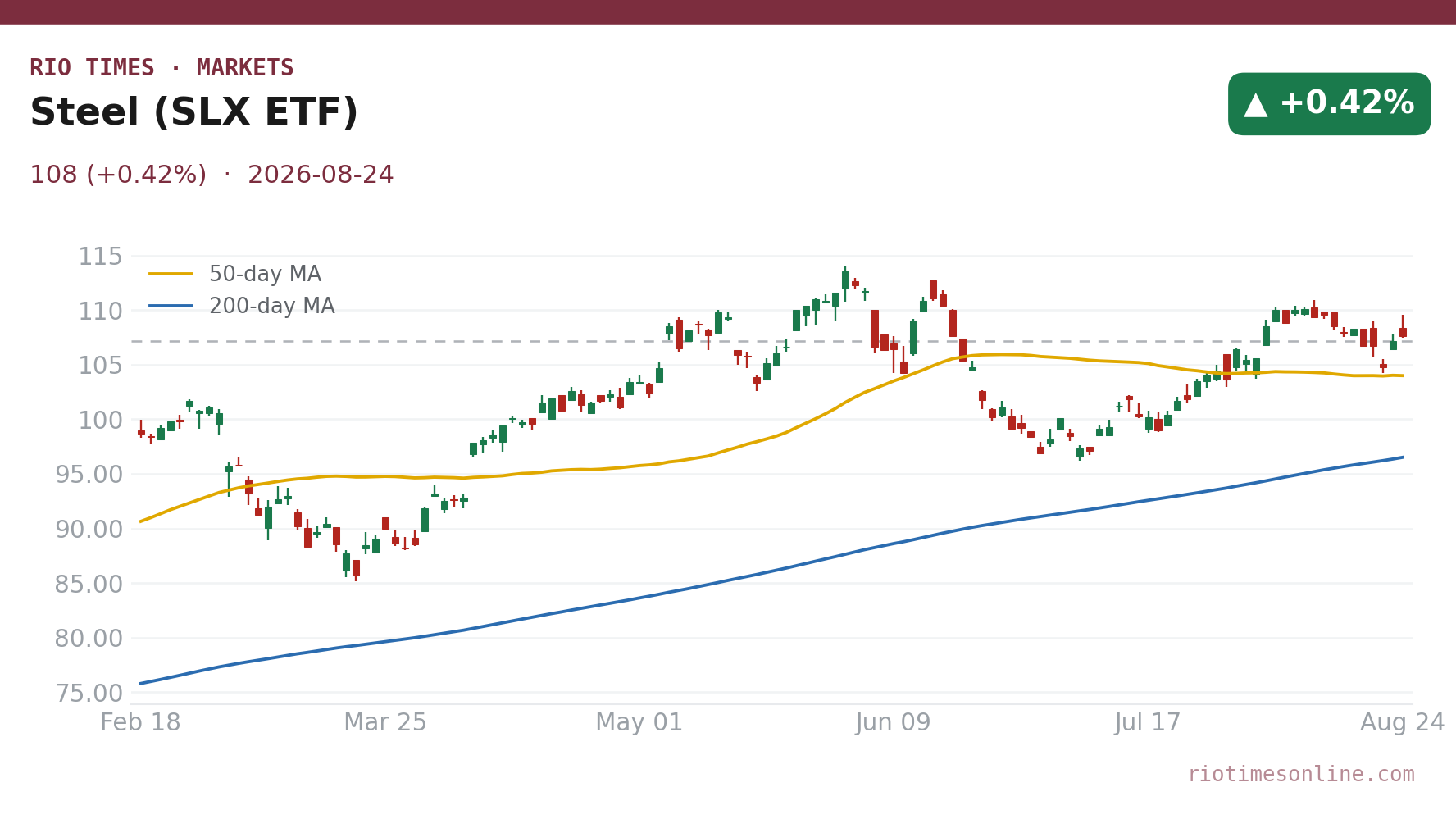
- SLX closed up the VanEck Steel ETF finished Monday at US$107.66, a gain of 0.42% on the session.
- CSN led gains CSN’s New York-traded shares jumped 5.40% to US$1.03, the strongest mover among the regional steel proxies.
- Ternium eased Ternium closed at US$55.11, down 0.61%, even as Mexico’s commercial market and USMCA-linked auto orders keep growing.
- Gerdau was flat Gerdau’s New York shares settled unchanged at US$4.33, reflecting weak Brazilian construction demand and thin auto order books.
- Tariffs remain high Brazil keeps a 25% duty on above-quota steel imports regardless of origin, while Mexico holds duties of up to 50% on Chinese-origin products.
- Chinese imports still bite cheap Chinese steel remains the main squeeze on Latin American mill margins, even with duties in place.
Today’s Focus
Latin American steel names split on Monday, with CSN surging 5.40% while Ternium fell 0.61% and Gerdau closed flat. The VanEck Steel ETF, which holds Gerdau and Ternium among its producers, rose 0.42% to US$107.66.
The region’s mills remain caught between two forces: cheap Chinese imports that squeeze margins, and tariffs that soften the blow. Brazil charges 25% above quota; Mexico applies up to 50% on Chinese-origin steel, plus a 25% levy in place since August 2023.
Demand varies sharply by country. Brazilian construction is weak and auto order books are thin, limiting upside for Gerdau, CSN and Usiminas. Mexico’s commercial market is growing, and nearshoring plus USMCA-linked auto orders are supporting Ternium, even though consumption remains below 2023 levels.
The session showed how micro-company moves, not macro steel trends, drove prices. Investors should watch Mexican auto orders and any shift in Brazil’s tariff regime for the next directional cue.
What matters today. Mexican demand is diverging from Brazilian weakness, and tariffs are the only thing standing between regional mills and a flood of Chinese steel.
01 The session in one read
Latin America’s listed steel names gave a mixed reading on Monday, August 24, 2026, with CSN’s New York shares jumping 5.40% to US$1.03 while Ternium slipped 0.61% to US$55.11 and Gerdau closed flat at US$4.33. The VanEck Steel ETF, a basket of producers that includes both Gerdau and Ternium, rose 0.42% to US$107.66.
The moves summed up a two-speed regional market: Mexican nearshoring and auto demand are keeping Ternium’s story alive, while Brazilian construction weakness makes domestic producers more reliant on trade protection.
The Latin American steel complex is splitting along national demand lines: Mexico’s nearshoring boom and USMCA auto orders offer Ternium a firmer floor, while Brazil’s weak construction and thin auto demand leave Gerdau, CSN and Usiminas exposed to any tariff relaxation. The variable to watch is Mexico’s monthly auto production data, which will show whether the commercial market’s growth is translating into sustained steel orders.
02 The board
The VanEck Steel ETF’s 0.42% gain to US$107.66 signalled mild optimism in global steel producers, but the Latin American constituents diverged sharply. CSN was the standout, its New York-traded shares up 5.40% at US$1.03.
Gerdau sat still at US$4.33, a flat close that reflects Brazil’s sluggish construction sector. Ternium’s 0.61% decline to US$55.11 suggested investors were taking profit even as Mexican demand fundamentals hold up.
| Asset | Level | Change |
|---|---|---|
| Steel (SLX ETF) | US$107.66 | +0.42% |
| Gerdau | US$4.33 | +0.00% |
| CSN (ADR) | US$1.03 | +5.40% |
| Ternium | US$55.11 | -0.61% |
Source: RT close, 2026-08-24. Where a commodity has no spot feed, an exchange-traded tracker or leading producer is shown as a labelled proxy.
Live Market IntelligenceThe live market board
Rio Times · Live Market Intelligence
Latin America — Cross-Market Board
| Instrument | Last | Change | YoY | Prev. | High | Low | Volume |
|---|---|---|---|---|---|---|---|
| IBOV | 205,079.25 | -0.17% | +21.85% | 205,430.33 | 168,310 | 167,142 | — |
| IPSA | 10,972.40 | +0.02% | — | 10,970.29 | 11,210 | 10,984 | 1,513,213,483 |
| IPC MEX | 68,969.69 | +0.06% | +12.17% | 68,929.72 | 66,121 | 65,405 | 108,886,187 |
| MERVAL | 3,017,221 | — | +30.51% | 3,022,485 | 3,042,365 | 2,991,150 | — |
| COLCAP | 2,521.34 | -1.75% | — | 9.04 | 9.05 | 9.02 | 4,133 |
| BVL PERÚ | 59,664.64 | +0.40% | — | — | — | — | — |
| USD/BRL | 5.16 | +0.01% | -5.13% | 5.16 | 5.18 | 5.14 | — |
| EUR/BRL | 5.95 | +1.01% | -5.83% | 5.89 | 5.98 | 5.94 | — |
| USD/MXN | 17.06 | -0.24% | -8.58% | 17.10 | 17.08 | 17.01 | — |
| USD/CLP | 913.98 | +0.04% | -5.67% | 913.65 | 915.11 | 906.68 | — |
| USD/COP | 3,140 | +0.03% | -22.04% | 3,139 | 3,141 | 3,105 | — |
| USD/PEN | 3.36 | -0.66% | -4.82% | 3.38 | 3.38 | 3.35 | — |
| USD/ARS | 1,493 | +0.10% | +12.96% | 1,491 | 1,494 | 1,480 | — |
| USD/UYU | 40.27 | +1.24% | +1.80% | 39.77 | 40.27 | 40.23 | — |
| USD/PYG | 5,939 | +1.68% | -19.54% | 5,841 | 5,939 | 5,925 | — |
| USD/BOB | 11.64 | -0.76% | +72.04% | 11.73 | 11.72 | 11.64 | — |
| USD/DOP | 58.34 | +1.25% | -3.44% | 57.62 | 58.34 | 58.04 | — |
| USD/CRC | 445.92 | +0.89% | -9.71% | 441.97 | 448.50 | 445.92 | — |
03 What moved it
Cheap Chinese imports remain the central pressure on Latin American mill margins, even with duties in place. Brazil keeps a 25% duty on above-quota steel imports regardless of origin, shielding Gerdau, CSN and Usiminas, while Mexico applies up to 50% on Chinese-origin products.
The demand picture is uneven. Brazilian construction demand remains weak and auto order books are thin, limiting upside for domestic producers. Mexico’s commercial market is growing, and nearshoring plus USMCA-linked auto orders are supporting Ternium, though steel consumption still sits below 2023 levels.
04 The Latin American read
For foreign investors, the split between Brazil and Mexico is the key takeaway. Brazil’s mills are fighting a domestic demand slump, relying on a 25% tariff above quota to keep Chinese steel from flooding the market.
Mexico offers a different proposition: up to 50% duties on Chinese-origin steel, plus a 25% levy held since August 2023, combined with growing commercial demand and nearshoring-driven auto orders. That mix gives Ternium a firmer demand base, even if consumption has yet to reclaim 2023 levels.
05 The names to watch
CSN’s 5.40% surge stands out because it came without a clear company-specific catalyst, suggesting short covering or a technical bounce after a weak stretch. The move may prove fragile given thin Brazilian auto order books.
Ternium’s 0.61% dip to US$55.11 looks like a pause rather than a reversal, with Mexican commercial demand still growing. Gerdau’s flat close at US$4.33 underscores how weak Brazilian construction is capping upside despite tariff protection.
06 The outlook
Watch whether CSN’s gain extends or fades, as any follow-through will signal whether investors see a genuine recovery in Brazilian steel demand. The bigger test is Mexico’s auto data; sustained USMCA-linked orders would support Ternium and underpin the thesis that nearshoring is a durable tailwind.
07 What to watch
- Mexico auto production: monthly figures will show whether USMCA-linked orders are translating into sustained steel demand for Ternium
- China steel exports: any rise in Chinese export volumes or price cuts would pressure Latin American mill margins despite tariffs
- Brazil tariff policy: signals on the 25% above-quota duty will drive Gerdau, CSN and Usiminas, given weak domestic demand
- SLX flows: moves in the VanEck Steel ETF reflect global investor appetite for steel producers, including Gerdau at around 1.9% of net assets
Frequently Asked Questions
What is the VanEck Steel ETF (SLX)?
It is an exchange-traded fund that holds steel producers and miners, including Gerdau and Ternium among its listed holdings.
Why is Ternium better positioned than Brazilian mills?
Mexico’s commercial market is growing and nearshoring plus USMCA-linked auto orders support Ternium, while Brazilian construction demand remains weak and auto order books are thin.
How do tariffs protect Latin American steel producers?
Brazil keeps a 25% duty on above-quota steel imports regardless of origin, while Mexico applies duties of up to 50% on Chinese-origin products plus a 25% levy held since August 2023.
Why did CSN jump 5.40% on Monday?
The move lacked a clear company-specific catalyst, suggesting short covering or a technical bounce, but it may prove fragile given thin Brazilian auto demand.
This article was produced by The Rio Times’ automated newsroom system. How we use AI · Report an error · Editorial responsibility: Matthias Camenzind, Editor-in-Chief
LatAm Markets: Live Signals → — real-time movers, turnover leaders and FX across Latin America.