Latin America Steel Steadies; Ternium Gains, CSN Slides
Key Facts
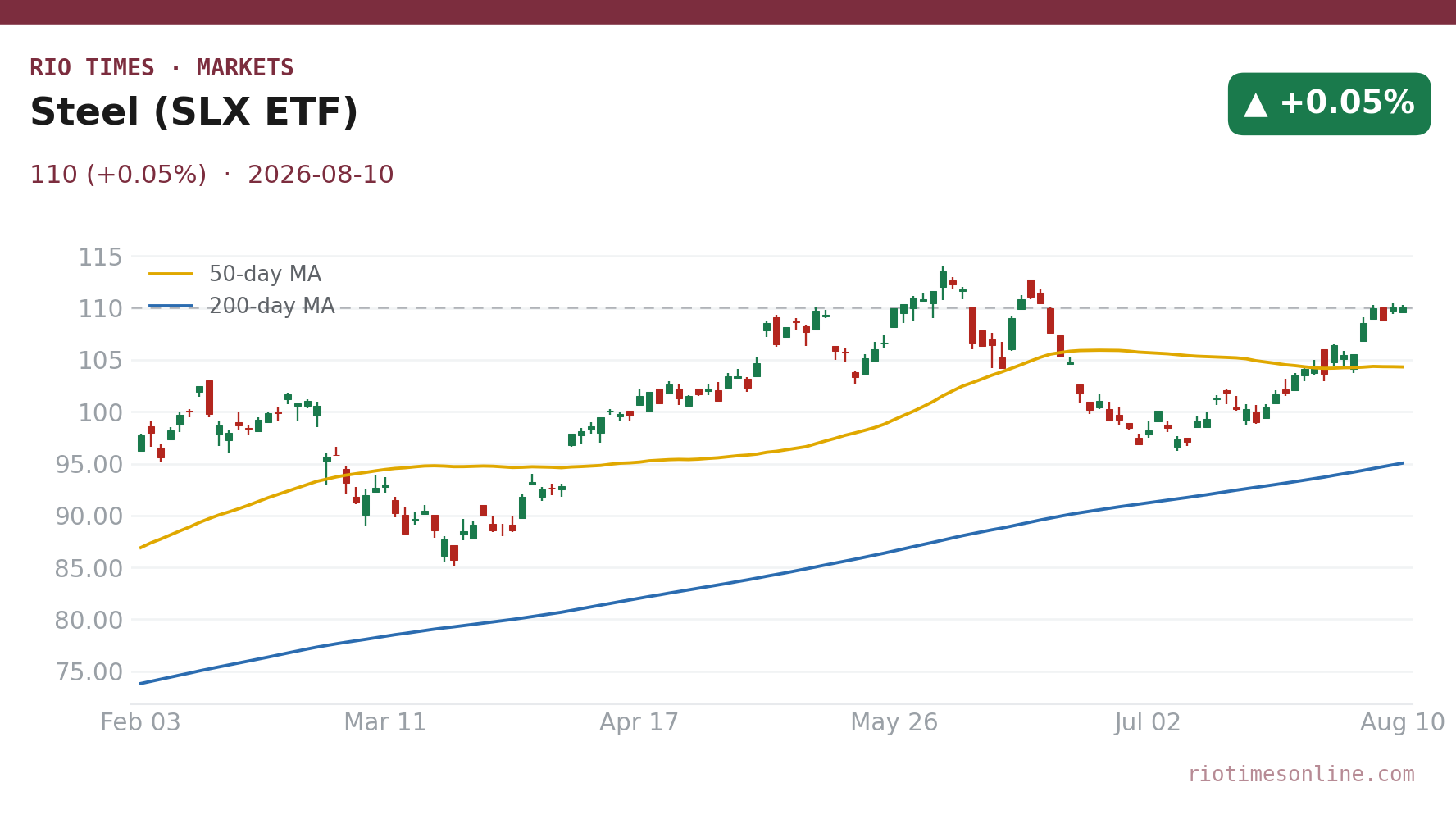
- The steel-producers ETF SLX settled at US$110.07, a barely positive move of plus 0.05% on the day.
- Mexico’s Ternium advanced 1.67% to US$54.80, pacing gains among the region’s major steel names.
- Brazil’s CSN saw its New York-traded ADR fall 3.18% to US$0.9004, marking the steepest decline on the monitor.
- Brazil’s Gerdau edged up 0.40% to US$4.96, showing modest resilience in a generally cautious session.
- Cheap Chinese steel exports continued to weigh on global prices, with Beijing’s domestic demand faltering amid a prolonged property slump.
- US trade policy remained in focus, as existing tariffs and potential new measures on Mexican steel kept investors on edge.
Today’s Focus
Latin America’s steel shares painted a divided picture on Monday, August 10, 2026. Mexico’s Ternium rallied 1.67% to US$54.80, while Brazil’s CSN slumped 3.18% to just US$0.9004 in New York trading. The broad steelmakers’ ETF, SLX, barely budged, adding 0.05% to settle at US$110.07. Brazilian producer Gerdau managed a 0.40% gain to US$4.96.
The split reflected a tug-of-war between local demand hopes and the relentless pressure of Chinese overcapacity. A still-sickly Chinese property sector is forcing mills there to dump record volumes of cheap steel abroad. This flood of imports remains the single largest drag on Latin American pricing power.
Investors were also parsing tariff headlines out of Washington. Existing duties already redirect some Chinese metal, but the threat of renewed US measures on Mexican-origin steel introduces a fresh layer of uncertainty for Ternium, which operates on both sides of the border.
Construction and auto demand in Brazil is providing a floor, but not enough to spark a sustained rally. The market’s attention is fixed squarely on any sign that Beijing will meaningfully curb steel output or that Washington will tighten trade rules further.
What matters today. The split between a surging Ternium and a sliding CSN shows this was a market driven by stock-specific positioning and tariff anxiety, not a uniform sector-wide view.

01 The session in one read
Latin America’s listed steelmakers gave no clear directional signal on Monday, August 10, 2026, with gains for Mexico’s Ternium and Brazil’s Gerdau offset by a steep drop in CSN. The broad-based steel ETF, SLX, finished practically flat, rising just 0.05% to US$110.07.
The price action revealed a market pulled in competing directions: the persistent weight of cheap Chinese steel exports versus a fragile hope that Western trade barriers might finally offer regional mills some protection.
The session’s mixed outcomes were a direct reflection of policy risk colliding with a structural oversupply. Ternium’s 1.67% gain may signal traders betting that near-shoring to Mexico offers a tariff shield, but that bullish view remains fragile. CSN’s sharp 3.18% decline, by contrast, underscores how heavily Brazilian mills remain exposed to the pricing collapse caused by relentless Chinese exports, a headwind that no amount of modest local construction demand can fully offset. The variable to watch: any formal US Commerce Department announcement on new Mexican steel duties.
02 The board
The clearest winner was Ternium, whose US-listed shares jumped 1.67% to US$54.80. The Mexican steelmaker, which operates across the USMCA trade zone, outperformed every other name on the monitor. Brazilian producer Gerdau also held in positive territory, with its stock rising 0.40% to US$4.96.
In stark contrast, CSN’s American Depositary Receipt cratered 3.18% to US$0.9004. That decline made it the session’s underperformer and pulled the wider narrative toward caution. The SLX ETF, a basket of global steel producers, barely acknowledged the divergence, settling up just 0.05% at US$110.07.
| Asset | Level | Change |
|---|---|---|
| Steel (SLX ETF) | US$110.07 | +0.05% |
| Gerdau | US$4.96 | +0.40% |
| CSN (ADR) | US$0.9004 | -3.18% |
| Ternium | US$54.80 | +1.67% |
Source: RT close, 2026-08-10. Where a commodity has no spot feed, an exchange-traded tracker or leading producer is shown as a labelled proxy.
Live Market IntelligenceThe live market board
Rio Times · Live Market Intelligence
Latin America — Cross-Market Board
| Instrument | Last | Change | YoY | Prev. | High | Low | Volume |
|---|---|---|---|---|---|---|---|
| IBOV | 183,476.86 | -0.27% | +21.85% | 183,965.91 | 168,310 | 167,142 | — |
| IPSA | 11,255.90 | -0.39% | — | 11,299.82 | 11,210 | 10,984 | 1,513,213,483 |
| IPC MEX | 64,992.23 | +1.13% | +12.17% | 64,264.16 | 66,121 | 65,405 | 108,886,187 |
| MERVAL | 2,893,751 | -1.57% | +30.51% | 3,022,485 | 3,042,365 | 2,991,150 | — |
| COLCAP | 2,584.72 | -0.95% | — | 9.04 | 9.05 | 9.02 | 4,133 |
| BVL PERÚ | 59,934.37 | +1.27% | — | — | — | — | — |
| USD/BRL | 5.16 | +0.01% | -5.13% | 5.16 | 5.18 | 5.14 | — |
| EUR/BRL | 5.95 | +1.01% | -5.83% | 5.89 | 5.98 | 5.94 | — |
| USD/MXN | 17.06 | -0.24% | -8.58% | 17.10 | 17.08 | 17.01 | — |
| USD/CLP | 913.98 | +0.04% | -5.67% | 913.65 | 915.11 | 906.68 | — |
| USD/COP | 3,140 | +0.03% | -22.04% | 3,139 | 3,141 | 3,105 | — |
| USD/PEN | 3.36 | -0.66% | -4.82% | 3.38 | 3.38 | 3.35 | — |
| USD/ARS | 1,493 | +0.10% | +12.96% | 1,491 | 1,494 | 1,480 | — |
| USD/UYU | 40.27 | +1.24% | +1.80% | 39.77 | 40.27 | 40.23 | — |
| USD/PYG | 5,939 | +1.68% | -19.54% | 5,841 | 5,939 | 5,925 | — |
| USD/BOB | 11.64 | -0.76% | +72.04% | 11.73 | 11.72 | 11.64 | — |
| USD/DOP | 58.34 | +1.25% | -3.44% | 57.62 | 58.34 | 58.04 | — |
| USD/CRC | 445.92 | +0.89% | -9.71% | 441.97 | 448.50 | 445.92 | — |
03 What moved it
The dominant weight on the sector remains the flood of cut-price steel from China. Chinese mills, grappling with a property crisis that has crushed domestic demand, are exporting at levels that depress prices globally. Latin American producers simply cannot match the cost structure of state-supported Chinese output.
Trade policy is the other half of the story. The United States maintains tariffs that partially wall off part of the American market from Chinese steel. But uncertainty crept in around whether new duties could target Mexican-origin metal, a scenario that would directly threaten Ternium’s business model even as it benefits some Brazilian rivals.
On the ground in Brazil, construction activity and auto manufacturing continue to absorb domestic supply. This demand prevented a wider sell-off in names like Gerdau, but the buying appetite was not strong enough to lift CSN, which carries a heavier exposure to the commoditized slab and flat-steel segments most squeezed by Asian imports.
04 The Latin American read
For investors reading the tea leaves, the August 10 session confirmed that the Mexican and Brazilian steel stories have sharply diverged. Ternium is being repriced as a potential beneficiary of any further decoupling from China-centric supply chains, especially if it can serve the tight US market from its Mexican mills without new tariff friction.
Brazilian producers, by contrast, are viewed as price-takers in a global commodity glut. Gerdau’s relative steadiness stems from its long-steel focus and its significant US mini-mill operations, which provide a natural hedge. CSN’s 3.18% drop is a painful reminder that an integrated mill selling slabs and flat products into the Atlantic basin faces the full force of Chinese overcapacity.
05 The names to watch
Ternium (US$54.80) is the region’s highest-stakes play on North American industrial integration. Its fate is tied to US trade policy announcements and auto-sector demand in Mexico, which remains a key engine.
Gerdau (US$4.96) offers a more defensive posture. Its US-focused mini-mill operations benefit from higher American prices and existing tariff protections, insulating it somewhat from the acute margin compression hitting its domestic Brazilian peers.
06 The outlook
The steel trade in Latin America will remain reactive to news flow from Beijing and Washington. Any credible signal that China will mandate steep production cuts to support prices could trigger a rapid short-covering rally across the sector. Conversely, a broadening of US tariffs to include Mexican steel would violently reprice Ternium’s risk premium, likely erasing its August 10 gains in a single session.
07 What to watch
- US tariff rulings on Mexico: Any new duties on Mexican-origin steel would directly threaten Ternium’s recent outperformance and ripple across the USMCA supply chain.
- Chinese export volumes: The main price-setter for global steel; a sustained dip in monthly export data would offer the first real hope for a price floor.
- Brazil construction data: A demand-side barometer for Gerdau and CSN; a slowdown in Brazilian infrastructure or housing starts would remove a key price support.
- CSN’s debt restructuring steps: CSN’s extreme price sensitivity reflects its leveraged balance sheet; any delay in asset sales or refinancing plans will magnify its stock moves.
Frequently Asked Questions
Why did CSN fall 3.18% on August 10?
CSN’s ADR dropped to US$0.9004 as investors punished its heavy exposure to cheap Chinese steel imports, which compete directly with its flat-steel and slab products.
What lifted Ternium’s share price?
Ternium rose 1.67% to US$54.80, likely on positioning that its Mexican mills are well-placed to supply the protected US market as long as cross-border tariffs remain stable.
How did the SLX ETF perform?
The steel-producers ETF SLX settled at US$110.07, edging up just 0.05%, reflecting the mixed performance of its global holdings including Latin American names.
What role do Chinese exports play in Latin American steel?
Chinese mills are flooding global markets with cheap steel as their domestic property market slumps. This excess supply directly undercuts the prices Latin American producers can charge.
This article was produced by The Rio Times’ automated newsroom system. How we use AI · Report an error
LatAm Markets: Live Signals → — real-time movers, turnover leaders and FX across Latin America.
Read More from The Rio Times