South Korea’s April Exports Hit Record as Semiconductors Offset U.S. Tariff Pressures
South Korea’s Ministry of Trade, Industry and Energy reported that April 2025 exports rose 3.7% year-on-year to $58.21 billion, marking the highest April figure recorded.
This growth surprised most analysts, who expected a decline, and surpassed the previous April record set in 2022. Imports fell 2.7% to $53.32 billion, resulting in a trade surplus of $4.88 billion.
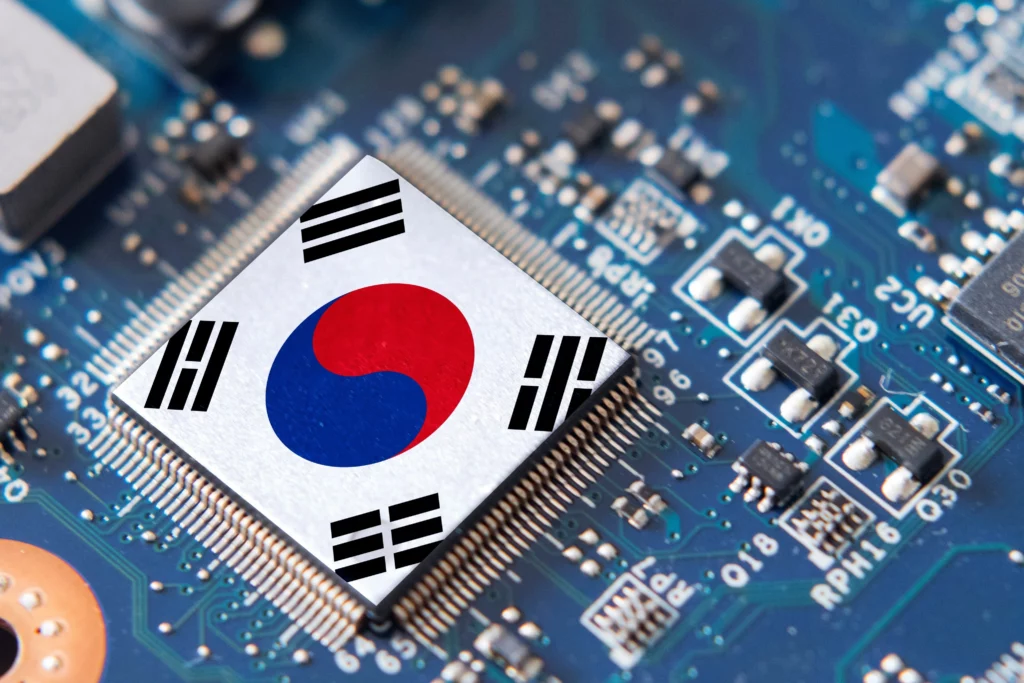
Semiconductors powered this export surge. Shipments of chips, South Korea’s top export, jumped 17.2% to $11.7 billion, the strongest April performance for the sector.
This growth followed a recovery in DRAM prices and rising demand for high-bandwidth memory chips. Wireless communication devices and biopharmaceuticals also posted strong gains, rising 26.5% and 21.8%, respectively.
However, the story behind the headline numbers reveals pressure points. U.S. tariffs, introduced by President Trump, weighed heavily on key sectors. A 25% tariff on auto imports and a 10% blanket tariff on all goods hit South Korean automakers hard.
Automobile exports dropped 3.8% to $6.5 billion, and total shipments to the U.S. fell 6.8% to $10.6 billion. The decline in U.S.-bound trade offset gains in other markets. Despite these challenges, South Korea’s export engine found new momentum in other regions.
South Korea’s Trade Performance Amid Global Shifts
Exports to China rose 3.9%, while sales to the European Union surged 18.4% to a record $6.7 billion. Shipments to ASEAN countries also grew 4.5%. Steel exports increased by 5.4%, breaking a three-month losing streak.
The trade surplus, while slightly below March’s figure, still beat expectations and reflected the country’s ability to adapt. Factories moved quickly to ship goods ahead of tariff deadlines, and the high-tech sector’s strength balanced out weaknesses in traditional manufacturing.
The government continues to negotiate with the U.S. to ease tariff pressures, but the risk of renewed trade barriers remains. South Korea’s export performance in April highlights a shift in global trade dynamics.
The country’s reliance on semiconductors and advanced technology has helped it weather tariff headwinds, but the vulnerability of its automotive sector and dependence on major markets like the U.S. remain clear.
The data shows resilience and adaptability, but also underscores the risks facing South Korea’s trade-dependent economy as global policies shift.
This article was produced by The Rio Times’ automated newsroom system. How we use AI · Report an error · Editorial responsibility: Matthias Camenzind, Editor-in-Chief