Russia faces severe Western sanctions due to its invasion of Ukraine. In response, the country is exploring cryptocurrencies to maintain international trade and financial stability.
Both the Central Bank and the Finance Ministry are pushing for legislation to legalize cryptocurrencies for cross-border payments, aiming for enactment by September 1.
Historically, Russia’s central bank has resisted cryptocurrencies, citing financial stability concerns.
However, economic pressures have softened this stance. The bank now supports using digital currencies experimentally for international settlements.
This change aims to ease the impact of sanctions and exclusion from traditional systems like SWIFT.
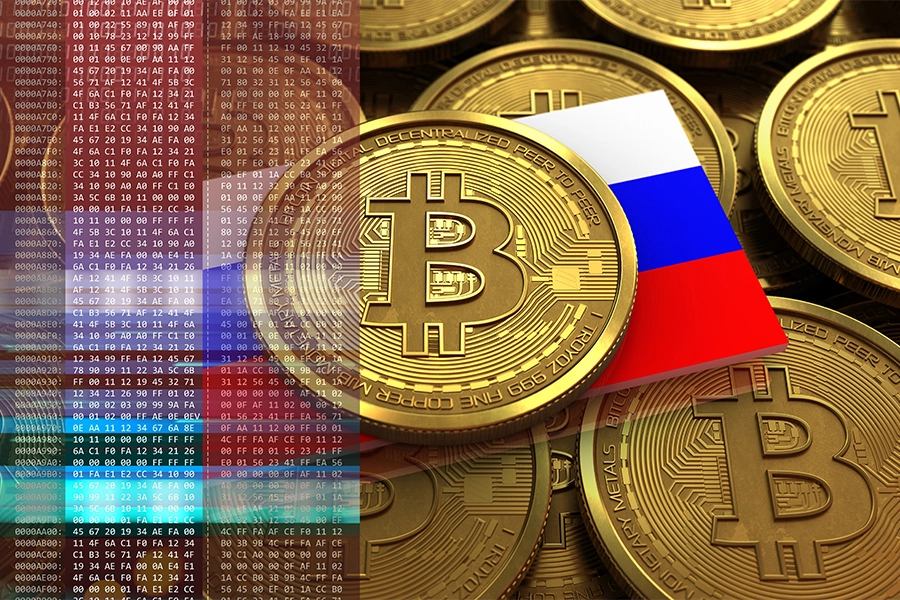
Cryptocurrencies provide a decentralized banking alternative, enabling peer-to-peer transfers without intermediaries.
This feature appeals to Russian businesses and individuals aiming to protect assets and continue trade.
Risks, Challenges, and Global Reactions
The Russian Export Center (REC) is piloting a digital sandbox for cross-border crypto transactions, working with the Central Bank and other regulators to address potential risks.
Despite potential benefits, using cryptocurrencies to evade sanctions presents challenges. Digital currencies’ volatility and blockchain transparency complicate large-scale adoption.
Experts argue cryptocurrencies may only help Russia minimally due to blockchain transparency, which allows easier tracking and enforcement by regulators.
Western nations criticize this move, urging stricter measures to prevent Russia from bypassing sanctions using digital assets.
U.S. and EU lawmakers highlight that while cryptocurrencies offer some anonymity, blockchain transparency can help track illicit activities.
Russia’s strategy mirrors that of other sanctioned nations like Iran and North Korea, which used cryptocurrencies for trade and to mitigate sanctions’ impacts.
However, Russia’s larger, more complex economy presents unique challenges in replicating these strategies effectively.
As Russia pursues cryptocurrency legalization and regulation for international payments, the global financial community watches closely.
This initiative’s success or failure could set a precedent for how countries navigate economic sanctions in the digital age.
The outcomes will significantly impact Russia’s economy, global financial stability, and the future role of digital currencies in international trade.
Live Market IntelligenceCrypto — Live Market Board
Rio Times · Live Market Intelligence
Crypto — Live Market Board
-0.26%
| Instrument | Last | Change | YoY | Prev. | High | Low | Volume |
|---|---|---|---|---|---|---|---|
| BTC | 63,384 | -0.26% | -47.24% | 63,552 | 64,346 | 63,305 | 22,774,743,040 |
| ETH | 1,886 | +0.26% | -58.90% | 1,881 | 1,920 | 1,879 | 7,916,475,392 |
| SOL | 75.89 | -0.40% | -60.44% | 76.20 | 76.99 | 75.39 | 1,473,821,056 |
| XRP | 1.01 | -1.15% | -69.07% | 1.02 | 1.02 | 1.01 | 1,144,044,416 |
| BNB | 609.60 | -1.12% | -26.81% | 616.50 | 619.30 | 609.23 | 1,266,706,432 |
| ADA | 0.18 | -1.98% | -78.22% | 0.19 | 0.19 | 0.18 | 238,085,632 |
| DOGE | 0.07 | -1.56% | -70.00% | 0.07 | 0.07 | 0.07 | 553,256,192 |
| AVAX | 6.38 | +1.04% | -74.11% | 6.32 | 6.42 | 6.21 | 248,470,560 |
| LINK | 8.77 | -0.06% | -62.73% | 8.77 | 8.87 | 8.68 | 317,054,880 |
| DOT | 0.78 | -0.75% | -81.11% | 0.79 | 0.80 | 0.78 | 43,490,492 |
| LTC | 45.08 | -0.85% | -65.45% | 45.47 | 45.59 | 44.98 | 143,727,712 |
| BCH | 213.85 | +0.10% | -65.44% | 213.64 | 215.69 | 212.54 | 137,956,688 |
| TRX | 0.34 | +0.28% | -4.73% | 0.33 | 0.34 | 0.33 | 436,576,064 |
| XLM | 0.16 | -1.33% | -64.46% | 0.16 | 0.16 | 0.16 | 89,559,864 |
| HBAR | 0.07 | -0.53% | -74.67% | 0.07 | 0.07 | 0.07 | 22,546,186 |
| NEAR | 1.65 | +2.42% | -40.55% | 1.62 | 1.68 | 1.61 | 187,591,264 |
| ATOM | 1.40 | -2.36% | -70.15% | 1.44 | 1.44 | 1.40 | 18,626,964 |
| AAVE | 89.06 | +0.93% | -72.33% | 88.24 | 90.20 | 88.19 | 129,099,704 |
This article was produced by The Rio Times’ automated newsroom system. How we use AI · Report an error
Read More from The Rio Times