Key Facts
- US crude inventories saw a surprise build of 9.072 million barrels the American Petroleum Institute reported, smashing expectations for a 500,000-barrel draw and the prior week’s 2.69-million-barrel rise.
- Traffic through the Strait of Hormuz sank to just six commodity vessels on Monday, according to Reuters, down from an 11-ship ten-day average, as Iran stated the waterway will remain closed until the United States ends the war and meets Tehran’s conditions.
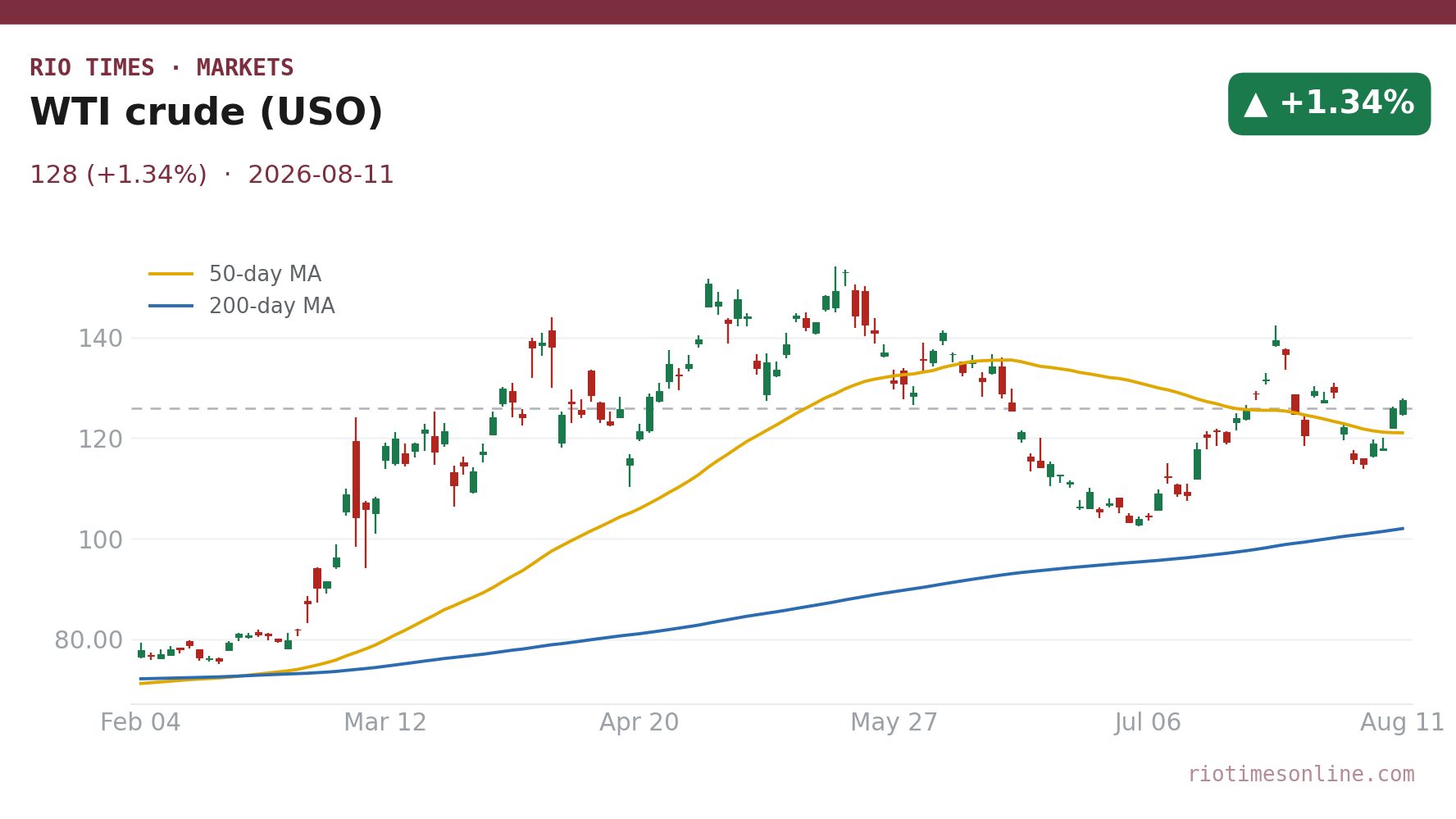
- The WTI-tracking USO fund settled at US$127.61 a gain of 1.34 percent on the day, reflecting persistent supply-fear premiums even as a surprising stockbuild in the United States argued for looser physical markets.
- Petrobrás’s New York shares fell 2.18 percent to US$17.93 bucking the crude rally as local Brazilian political noise and a sharp 2.50 percent drop in the Ibovespa index dragged the state-controlled producer lower.
- Argentina’s YPF slumped 3.51 percent to US$49.15 the steepest drop among the proxy names, as concerns over Vaca Muerta’s export pace and Argentina’s domestic fiscal tightening outweighed any Brent tailwind.
- Russia’s seaborne crude exports dropped to 3.71 million barrels per day in the four weeks through August 9 the lowest since May, as recovering domestic refinery runs and loading disruptions at key ports pulled barrels away from export markets.
Today’s Focus
Oil markets climbed further into crisis territory on Tuesday even as a startling US inventory report would normally crush prices. The American Petroleum Institute estimated a 9.072-million-barrel build in crude stocks last week, a colossal miss against forecasts for a 500,000-barrel draw. Yet the WTI-tracking USO fund still settled at US$127.61, up 1.34% on the day, because the supply threat is now entirely dominated by Iran’s closure of the Strait of Hormuz.
Only six commodity vessels transited the strait on Monday, according to vessel-tracking data, down from an 11-vessel ten-day average. a senior Iranian official said on Tuesday that the chokepoint will stay shut unless the United States ends the war and meets Tehran’s conditions. That position effectively ties a fifth of the world’s oil trade to an unconditional American concession, driving Brent toward US$87 and reviving chatter of a US$100 barrel.
While crude futures soared, the Latin American equity proxies split violently. Petrobrás shares in New York fell -2.18% to US$17.93 as the Ibovespa’s 2.50 percent rout on domestic fiscal angst overwhelmed any pre-salt cash-flow gleam. Argentina’s YPF was hit harder still, dropping -3.51% to US$49.15 because Vaca Muerta’s shale boom needs open sea lanes and predictable pricing, not a Hormuz-driven super-spike that throttles importers. Colombia’s Ecopetrol barely budged, shedding -0.23% to US$17.01, as its heavier crude basket is less directly wired to short-term Brent moves.
The geopolitical bid also absorbed what would otherwise be a deeply bearish secondary signal out of Moscow. Russia’s seaborne crude exports fell to 3.71 million barrels per day in the four weeks through August 9, the lowest since May, as recovering domestic refinery runs and port disruptions kept barrels at home. That tightening should squeeze Asian buyers, particularly Chinese refiners watching their own inventories shrink, but with Hormuz shut the market’s supply anxiety is entirely focused on the Persian Gulf rather than the Baltic or Black Sea.
What matters today. The Strait of Hormuz closure is now a stated Iranian negotiation tactic, not a temporary disruption, and it is overriding every other physical supply-demand signal, including a colossal US inventory build.

01 The session in one read
The WTI-tracking USO fund rallied to US$127.61, a 1.34% gain, during a Tuesday session in which a massive American inventory build would ordinarily have crushed prices. Instead, traders shrugged off the American Petroleum Institute estimate of a 9.072-million-barrel crude stockpile increase and kept buying, because Iran declared the Strait of Hormuz will stay closed unless the United States ends its military operations and meets Tehran’s demands.
That statement by a senior Iranian official, was the session’s only real price driver. With vessel traffic through the chokepoint collapsing to just six ships on Tuesday, the market is now pricing a prolonged outage of the waterway that carries roughly a fifth of global oil trade. Russia’s simultaneous export drop to 3.71 million barrels per day—the lowest since May—tightened supply further but was treated as a footnote compared to events in the Persian Gulf.
Tuesday’s session confirmed that the oil market is trading a single variable: whether Iranian and American officials can cut a deal to reopen the Strait of Hormuz. The API’s 9-million-barrel inventory build should have sent crude sharply lower, yet the USO fund rallied more than one percent because traders cannot price a market whose main artery is sealed. For Latin American producers, the split is stark. Brazil’s Petrobrás and Argentina’s YPF are seeing their equities pressured by local risk factors—a tumbling Ibovespa and Vaca Muerta’s evacuation timeline, respectively—while the pure-play crude rally is being captured only by instruments that track the front-month futures in New York and London. The variable to watch is the United States response to Iran’s explicit demand that Washington end hostilities before tanker traffic resumes; a refusal guarantees triple-digit Brent, and a capitulation would trigger the steepest single-day oil crash since the pandemic.
02 The board
The producer proxies across the Americas told a fractured story. The WTI-tracking USO fund advanced 1.34% to US$127.61, buoyed solely by the Hormuz supply panic. Yet Brazil’s Petrobrás slid -2.18% to US$17.93 in New York trading, carved lower by a 2.50 percent tumble in the Ibovespa that had nothing to do with oil and everything to do with Brasília’s latest fiscal standoff. Pre-salt output remains at record levels but the equity is hostage to domestic risk.
Argentina’s YPF was the session’s worst performer among the names on the board, slumping -3.51% to US$49.15. Investors are increasingly anxious that Vaca Muerta’s shale growth narrative requires orderly global trade lanes and solvent buyers, not a US$100-oil panic that triggers demand destruction. Colombia’s Ecopetrol took a quieter but still negative path, falling -0.23% to US$17.01, as its heavier crude basket offered no defence against broad regional equity weakness.
| Asset | Level | Change |
|---|---|---|
| WTI crude (USO) | US$127.61 | +1.34% |
| Petrobrás | US$17.93 | -2.18% |
| Ecopetrol | US$17.01 | -0.23% |
| YPF | US$49.15 | -3.51% |
Source: RT close, 2026-08-11. Where a commodity has no spot feed, an exchange-traded tracker or leading producer is shown as a labelled proxy.
Live Market IntelligenceThe live market board
Rio Times · Live Market Intelligence
Latin America — Cross-Market Board
| Instrument | Last | Change | YoY | Prev. | High | Low | Volume |
|---|---|---|---|---|---|---|---|
| IBOV | 183,476.86 | -0.27% | +21.85% | 183,965.91 | 168,310 | 167,142 | — |
| IPSA | 11,255.90 | -0.39% | — | 11,299.82 | 11,210 | 10,984 | 1,513,213,483 |
| IPC MEX | 64,992.23 | +1.13% | +12.17% | 64,264.16 | 66,121 | 65,405 | 108,886,187 |
| MERVAL | 2,893,751 | -1.57% | +30.51% | 3,022,485 | 3,042,365 | 2,991,150 | — |
| COLCAP | 2,584.72 | -0.95% | — | 9.04 | 9.05 | 9.02 | 4,133 |
| BVL PERÚ | 59,934.37 | +1.27% | — | — | — | — | — |
| USD/BRL | 5.16 | +0.01% | -5.13% | 5.16 | 5.18 | 5.14 | — |
| EUR/BRL | 5.95 | +1.01% | -5.83% | 5.89 | 5.98 | 5.94 | — |
| USD/MXN | 17.06 | -0.24% | -8.58% | 17.10 | 17.08 | 17.01 | — |
| USD/CLP | 913.98 | +0.04% | -5.67% | 913.65 | 915.11 | 906.68 | — |
| USD/COP | 3,140 | +0.03% | -22.04% | 3,139 | 3,141 | 3,105 | — |
| USD/PEN | 3.36 | -0.66% | -4.82% | 3.38 | 3.38 | 3.35 | — |
| USD/ARS | 1,493 | +0.10% | +12.96% | 1,491 | 1,494 | 1,480 | — |
| USD/UYU | 40.27 | +1.24% | +1.80% | 39.77 | 40.27 | 40.23 | — |
| USD/PYG | 5,939 | +1.68% | -19.54% | 5,841 | 5,939 | 5,925 | — |
| USD/BOB | 11.64 | -0.76% | +72.04% | 11.73 | 11.72 | 11.64 | — |
| USD/DOP | 58.34 | +1.25% | -3.44% | 57.62 | 58.34 | 58.04 | — |
| USD/CRC | 445.92 | +0.89% | -9.71% | 441.97 | 448.50 | 445.92 | — |
03 What moved it
The Hormuz shutdown intensified because diplomacy collapsed. Iran framed the closure not as a temporary pressure tactic but as a permanent condition tied to America ending a war and accepting Iranian terms. That remade the Strait from a geopolitical chokepoint into a full-blown embargo wall, leaving just six commodity vessels daring the passage on Tuesday compared to an 11-ship ten-day average.
The surprise 9.072-million-barrel US inventory build reported by the API should have been the day’s dominant story. It missed analyst calls for a 500,000-barrel draw by an extraordinary margin and followed a 2.69-million-barrel build the week before. In a normal session that would have pushed WTI sharply lower; instead it was ignored, because no quantity of American storage can offset losing the Strait of Hormuz.
Russia’s export decline to 3.71 million barrels per day added a tightening impulse that would normally attract buying in Asian hours. But with China’s crude inventories shrinking and Iranian barrels physically unavailable, Beijing’s refineries are being squeezed, and the market is quietly banking on a Chinese buying spree for Russian and non-Iranian grades once the panic eases.
04 The Latin American read
Brazil’s pre-salt deep-water fields should be a global safe-haven bet in a supply crisis, yet Petrobrás American depositary receipts fell -2.18% to US$17.93. The culprit was a brutal 2.50 percent Ibovespa sell-off rooted in domestic politics, not geology. Foreign investors treat Petrobrás as a play on Rio’s and Brasília’s policy risk, not just a pure crude producer, and on Tuesday that tradition was punishing.
Argentina’s YPF suffered a deeper cut, falling -3.51% to US$49.15, because Vaca Muerta’s growth story depends on visible, predictable export routes. A Hormuz-driven crude spike that slams global growth and import demand is exactly the nightmare scenario for Neuquén’s shale patch, and the share price reflected that anxiety unvarnished. Guyana’s Exxon-led boom, by contrast, is being treated as a quiet beneficiary because its light sweet crude moves through open Atlantic waters without needing Hormuz, though the country lacks a proxy on Tuesday’s board.
05 The names to watch
Petrobrás (US$17.93, -2.18 percent) is now in a tug-of-war between pre-salt production records and the Ibovespa’s domestic fiscal tailspin. If the local equity benchmark stabilises, the crude tailwind should eventually lift the stock; until then, it is a Brazil trade first and an oil trade second.
Argentina’s YPF (US$49.15, -3.51 percent) is the most vulnerable to a sustained Hormuz crisis because high oil prices driven by a supply seizure, rather than strong demand, compress the global economic growth that Vaca Muerta’s export ramp needs. Ecopetrol (US$17.01, -0.23 percent) showed defensive resilience relative to peers, but Colombia’s production growth is too modest to attract a serious flight-to-non-Iranian-oil bid.
06 The outlook
Oil traders will watch Wednesday’s American consumer-price-inflation report as the secondary variable that could make or break a Federal Reserve policy pivot, but the primary driver remains the Strait of Hormuz. Gold holding above US$4,370 alongside crude confirms the market is pricing both a supply catastrophe and a potential stagflationary impulse. Unless Washington or Tehran blinks, every Latin American producer equity that struggles to track its resource will continue to frustrate investors who expect a geopolitical windfall.
07 What to watch
- US CPI release Wednesday: A hot print could revive Federal Reserve rate-hike bets, strengthening the dollar and punishing emerging-market equities like Petrobrás and YPF even if crude stays elevated.
- EIA inventories and the IEA/OPEC monthly reports: The EIA’s weekly crude stocks land Wednesday at 10:30 a.m. New York, following the API’s reported build; the IEA and OPEC monthly reports the same morning will reset demand-growth expectations for the rest of 2026.
- Strait of Hormuz vessel count: If daily transits stay in single digits for a third consecutive session, Brent’s push toward US$100 will accelerate and Latin American importers like Chile and Central America will face acute cost pressure.
- Petrobrás-Ibovespa correlation: The state giant’s shares are tracking Brazil’s broad index more closely than crude; a continued Ibovespa slide below 167,000 would likely drag Petrobrás ADRs lower regardless of Brent’s moves.
- YPF and Vaca Muerta export logistics: Argentina’s shale shipments need open Asian demand channels; any sign that Chinese refineries are accepting delayed deliveries would ease the equity’s underperformance.
Frequently Asked Questions
Why did WTI rise despite a huge US inventory build?
The API reported a 9.072-million-barrel build, far exceeding the expected draw, but Iran’s closure of the Strait of Hormuz is a supply threat so large that it entirely overrode the bearish American storage data.
Why did Petrobrás shares fall when crude oil rallied?
Petrobrás dropped 2.18 percent to US$17.93 because Brazil’s Ibovespa index plunged 2.50 percent on domestic fiscal and political concerns. Foreign investors treat the stock as a Brazilian risk proxy, not a pure crude play.
What did Iran say about the Strait of Hormuz on Tuesday?
a senior Iranian official said the Strait will remain closed until the United States ends the war and meets Tehran’s conditions, framing the blockage as a negotiation demand rather than a temporary disruption.
How is the Hormuz crisis affecting Latin American producers differently?
Brazil’s Petrobrás and Argentina’s YPF both fell because local political and fiscal risks are overriding the oil price surge. Colombian Ecopetrol shed just 0.23 percent, showing relative resilience, but none of the region’s listed producers are capturing Brent’s rally fully.
This article was produced by The Rio Times’ automated newsroom system. How we use AI · Report an error
LatAm Markets: Live Signals → — real-time movers, turnover leaders and FX across Latin America.
Read More from The Rio Times