Key Facts
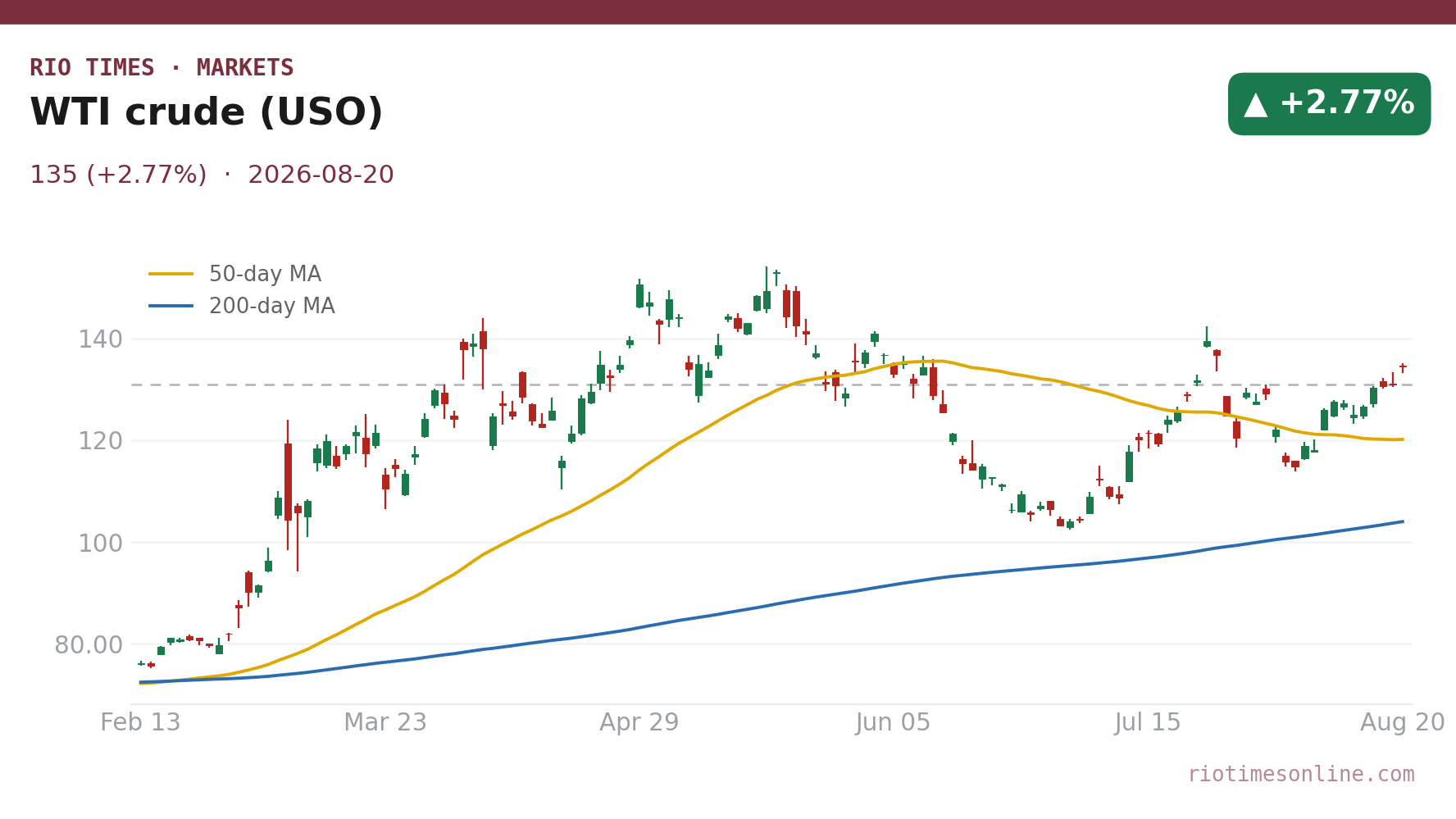
- USO closed up 2.77% at US$134.54 as investors priced in persistent Strait of Hormuz supply risk and a broader Middle East geopolitical premium into the WTI-tracking fund.
- Petrobras gained 2.54% to US$19.01 supported by record Q2 pre-salt output of 2.78 MMboe/d and the Tupi field crossing 4 billion barrels of cumulative production.
- Ecopetrol fell 1.34% to US$17.65 bucking the regional trend even as the Colombian state firm is among 19 qualified bidders for the fourth cycle of Brazil’s permanent production-sharing offer.
- YPF rose 1.72% to US$50.92 recouping some of Wednesday’s 3.83% drop as Vaca Muerta shale expectations continued to drive the Argentine producer more than daily Brent moves.
- Brent settled at US$93.41 a barrel, down 0.39% on the day but more than 5% higher on the week, as no major new Middle East trigger emerged but supply risk near Hormuz kept a floor under crude.
- Guyana’s Stabroek state share hit 39.8% after the Exxon-led consortium cut compensation oil to roughly one-fifth of output, lifting the government’s take from about 14.5% without amending the 2016 contract.
Today’s Focus
The WTI-tracking USO fund jumped 2.77% to US$134.54 on Thursday, August 20, while Brent settled at US$93.41, as lingering Hormuz supply risk kept crude elevated even without a fresh trigger.
Latin American equities split: Petrobras rose 2.54% to US$19.01 on record pre-salt output and the Tupi milestone, YPF added 1.72% to US$50.92 on Vaca Muerta expectations, but Ecopetrol slipped 1.34% to US$17.65.
Guyana’s government announced its Stabroek block take has climbed to 39.8% of output as cost recovery shrinks, a fiscal shift that matters for ExxonMobil, Chevron and CNOOC investors.
Brazil’s policy push also moved the story: a CNPE resolution approved on 30 July lets PPSA auction the Union’s pre-salt gas directly, potentially cutting industrial prices from around US$12 to US$5 per million BTU.
What matters today. Crude’s geopolitical premium is real and rising, but Latin America’s own supply and policy stories are increasingly shaping how Petrobras, YPF and Ecopetrol trade.
01 The session in one read
The WTI-tracking United States Oil Fund closed at US$134.54, up 2.77%, on Thursday, August 20, as crude markets kept a geopolitical premium tied to the Strait of Hormuz and the wider Middle East.
Brent settled at US$93.41 a barrel, down 0.39% on the day but more than 5% higher on the week, a signal that no new trigger emerged but supply risk remained priced in.
Among Latin American proxies, Petrobras added 2.54% to US$19.01, YPF gained 1.72% to US$50.92, while Ecopetrol diverged with a 1.34% decline to US$17.65.
Thursday’s session showed the Gulf’s chokepoint risk acting as a tide that lifts US crude proxies sharply, while Latin American producers moved on their own fundamentals. Brent settled at US$93.41, down 0.39% on the day but more than 5% higher on the week. Brazil’s pre-salt records, Guyana’s improving fiscal take and Argentina’s shale optimism give the region a growth narrative that a single flat session cannot capture. The variable to watch is whether any actual disruption at Bab el-Mandeb or Hormuz pushes USO beyond its Thursday surge of 2.77%.
02 The board
The WTI-tracking USO fund’s 2.77% surge to US$134.54 stood out as the strongest move on the board, reflecting front-month futures exposure rather than a spot barrel.
Petrobras at US$19.01, up 2.54%, captured Brazil’s pre-salt production momentum, while YPF at US$50.92, up 1.72%, showed Vaca Muerta expectations still supporting the Argentine producer.
Ecopetrol at US$17.65, down 1.34%, was the outlier, despite the Colombian firm’s presence among 19 qualified bidders in the fourth cycle of Brazil’s permanent production-sharing offer.
| Asset | Level | Change |
|---|---|---|
| WTI crude (USO) | US$134.54 | +2.77% |
| Petrobras | US$19.01 | +2.54% |
| Ecopetrol | US$17.65 | -1.34% |
| YPF | US$50.92 | +1.72% |
Source: RT close, 2026-08-20. Where a commodity has no spot feed, an exchange-traded tracker or leading producer is shown as a labelled proxy.
Live Market IntelligenceThe live market board
Rio Times · Live Market Intelligence
Latin America — Cross-Market Board
| Instrument | Last | Change | YoY | Prev. | High | Low | Volume |
|---|---|---|---|---|---|---|---|
| IBOV | 167,927.15 | +0.06% | +21.85% | 167,830.27 | 168,310 | 167,142 | — |
| IPSA | 11,237.90 | -0.03% | — | 11,241.32 | 11,210 | 10,984 | 1,513,213,483 |
| IPC MEX | 64,436.38 | +0.68% | +12.17% | 63,999.26 | 66,121 | 65,405 | 108,886,187 |
| MERVAL | 2,875,950 | +0.05% | +30.51% | 3,022,485 | 3,042,365 | 2,991,150 | — |
| COLCAP | 2,444.32 | -0.39% | — | 9.04 | 9.05 | 9.02 | 4,133 |
| BVL PERÚ | 58,380.78 | +0.54% | — | — | — | — | — |
| USD/BRL | 5.16 | +0.01% | -5.13% | 5.16 | 5.18 | 5.14 | — |
| EUR/BRL | 5.95 | +1.01% | -5.83% | 5.89 | 5.98 | 5.94 | — |
| USD/MXN | 17.06 | -0.24% | -8.58% | 17.10 | 17.08 | 17.01 | — |
| USD/CLP | 913.98 | +0.04% | -5.67% | 913.65 | 915.11 | 906.68 | — |
| USD/COP | 3,140 | +0.03% | -22.04% | 3,139 | 3,141 | 3,105 | — |
| USD/PEN | 3.36 | -0.66% | -4.82% | 3.38 | 3.38 | 3.35 | — |
| USD/ARS | 1,493 | +0.10% | +12.96% | 1,491 | 1,494 | 1,480 | — |
| USD/UYU | 40.27 | +1.24% | +1.80% | 39.77 | 40.27 | 40.23 | — |
| USD/PYG | 5,939 | +1.68% | -19.54% | 5,841 | 5,939 | 5,925 | — |
| USD/BOB | 11.64 | -0.76% | +72.04% | 11.73 | 11.72 | 11.64 | — |
| USD/DOP | 58.34 | +1.25% | -3.44% | 57.62 | 58.34 | 58.04 | — |
| USD/CRC | 445.92 | +0.89% | -9.71% | 441.97 | 448.50 | 445.92 | — |
03 What moved it
Global crude stayed elevated because the closure of the Strait of Hormuz removed or disrupted one of the world’s largest oil flows, and Thursday’s session showed the market unwilling to shed that premium even without a fresh headline.
Houthi moves to tighten control of the Bab el-Mandeb Strait added a second chokepoint concern, reinforcing fears that marine traffic through critical shipping lanes could face further disruption.
China’s shift toward more Russian crude, estimated at 1.25 million barrels per day in August, squeezed Indian refiners out and reshaped flows, keeping Asian demand for alternative barrels intense.
04 The Latin American read
Brazil’s pre-salt story remains the region’s strongest supply narrative: Petrobras produced a record 2.78 million barrels of oil equivalent per day from operated pre-salt fields in Q2 2026, and Tupi became the first field in company history to exceed 4 billion barrels of cumulative output.
The CNPE resolution approved on 30 July, letting PPSA auction the Union’s pre-salt gas directly could cut industrial gas costs from about US$12 to US$5 per million BTU, weakening Petrobras’ marketing monopoly and lowering energy costs for Brazilian industry.
Guyana’s announcement that the state share of Stabroek output reached 39.8%, up from about 14.5% at peak cost recovery, shows how the Exxon-led consortium’s milestone of reducing compensation oil to roughly one-fifth of production is transforming the country’s fiscal position.
YPF’s gain to US$50.92 reflects investors still favouring Vaca Muerta’s shale potential, with the Argentine producer proving more sensitive to domestic shale expectations than to a single session’s crude move.
05 The names to watch
Petrobras remains the anchor for deepwater growth, with the Equatorial Margin’s FZA-M-59 well showing hydrocarbon presence but no volumes yet, and company executives cautioning that commercial viability is still unknown.
Ecopetrol’s participation alongside Repsol in Brazil’s pre-salt auction signals Colombian interest in diversifying beyond its own maturing fields, even as Thursday’s share price fell.
ExxonMobil, Chevron and CNOOC matter for Guyana, where the Whiptail project is expected to lift Stabroek gross capacity to about 1.3 million barrels per day by end-2027, adding a further 250,000 bpd.
06 The outlook
The market heads into next week with crude holding a Hormuz-driven premium and Latin American producers trading on distinct local catalysts: Brazil’s pre-salt auction progress, Guyana’s fiscal transition and Argentina’s shale momentum.
With no de-escalation in the Gulf shipping lanes visible, the WTI-tracking USO could remain bid, while Petrobras and YPF may extend gains if regional production stories stay strong.
07 What to watch
- Hormuz and Bab el-Mandeb: Any confirmed disruption or Houthi coastal seizure could extend the crude premium and push USO higher from US$134.54.
- The fourth cycle of Brazil’s permanent production-sharing offer: The 13 deepwater blocks and 19 qualified bidders, including Ecopetrol and Repsol, will test foreign appetite for offshore Brazil.
- PPSA gas auctions: If short-term auctions between 2026 and 2030 deliver gas near US$5 per million BTU, Brazilian industrial energy costs could fall sharply.
- Guyana’s next quarterly production: With FPSO output at about 869,000 bpd in June and cost recovery shrinking, the state take could rise further from 39.8%.
Frequently Asked Questions
What does USO track?
USO tracks front-month WTI crude futures, not the spot barrel, which is why its 2.77% jump to US$134.54 reflects futures positioning.
Why did Petrobras rise while Brent slipped?
Petrobras rallied 2.54% to US$19.01 on record Q2 pre-salt production of 2.78 MMboe/d and the Tupi field surpassing 4 billion barrels of cumulative output.
Why did Ecopetrol fall?
Ecopetrol dropped 1.34% to US$17.65 despite its pre-salt auction participation, suggesting investors weighed other Colombian operational or fiscal concerns.
What changed in Guyana’s oil contract?
Nothing changed contractually; the state’s share rose to 39.8% because the Exxon-led consortium cut compensation oil to about one-fifth of output, expanding profit oil.
This article was produced by The Rio Times’ automated newsroom system. How we use AI · Report an error
LatAm Markets: Live Signals → — real-time movers, turnover leaders and FX across Latin America.
Read More from The Rio Times