Nationalize the Paraná River: Argentina and the privatizations of the 90s
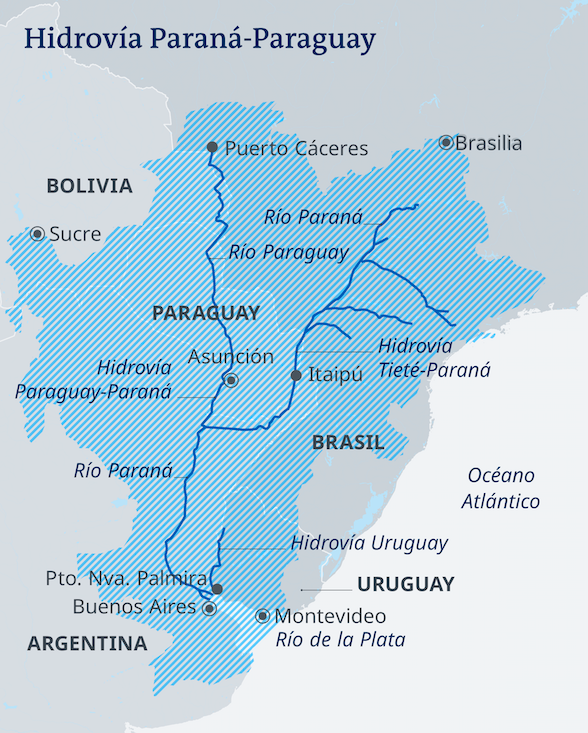
The “Paraná-Paraguay Waterway” is a 3,442 km river transport route that includes the ports of Argentina, Brazil, Bolivia, Paraguay, and Uruguay.
It is key at the geopolitical level: products from five countries go abroad from there.
The Argentine section through the Paraná, the Trunk Navigation System, is 1,635 km long, crosses seven provinces, and is a direct route to the south of Brazil, where 80% of Argentina’s agro-exports are transported and 90% of its imports.
It is part of the Plata Basin, three million square kilometers, one of the most critical water systems on the planet for its biodiversity and the second in importance after the Amazon Basin.
The name “hydrovía” for the Argentine section arose in 1995 when the Peronist government Carlos Menem gave the concession to Hidrovía S.A., formed by the Belgian Jan de Nul and the Argentine Emepa, amid the advance of liberal policies and a wave of privatizations co-directed by the IMF and the World Bank, among others, of the oil company YPF, ports, railways and Aerolineas Argentinas.
Read also: Check out our coverage on Argentina
On August 1, 2022, the Argentine Government extended the maintenance concession with the General Administration of Ports (AGP) for the Main Navigable Way.
This revived demands from various political and intellectual sectors for the definitive nationalization of control over that section of the Paraná River.
The objective would be to prevent the flight of fiscal money, which, according to analysts, would have reached US$30 billion dollars in 2021, as well as smuggling.
They also asked that the Magdalena Canal be built, a new route for direct access to the sea from the ports of Buenos Aires, which could improve fiscal controls by the State.

NATIONALIZE OR BROADEN THE DEBATE?
In Argentina, opinions on the nationalization of the waterway are divided.
In the first place, Carolina Beltramino, chief economist of the IERAL Litoral institute of the Mediterranean Foundation, tells DW, “we must differentiate between the maintenance of the waterway and the state control of exports.
And maintenance should not be mixed with the question of sovereignty. The economic impact of this waterway on the economy depends directly on its efficiency,” she told DW from Rosario, for which its maintenance is critical.
“The Argentine experience shows that when the State was in charge of these works, before 1995, the waterway was not predictable, since the river’s depth was not guaranteed”, she stresses.
“There are few companies at the international level that can carry out the necessary complex works,” she maintains. In her opinion, nationalization would be negative since “the cost of a failure in the Waterway affects the Argentine economy in its setting”.
According to Sergio Arelovich, an economist and professor at the National University of Rosario, the issue should not be limited to privatization or nationalization since “millions of people live in the Paraná basin, and there are small companies that compete for space with large companies, national and international, in a key region for the strategic access to fresh water”.
He affirms that the Argentine State “has export control mechanisms, but it is far from working on an equal footing with foreign companies.”
The problem is the prices at which foreign trade operations are negotiated, which also affect others.
The legal framework in Argentina stems from “years of dictatorship”. It allows for creating a strategy “that benefits multinationals,” highlighting the Mirador de la Actualidad del Trabajo y la Economía de Argentina coordinator.
Arelovich believes that the nationalization of the waterway should be done in stages and that it must be linked to a development program that implies respect for the community and the recovery of the natural dynamics of the river.
“The issue of sovereignty includes the question of for whom it is produced, with what costs, with what fertilizers, not only from a monetary point of view but also from an environmental and ecological one.”
With information from DW
More: Argentina news in English, every day from The Rio Times.
Editorial responsibility: Matthias Camenzind, Editor-in-Chief · Editorial standards · Report an error