Morocco Security Alert After Calls for New Mass Crossing to Ceuta
Morocco · GEOPOLITICS
Key Facts
—Security deployment: Moroccan forces are on high alert around Fnideq after online calls for a new mass crossing into the Spanish enclave of Ceuta.
—Late-July surge: Spain reported roughly 49,000 people crossed into Ceuta in about 24 hours, with about 69,500 returning to Morocco within days.
—Death toll: Reuters reported 72 deaths on the Spanish side and 11 on the Moroccan side, while other outlets placed total fatalities at 18 to 19.
—Spanish response: Madrid deployed military and police reinforcements to Ceuta, and the European Union said it could support Spain through Frontex.
—Shadow economy: The Ceuta-Fnideq corridor sustains an annual smuggling-market turnover of 6 to 8 billion Moroccan dirhams.
—Legal trigger: A Spanish Supreme Court ruling in late June limited summary returns of migrants arriving by sea to Ceuta and Melilla, which smugglers exploited to encourage crossings.
Morocco has placed security forces on high alert in the Fnideq-Ceuta border zone after social-media calls for a renewed mass crossing, weeks after a deadly surge that brought roughly 49,000 people into the Spanish enclave in a single day and exposed the fragility of Europe’s southern frontier.
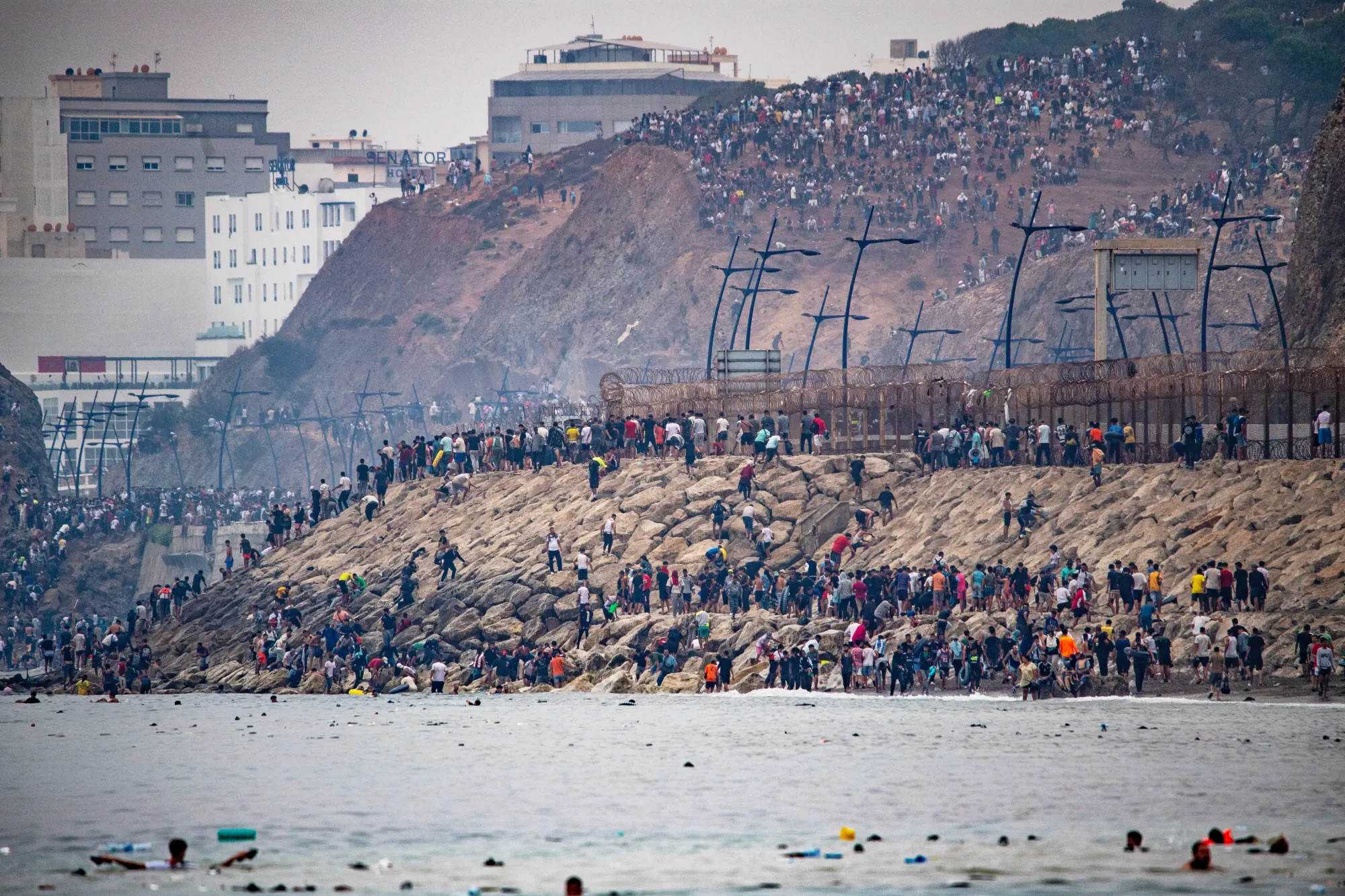
A border on edge after the July surge
Moroccan authorities have maintained a heavy security presence around Fnideq and the roads and coastline leading toward Ceuta after fresh online calls for another mass crossing. Officials have warned against incitement and vowed to dismantle human-trafficking networks that they say exploited social-media rumours to mobilise people.
The alert follows an extraordinary late-July episode in which Spain said roughly 49,000 people crossed into Ceuta over approximately 24 hours. Reuters reported that about 69,500 had returned to Morocco within days, while the official death toll on the Spanish side stood at 72, with 11 deaths recorded on the Moroccan side.
Other outlets reported lower but still staggering figures, including estimates of 50,000 to 60,000 arrivals and at least 18 to 19 deaths. The scale of the movement briefly overwhelmed border control and triggered an emergency response from Madrid, which deployed military and police reinforcements to the enclave.
Why Ceuta is Europe’s most exposed entry point
Ceuta is a Spanish enclave on Morocco’s northern coast, governed by Spain for centuries but claimed by Rabat. It sits directly on the Moroccan border, making it one of the European Union’s most structurally vulnerable entry points for irregular migration.
The enclave’s small size and geographic exposure mean that even modest shifts in Moroccan border enforcement can produce dramatic consequences for Spain. A Spanish Supreme Court ruling in late June limited summary returns of migrants arriving by sea to Ceuta and Melilla, and Spanish officials said smugglers and online rumours quickly exploited that legal change to encourage crossings.
The European Union said it could support Spain through Frontex, the bloc’s border agency, underscoring how a localised crisis on North African soil rapidly becomes a continent-wide concern. The episode revived longstanding disputes over Ceuta’s status and Morocco’s ability to influence flows across the frontier.
The money and power behind the Morocco security alert
The Ceuta-Fnideq corridor has long been tied to a shadow economy and local livelihoods built on smuggling and cross-border trade. One source cites annual smuggling-market turnover of 6 to 8 billion Moroccan dirhams flowing through the corridor, a figure that helps explain why border control is as much an economic question as a security one.
Policy analysts have repeatedly argued that Morocco can use migration flows as leverage in disputes with Spain and the EU, especially when Rabat wants concessions on sovereignty, diplomatic recognition, or other strategic issues. This fits a wider pattern of asymmetric dependence: Spain and the EU need Moroccan cooperation on border control and counter-smuggling, while Morocco benefits from being able to modulate pressure at a frontier that matters politically in Madrid and Brussels.
The latest episode also intersects with the long-running Spanish-Moroccan rivalry over Ceuta and Melilla, which Morocco claims as its own. Both enclaves remain highly symbolic in bilateral relations, and any crisis there tests the durability of three decades of strategic rapprochement between the two countries.
Migration as a geopolitical instrument
The immediate great-power layer is the EU-Spain-Morocco triangle. Brussels wants stable migration control on the southern edge of Europe, Madrid wants order at a sovereign border, and Rabat wants its interests recognised without jeopardising security cooperation or economic ties.
The crisis illustrates how migration has become a geopolitical instrument in Europe’s southern neighbourhood. Movements of people are not only humanitarian or economic events but also pressure points in diplomacy, intelligence, and domestic politics, as the Barcelona-based think tank CIDOB noted in an analysis titled “Ceuta: The weaponisation of migration”.
Reporting suggests Moroccan and Spanish intelligence circles were already alert to the risk of a surge, including claims that social-media rumours and political timing could have played a role. For investors and professionals watching North Africa, the takeaway is that Ceuta is not just a border incident: it is a frontier where state capacity, informal economies, legal rules, and diplomatic leverage collide.
What the Ceuta crisis means for the wider region
The Ceuta flashpoint carries read-throughs for the entire western Mediterranean. It demonstrates that Europe’s southern border remains only as stable as the political bargains underpinning it, and that any rupture in the Morocco-Spain relationship can produce immediate, large-scale consequences.
The episode also highlights the growing role of social media in accelerating migration events. Rumours spread on platforms can mobilise thousands of people within hours, compressing the time available for governments to respond and raising the stakes for intelligence agencies on both sides of the Mediterranean.
For readers following the broader scramble for influence across Africa, the Ceuta crisis fits a pattern of external powers navigating asymmetric dependencies with North African states. The dynamics echo across the continent, as explored in our pillar series Africa: The New Scramble.
What to watch next along the Morocco-Spain frontier
Moroccan authorities have arrested people accused of inciting the renewed crossing attempts, and the heavy security presence around Fnideq is expected to remain in place for the foreseeable future. The immediate question is whether the deterrent holds or whether another surge materialises despite the reinforced deployment.
Madrid and Brussels will be watching closely for any sign that Rabat is recalibrating its border enforcement posture. The episode has already demonstrated that even a brief relaxation can produce a humanitarian and political crisis that reverberates across the European Union.
The longer-term question is whether the crisis accelerates EU investment in border infrastructure and Frontex capabilities, or whether it prompts a deeper renegotiation of the migration cooperation agreements that bind Morocco, Spain, and Brussels. Either outcome would reshape the political economy of the western Mediterranean for years to come.
Frequently Asked Questions
Why has Morocco issued a security alert at the Ceuta border?
Moroccan authorities reinforced the Fnideq-Ceuta border zone after social-media calls for a renewed mass crossing, weeks after roughly 49,000 people crossed into the Spanish enclave in a single day in late July.
How many people died during the July mass crossing into Ceuta?
Reuters reported 72 deaths on the Spanish side and 11 on the Moroccan side, while other outlets placed total fatalities at 18 to 19, confirming the toll reached the dozens.
What role does the Ceuta-Fnideq corridor play in the local economy?
The corridor sustains an annual smuggling-market turnover of 6 to 8 billion Moroccan dirhams, making border control as much an economic question as a security one.
Connected Coverage
The Ceuta crisis illustrates how external powers navigate asymmetric dependencies with North African states, a dynamic explored across the continent in our pillar series Africa: The New Scramble.
Sources
This article was produced by The Rio Times’ automated newsroom system. How we use AI · Report an error
Read More from The Rio Times