Key Facts
- The Global X Lithium & Battery Tech ETF (LIT) rose 3.28% to US$71.69, driven by strength in both lithium miners and Asian battery makers within its diversified portfolio.
- Albemarle Corporation shares advanced 1.78% to US$120.82, as investors assessed the stability of its long-standing Atacama brine operations in Chile.
- Sociedad Química y Minera de Chile (SQM) climbed 2.31% to US$68.58, benefiting from clarity around its renegotiated Atacama contract extending its production role to 2060 alongside state-owned Codelco.
- Arcadium Lithium, the merged Livent-Allkem entity with major Argentine brine assets, settled up at US$5.74, reflecting recalibrated earnings expectations involving peso volatility and import restrictions.
- The rally was underpinned by International Energy Agency data showing electric vehicles claimed roughly one in five new car sales globally in 2023, a pace that keeps lithium central to battery chemistries even as nickel and cobalt intensity falls.
- Chile’s National Lithium Strategy continues to shape valuations, as the public-private model provides contract certainty for incumbents while reserving new strategic salt-flat projects for majority state participation.
Today’s Focus
Lithium equities tracked by the Global X Lithium & Battery Tech ETF (LIT) advanced sharply, with the fund rising 3.28% to US$71.69. Albemarle, a major producer in Chile’s Atacama Desert, added 1.78% to reach US$120.82, while Chilean giant SQM gained 2.31% to close at US$68.58 in New York trading. The moves came as electric-vehicle demand signals from the International Energy Agency reinforced medium-term bullishness for battery raw materials, despite a recent easing in Chinese spot lithium carbonate prices.
In Argentina, Arcadium Lithium—born from the all-stock merger of Livent and Allkem—settled at US$5.74, a rise of 1.06% on the session, as investors weighed the company’s exposure to the country’s decentralised provincial permitting and foreign-exchange volatility. The LIT ETF, which blends upstream miners with downstream battery specialists like BYD, captured the broader value-chain optimism, demonstrating how equity proxies diverge from any single spot commodity quote. The upswing effectively priced in policy continuity in Chile and sustained electric-vehicle adoption rates that underpin long-dated lithium demand.
What matters today. The session showed that lithium equity baskets are trading on contract security and EV adoption rates rather than spot chemical prices alone.

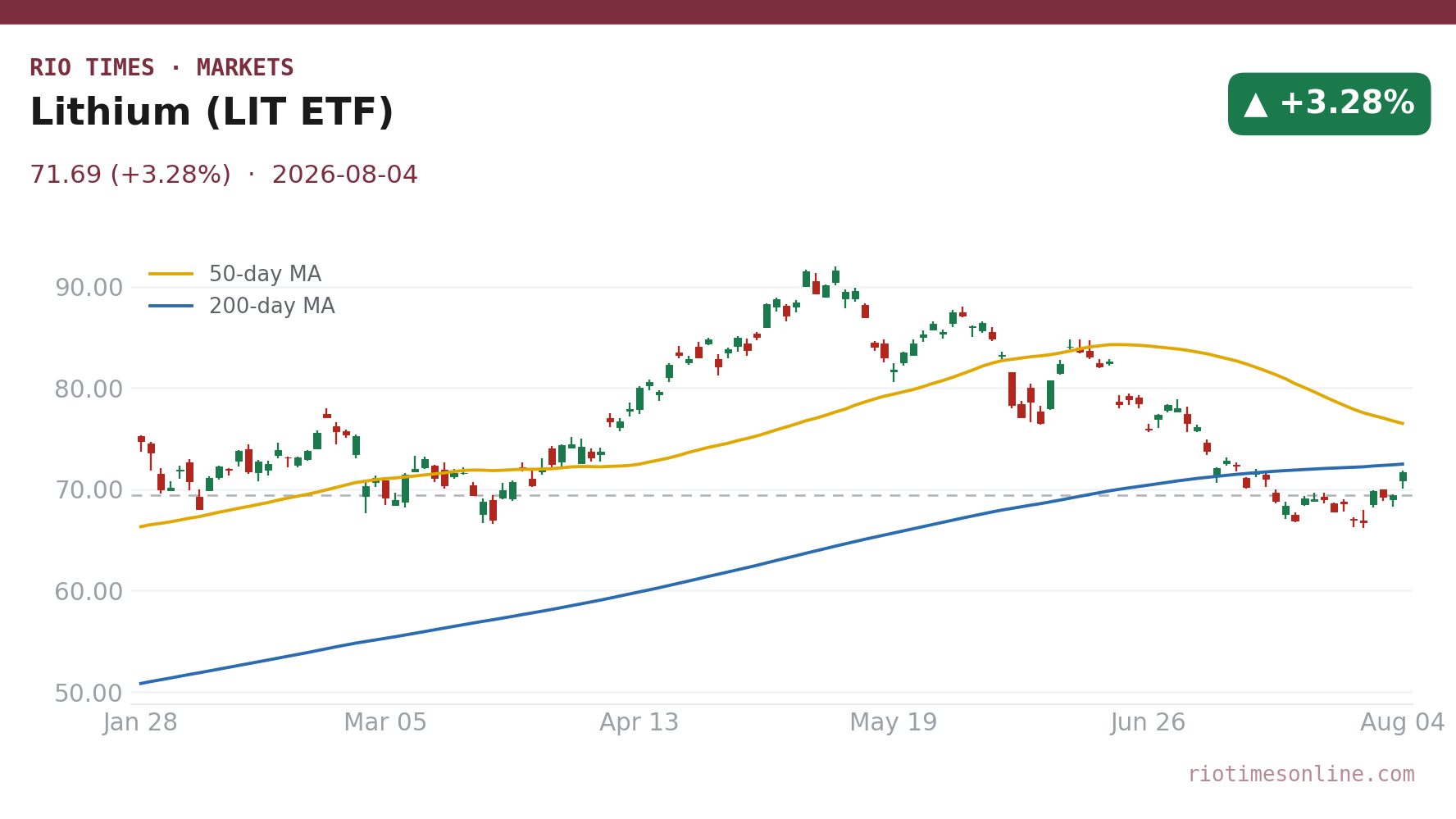
01 The session in one read
Lithium-focused equities reversed recent weakness as the Global X Lithium & Battery Tech ETF (LIT) jumped 3.28% to US$71.69, a move that rippled through major producers from Chile to Argentina. Albemarle shares advanced 1.78% to settle at US$120.82, while Santiago-based SQM saw its New York-traded ADR rise 2.31% to US$68.58.
The session’s gains were propelled by a combination of reassuring contract developments in Chile’s Atacama Desert and durable global electric-vehicle sales data. Arcadium Lithium, the Argentine-focused brine giant formed by the Livent-Allkem merger, edged up 1.06% to US$5.74 as the market absorbed its post-merger earnings profile alongside Argentina’s specific currency and infrastructure risks.
The advance across Albemarle, SQM, and the LIT ETF was a textbook response to the interplay between secure corporate contracts in Chile’s Atacama Desert and robust long-term electric-vehicle demand profiles. With Chile opting for a public-private model rather than outright nationalisation, extending SQM’s lease to 2060 and engaging Albemarle on similar state-partner terms, the policy overhang that had weighed on valuations is partially lifting. Meanwhile, IEA projections that EVs accounted for one in five new car sales globally in 2023 remind investors that battery-grade lithium requirements will compound even as battery chemistry shifts. The variable to watch is whether Argentina’s decentralised and volatile permitting framework allows Arcadium Lithium to scale its Fénix and Salar del Hombre Muerto brine projects fast enough to capture the next demand wave.
02 The board
The LIT ETF, which bundles lithium miners and battery producers into a single New York-listed vehicle, led the charge with a 3.28% daily gain to US$71.69, underscoring momentum across the entire battery supply chain. Albemarle, with its dual exposure to Chilean brine and Australian hard-rock, rose 1.78% to US$120.82, while SQM’s ADR climbed 2.31% to US$68.58, reflecting confidence in its freshly renegotiated Atacama partnership with state-owned Codelco.
Arcadium Lithium, which controls extensive brine operations across Argentina’s Salta and Catamarca provinces, added 1.06% to end the session at US$5.74. The broad advance shows that the market was not just repricing a single jurisdiction but recognising that secured long-term concessions, such as SQM’s extension to 2060, translate into investible cash-flow visibility for foreign capital.
| Asset | Level | Change |
|---|---|---|
| Lithium (LIT ETF) | US$71.69 | +3.28% |
| Albemarle | US$120.82 | +1.78% |
| SQM | US$68.58 | +2.31% |
Source: RT close, 2026-08-04. Where a commodity has no spot feed, an exchange-traded tracker or leading producer is shown as a labelled proxy.
Live Market IntelligenceThe live market board
Rio Times · Live Market Intelligence
Latin America — Cross-Market Board
| Instrument | Last | Change | YoY | Prev. | High | Low | Volume |
|---|---|---|---|---|---|---|---|
| IBOV | 185,229.17 | -0.41% | +21.85% | 185,992.03 | 168,310 | 167,142 | — |
| IPSA | 11,381.18 | +1.30% | — | 11,235.60 | 11,210 | 10,984 | 1,513,213,483 |
| IPC MEX | 63,375.93 | -0.78% | +12.17% | 63,873.32 | 66,121 | 65,405 | 108,886,187 |
| MERVAL | 3,021,926 | -1.29% | +30.51% | 3,022,485 | 3,042,365 | 2,991,150 | — |
| COLCAP | 2,548.22 | +1.05% | — | 9.04 | 9.05 | 9.02 | 4,133 |
| BVL PERÚ | 60,023.65 | -1.13% | — | — | — | — | — |
| USD/BRL | 5.16 | +0.01% | -5.13% | 5.16 | 5.18 | 5.14 | — |
| EUR/BRL | 5.95 | +1.01% | -5.83% | 5.89 | 5.98 | 5.94 | — |
| USD/MXN | 17.06 | -0.24% | -8.58% | 17.10 | 17.08 | 17.01 | — |
| USD/CLP | 913.98 | +0.04% | -5.67% | 913.65 | 915.11 | 906.68 | — |
| USD/COP | 3,140 | +0.03% | -22.04% | 3,139 | 3,141 | 3,105 | — |
| USD/PEN | 3.36 | -0.66% | -4.82% | 3.38 | 3.38 | 3.35 | — |
| USD/ARS | 1,493 | +0.10% | +12.96% | 1,491 | 1,494 | 1,480 | — |
| USD/UYU | 40.27 | +1.24% | +1.80% | 39.77 | 40.27 | 40.23 | — |
| USD/PYG | 5,939 | +1.68% | -19.54% | 5,841 | 5,939 | 5,925 | — |
| USD/BOB | 11.64 | -0.76% | +72.04% | 11.73 | 11.72 | 11.64 | — |
| USD/DOP | 58.34 | +1.25% | -3.44% | 57.62 | 58.34 | 58.04 | — |
| USD/CRC | 445.92 | +0.89% | -9.71% | 441.97 | 448.50 | 445.92 | — |
03 What moved it
Chile’s evolving lithium policy landscape provided a powerful anchor for the rally. The National Lithium Strategy, which seeks majority state participation in new strategic salt flats while preserving the operational roles of Albemarle and SQM in the Atacama, has removed a layer of uncertainty that had capped valuations. Investors saw the binding agreement extending SQM’s contract to 2060 through a joint venture with Codelco as a template for durable public-private coexistence rather than a precursor to resource nationalism.
On the demand side, International Energy Agency data showing that electric vehicles accounted for roughly one in five new car sales globally in 2023 reinforced the long-term case for lithium. Battery chemistry shifts toward lithium iron phosphate (LFP) cathodes keep lithium intensity high even as nickel and cobalt use falls, while automakers like Tesla and BYD continue signing long-term offtake agreements directly with producers. Global equity markets translated this structural demand signal into a bid for lithium proxies, lifting the entire LIT basket despite recent softness in Chinese spot chemical pricing.
04 The Latin American read
For foreign investors, the session crystallised a key distinction within the Lithium Triangle: Chile’s contract-driven model is currently commanding a premium over Argentina’s more fragmented provincial system and Bolivia’s state-controlled inertia. SQM’s 2.31% gain and Albemarle’s 1.78% rise reflect a market view that the Codelco joint-venture structure provides a workable, long-term framework that secures brine extraction rights in the world’s most productive lithium salar.
Argentina’s lithium narrative remains more influenced by macro risk, with Arcadium Lithium navigating foreign-exchange controls and equipment import restrictions at its Fénix and Salar del Hombre Muerto projects. Bolivia, despite holding enormous theoretical resources in the Uyuni and Coipasa salt flats, remains a footnote in equity market moves because its state-centric model and early-stage direct lithium extraction pilots still lack commercial-scale volumes. The LIT ETF’s surge demonstrates that when risk appetite returns, the structured, export-ready portions of the Triangle capture the biggest inflows.
05 The names to watch
The LIT ETF remains the simplest vehicle for gaining diversified lithium exposure without navigating Santiago or Buenos Aires brokerage accounts. Its portfolio weights span Western lithium majors Albemarle and SQM alongside Chinese battery giant BYD and processor Ganfeng Lithium, delivering a price signal that blends mining equity dynamics with downstream battery manufacturing sentiment.
Albemarle and SQM continue to be the bellwethers for foreign capital’s view on Chilean policy risk, with their respective Atacama contracts—Albemarle’s lease runs through 2043 while SQM’s has been extended to 2060—acting as discount-rate anchors. Arcadium Lithium is the name to monitor for the Argentine leg of the Triangle story, where provincial permitting speed and the government’s ability to ease import curbs will determine how fast brines translate into tradable chemicals and earnings.
06 The outlook
The rally reflects a market betting that lithium demand driven by electrification policies across Europe, North America and China can absorb new production from the Lithium Triangle and Australian hard-rock mines. With the IEA flagging years-long timelines from discovery to production, equity proxies like LIT are pricing in scarcity of investible capacity rather than near-term spot price recoveries. The key risk is that Argentina’s macro instability delays brine expansions just as global battery gigafactories require stepped-up feed, leaving Chile-focused producers as the primary beneficiaries of the mid-decade supply squeeze expected by firms like Benchmark Mineral Intelligence and the IEA.
07 What to watch
- Chile-Codelco SQM transition: Track quarterly operational updates from the SQM-Codelco joint venture for any signs of production friction or capex delay as the 2060 lease framework moves from paper to practice.
- Arcadium Lithium Argentine capacity: Monitor Arcadium’s Fénix and Salar del Hombre Muerto output figures alongside Argentine peso policy, since import restrictions on processing equipment can stall brine-to-chemical capacity expansions.
- EV adoption pace in China and Europe: Watch monthly EV registration data as LFP battery chemistry gains share; strong electric-car uptake directly supports lithium-tonne forecasts used to value LIT holdings.
- Bolivia direct lithium extraction progress: Any indication that the CATL-led consortium in Uyuni has cleared pilot-stage hurdles would add a new producing jurisdiction to global supply, potentially weighing on incumbent valuations.
Frequently Asked Questions
Why did lithium equities rise today?
Investors reacted to the combination of durable electric-vehicle demand (EVs were one in five new car sales globally in 2023) and policy clarity in Chile, where renegotiated contracts for SQM and Albemarle have reduced nationalisation fears.
Is the LIT ETF a direct lithium price tracker?
No. LIT is an equity ETF holding shares of lithium miners and battery makers, meaning it responds to company earnings, equity-market sentiment and long-term demand expectations rather than a quoted spot lithium chemical price.
What is Chile’s National Lithium Strategy?
Announced in 2023, it requires majority state participation in new strategic salt-flat projects while letting incumbents like SQM and Albemarle continue under renegotiated terms, balancing state control with private-sector operation.
Why is Argentina riskier for lithium investors?
Argentina’s brine operations depend on provincial permits and are exposed to sharp currency volatility and import restrictions on key equipment, factors that can delay production growth relative to Chilean projects.
This article was produced by The Rio Times’ automated newsroom system. How we use AI · Report an error
LatAm Markets: Live Signals → — real-time movers, turnover leaders and FX across Latin America.
Read More from The Rio Times