
Key Facts
- Iron ore settled essentially flat at US$95.34 per tonne on Monday, August 24, 2026, with the movement driven by China’s restocking rather than new steel demand.
- China’s port inventories fell sharply by 1.24 million tons to 145.54 million tons on Monday, while daily outbound ore volumes rose 48,000 tons.
- Ore buying is outpacing steel production as China’s crude steel output fell about 3% in the first half of 2026 to 499.95 million tons, even as iron ore imports rose 6% in the first seven months to 736.84 million tons.
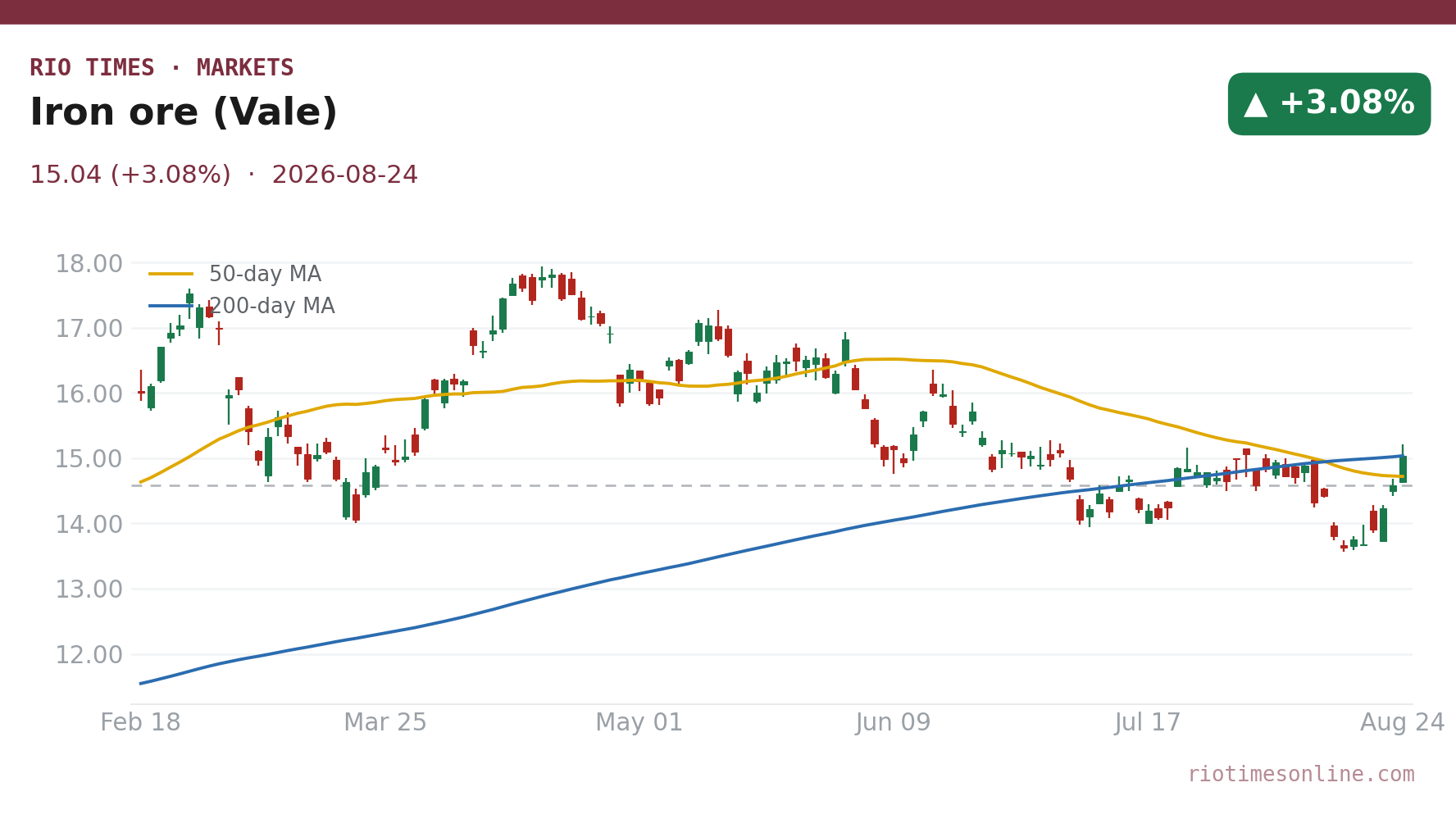
- Vale’s New York shares gained strength closing at US$15.04 for a rise of 3.08% on Monday, acting as a proxy for the iron ore price.
- The session revealed a split board with CSN Mineração up 1.19% to R$5.97 (about US$1.16) in São Paulo, while Rio Tinto edged down 0.47% to US$104.80 in New York.
- China’s July steel output hit a weak milestone coming in at 76.93 million metric tons, down 3.6% from a year earlier and the lowest July reading since 2017.
Today’s Focus
Iron ore settled nearly unmoved at US$95.34 per tonne on Monday, August 24, 2026, but the calm masked a telling divergence beneath the surface.
The buying impulse came from China’s ports, where inventories fell 1.24 million tons to 145.54 million tons and daily outbound volumes rose 48,000 tons, pointing to restocking rather than end-use demand.
That restocking sits against a weakening steel backdrop: China’s crude steel output fell about 3% in the first half to 499.95 million tons, while July steel production hit its weakest level since 2017 at 76.93 million metric tons.
Vale’s New York shares rose 3.08% to US$15.04 as investors used the Brazilian exporter as a liquid proxy for the ore complex.
What matters today. China is rebuilding ore stocks ahead of any policy stimulus even as its steel mills pull back, leaving the market in a fragile balance.
01 The session in one read
Iron ore closed essentially flat at US$95.34 per tonne on Monday, August 24, 2026, but the flatness disguised an active session beneath the headline number.
The trade was driven by China’s restocking: port inventories there fell 1.24 million tons to 145.54 million tons, and daily outbound volumes rose 48,000 tons, a sign that ore is moving from storage into mill stockpiles.
The session’s message is that traders are willing to absorb ore into Chinese ports as a bet on future stimulus, not because mills need more feedstock today. The fall in port inventories combined with rising imports and falling steel output suggests the ore is being stored in anticipation of a demand rebound that has not yet arrived. Watch whether China’s port outbound volumes hold above the 48,000-ton daily increase seen Monday or fade, as that will signal whether restocking has legs beyond a single session.
02 The board
Vale’s New York-listed American depositary receipts, the most watched proxy for the ore complex, closed up 3.08% at US$15.04 on Monday.
In São Paulo, CSN Mineração ended 1.19% higher at R$5.97 (about US$1.16), while Rio Tinto slipped 0.47% to US$104.80 in New York, showing that not every corner of the iron ore equity basket moved in lockstep.
| Asset | Level | Change |
|---|---|---|
| Vale ADR (iron-ore proxy) | US$15.04 | +3.08% |
| CSN Mineração | R$5.97 (about US$1.16) | +1.19% |
| Rio Tinto | US$104.80 | -0.47% |
Source: RT close, 2026-08-24. Where a commodity has no spot feed, an exchange-traded tracker or leading producer is shown as a labelled proxy.
Live Market IntelligenceThe live market board
Rio Times · Live Market Intelligence
Latin America — Cross-Market Board
| Instrument | Last | Change | YoY | Prev. | High | Low | Volume |
|---|---|---|---|---|---|---|---|
| IBOV | 205,079.25 | -0.17% | +21.85% | 205,430.33 | 168,310 | 167,142 | — |
| IPSA | 10,972.40 | +0.02% | — | 10,970.29 | 11,210 | 10,984 | 1,513,213,483 |
| IPC MEX | 68,969.69 | +0.06% | +12.17% | 68,929.72 | 66,121 | 65,405 | 108,886,187 |
| MERVAL | 3,017,221 | — | +30.51% | 3,022,485 | 3,042,365 | 2,991,150 | — |
| COLCAP | 2,521.34 | -1.75% | — | 9.04 | 9.05 | 9.02 | 4,133 |
| BVL PERÚ | 59,664.64 | +0.40% | — | — | — | — | — |
| USD/BRL | 5.16 | +0.01% | -5.13% | 5.16 | 5.18 | 5.14 | — |
| EUR/BRL | 5.95 | +1.01% | -5.83% | 5.89 | 5.98 | 5.94 | — |
| USD/MXN | 17.06 | -0.24% | -8.58% | 17.10 | 17.08 | 17.01 | — |
| USD/CLP | 913.98 | +0.04% | -5.67% | 913.65 | 915.11 | 906.68 | — |
| USD/COP | 3,140 | +0.03% | -22.04% | 3,139 | 3,141 | 3,105 | — |
| USD/PEN | 3.36 | -0.66% | -4.82% | 3.38 | 3.38 | 3.35 | — |
| USD/ARS | 1,493 | +0.10% | +12.96% | 1,491 | 1,494 | 1,480 | — |
| USD/UYU | 40.27 | +1.24% | +1.80% | 39.77 | 40.27 | 40.23 | — |
| USD/PYG | 5,939 | +1.68% | -19.54% | 5,841 | 5,939 | 5,925 | — |
| USD/BOB | 11.64 | -0.76% | +72.04% | 11.73 | 11.72 | 11.64 | — |
| USD/DOP | 58.34 | +1.25% | -3.44% | 57.62 | 58.34 | 58.04 | — |
| USD/CRC | 445.92 | +0.89% | -9.71% | 441.97 | 448.50 | 445.92 | — |
03 What moved it
China’s restocking was the central driver, with port inventories falling 1.24 million tons to 145.54 million tons while outbound volumes rose 48,000 tons, according to market tallies.
Yet the demand picture is not one of steel-driven strength: China’s July steel output fell 3.6% from a year earlier to 76.93 million metric tons, the weakest July since 2017, while first-half crude steel output dropped about 3% to 499.95 million tons.
Imports, by contrast, rose 6% in the first seven months to 736.84 million tons, leaving a clear gap between ore arriving in China and steel being produced.
04 The Latin American read
For Brazil, the session’s upward bias in Vale and CSN shares is a reminder that the local equity market treats iron ore producers as a direct line to Chinese infrastructure and property stimulus expectations.
Investors across Latin America watching the ore complex should note that the Monday move was not about stronger Brazilian shipments or a supply shock, but about Chinese buyers choosing to warehouse more ore.
05 The names to watch
Vale remains the dominant name for foreign investors: its US$15.04 close on Monday came with a 3.08% gain even as the underlying commodity barely moved, underscoring the stock’s liquidity premium.
CSN Mineração at R$5.97 (about US$1.16) offers a domestic Brazilian entry point into the same theme, while Rio Tinto at US$104.80 showed that diversified miners with exposure elsewhere can lag when the ore narrative hinges on Chinese restocking.
06 The outlook
The market enters Tuesday, August 25, 2026, with one clear question: whether China’s port outbound strength of 48,000 daily tons represents the start of a durable restocking cycle or a one-off replenishment.
With Chinese steel output still in contraction and July production at multiyear lows, the ore price will struggle to break decisively higher unless restocking is followed by actual mill demand. The flat US$95.34 settlement frames a market that is waiting, not trending.
07 What to watch
- China port inventories: Watch whether the 1.24-million-ton drop extends into another session, as sustained inventory draws would signal deepening restocking and support ore prices.
- Chinese steel output: July’s 3.6% decline to 76.93 million metric tons sets a weak baseline; any rebound in August output reads would shift the bull case for ore demand.
- Vale ADR momentum: Vale’s 3.08% gain to US$15.04 against a flat ore settlement suggests equity investors may be pricing stimulus faster than the commodity; divergence can’t last long.
- Rio Tinto direction: Rio Tinto’s 0.47% dip to US$104.80 shows the diversified miners are not fully participating in the restocking trade; a reversal here would confirm broader buying.
Frequently Asked Questions
Why did iron ore stay flat on Monday?
Iron ore settled at US$95.34 per tonne because China’s restocking-driven inventory draw offset the drag from weaker steel production, leaving the commodity nearly unchanged.
Why did Vale’s New York shares rise more than the commodity?
Vale ADRs are the most liquid listed proxy for iron ore, so traders often push the stock higher on any sign of Chinese buying, even when the ore price itself barely moves.
Is steel demand in China recovering?
Not yet. China’s July steel output fell 3.6% to 76.93 million metric tons, the weakest July since 2017, while first-half crude steel output fell about 3% to 499.95 million tons.
What signal is China’s port inventory drop sending?
The 1.24-million-ton fall to 145.54 million tons shows ore is moving out of ports into mill or trader stockpiles, which may reflect restocking ahead of expected stimulus rather than immediate consumption.
This article was produced by The Rio Times’ automated newsroom system. How we use AI · Report an error · Editorial responsibility: Matthias Camenzind, Editor-in-Chief
LatAm Markets: Live Signals → — real-time movers, turnover leaders and FX across Latin America.