Key Facts
- —What happened Iron ore settled at US$95.21 per tonne, barely up 0.05%, but Vale’s New York shares jumped 2.53%.
- —How big a jump China’s seven-month ore imports hit 736.84 million tons, up 6% year-on-year despite lower steel output.
- —The catch Mining shares rose sharply while the commodity stayed flat, suggesting positioning rather than a new price trend.
- —Who it touches Brazil’s Vale and CSN Mineração, plus Rio Tinto, all rallied on resilient Chinese demand.
- —What comes next August import data, estimated at 111.16 million tons, will test whether restocking strength continues.
Today’s Focus
Iron ore’s global benchmark settled at US$95.21 per tonne on Friday, August 21, 2026, up 0.05%, keeping the market within the US$93–US$100 band that has held since June.
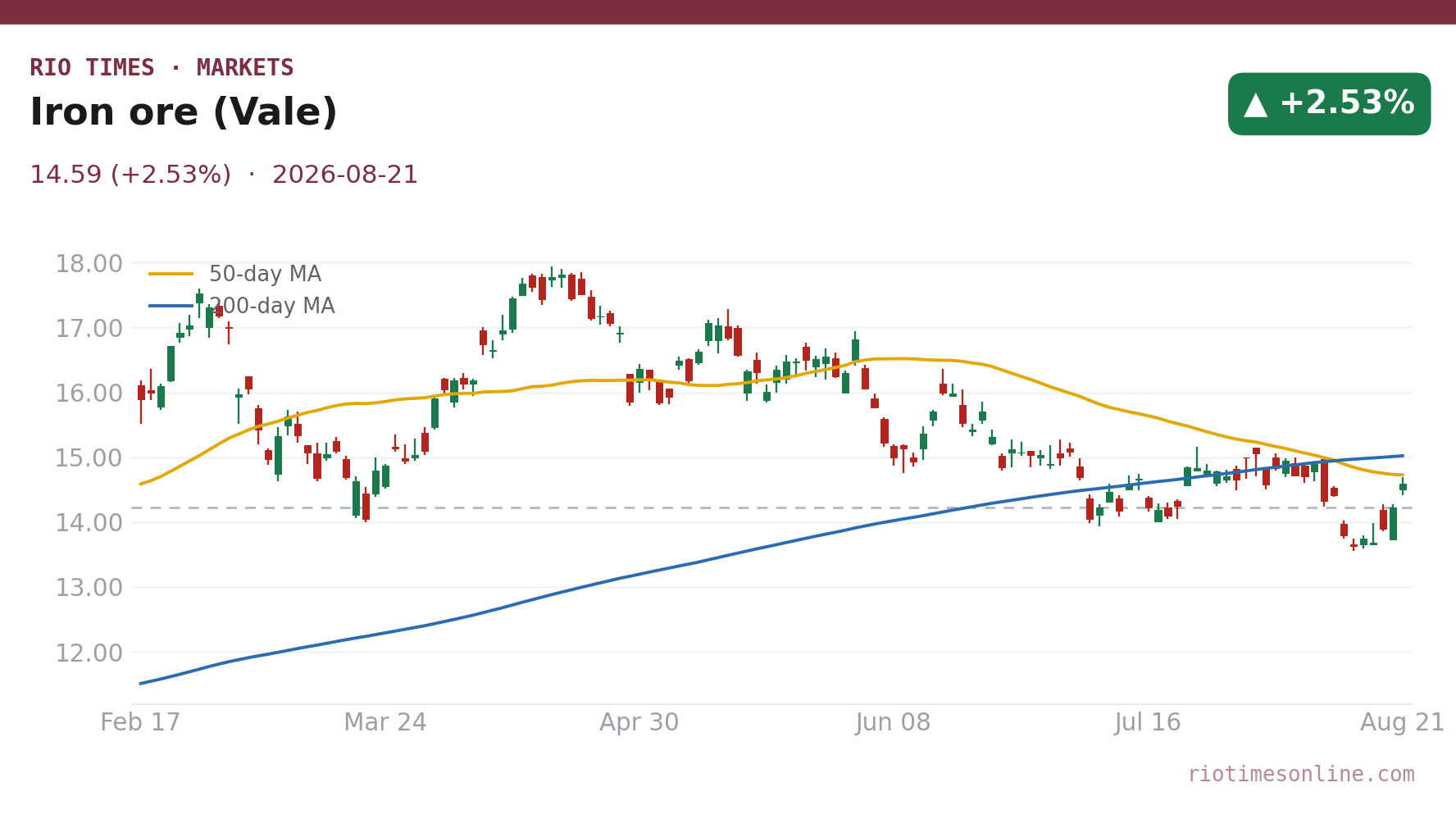
Brazil’s Vale, the world’s second-largest exporter, saw its New York shares jump 2.53% to US$14.59, a much stronger move than the commodity itself.
China is still buying heavily: imports in the first seven months hit 736.84 million tons, up 6% year-on-year, even while crude steel output fell about 3% in the first half.
New supply from Guinea’s Simandou remains small, with China’s imports from Guinea at just 2.1 million tons in July, so global balances stayed relatively tight.
What matters today. Chinese mills are still restocking ore despite weaker steel profitability, which is cushioning prices and lifting mining shares.
01 The session in one read
Iron ore’s global benchmark closed at US$95.21 per tonne on Friday, August 21, 2026, a gain of just 0.05% from the prior session.
That small move kept prices inside the US$93–US$100 range that has held since June, with the most-active Dalian futures contract near CNY, the Chinese yuan, 707.5–710 per tonne.
Brazil’s Vale, Latin America’s flagship producer, moved far more sharply: its New York-listed shares rose 2.53% to US$14.59.
The wider mining complex joined in, with Rio Tinto up 3.06% to US$105.30 and Brazil’s CSN Mineração jumping 4.80% to R$5.90 (US$1.14).
I
r
o
n
o
r
e
i
s
h
o
l
d
i
n
g
n
e
a
r
t
h
e
m
i
d
d
l
e
o
f
i
t
s
m
o
n
t
h
s
–
l
o
n
g
r
a
n
g
e
b
e
c
a
u
s
e
C
h
i
n
a
‘
s
i
m
p
o
r
t
v
o
l
u
m
e
s
r
e
m
a
i
n
r
o
b
u
s
t
e
n
o
u
g
h
t
o
o
f
f
s
e
t
s
o
f
t
e
r
s
t
e
e
l
o
u
t
p
u
t
a
n
d
w
e
a
k
c
o
n
s
t
r
u
c
t
i
o
n
.
T
h
e
m
a
r
k
e
t
i
s
n
o
t
p
r
i
c
i
n
g
a
s
h
a
r
p
r
e
b
o
u
n
d
,
b
u
t
i
t
i
s
a
l
s
o
n
o
t
e
x
p
e
c
t
i
n
g
a
c
o
l
l
a
p
s
e
w
h
i
l
e
r
e
s
t
o
c
k
i
n
g
c
o
n
t
i
n
u
e
s
a
n
d
n
e
w
s
u
p
p
l
y
f
r
o
m
S
i
m
a
n
d
o
u
r
a
m
p
s
u
p
s
l
o
w
l
y
.
W
a
t
c
h
t
h
e
n
e
x
t
r
o
u
n
d
o
f
C
h
i
n
e
s
e
i
m
p
o
r
t
a
n
d
p
o
r
t
s
t
o
c
k
p
i
l
e
d
a
t
a
f
o
r
a
n
y
s
i
g
n
t
h
a
t
b
u
y
i
n
g
m
o
m
e
n
t
u
m
f
a
d
e
s
.
02 The board
The proxy board shows how investors are bidding up mining equities even as the commodity itself barely budged.
Vale’s New York listing is the closest liquid proxy for iron ore in the Americas, and its 2.53% advance suggests buyers see value after the stock’s recent drift.
CSN Mineração’s 4.80% leap in São Paulo to R$5.90 (US$1.14) outpaced Vale, a sign local traders are chasing pure-play ore exposure.
Rio Tinto, quoted at US$105.30, reminded foreign investors that the big diversified miners ride the same Chinese demand story.
| Asset | Level | Change |
|---|---|---|
| Iron ore (Vale) | US$14.59 | +2.53% |
| CSN Mineração | R$5.9 (US$1.14) | +4.80% |
| Rio Tinto | US$105.30 | +3.06% |
Source: RT close, 2026-08-21. Where a commodity has no spot feed, an exchange-traded tracker or leading producer is shown as a labelled proxy.
Live Market IntelligenceThe live market board
Rio Times · Live Market Intelligence
Latin America — Cross-Market Board
| Instrument | Last | Change | YoY | Prev. | High | Low | Volume |
|---|---|---|---|---|---|---|---|
| IBOV | 205,079.25 | -0.17% | +21.85% | 205,430.33 | 168,310 | 167,142 | — |
| IPSA | 10,972.40 | +0.02% | — | 10,970.29 | 11,210 | 10,984 | 1,513,213,483 |
| IPC MEX | 68,969.69 | +0.06% | +12.17% | 68,929.72 | 66,121 | 65,405 | 108,886,187 |
| MERVAL | 3,017,221 | — | +30.51% | 3,022,485 | 3,042,365 | 2,991,150 | — |
| COLCAP | 2,521.34 | -1.75% | — | 9.04 | 9.05 | 9.02 | 4,133 |
| BVL PERÚ | 59,664.64 | +0.40% | — | — | — | — | — |
| USD/BRL | 5.16 | +0.01% | -5.13% | 5.16 | 5.18 | 5.14 | — |
| EUR/BRL | 5.95 | +1.01% | -5.83% | 5.89 | 5.98 | 5.94 | — |
| USD/MXN | 17.06 | -0.24% | -8.58% | 17.10 | 17.08 | 17.01 | — |
| USD/CLP | 913.98 | +0.04% | -5.67% | 913.65 | 915.11 | 906.68 | — |
| USD/COP | 3,140 | +0.03% | -22.04% | 3,139 | 3,141 | 3,105 | — |
| USD/PEN | 3.36 | -0.66% | -4.82% | 3.38 | 3.38 | 3.35 | — |
| USD/ARS | 1,493 | +0.10% | +12.96% | 1,491 | 1,494 | 1,480 | — |
| USD/UYU | 40.27 | +1.24% | +1.80% | 39.77 | 40.27 | 40.23 | — |
| USD/PYG | 5,939 | +1.68% | -19.54% | 5,841 | 5,939 | 5,925 | — |
| USD/BOB | 11.64 | -0.76% | +72.04% | 11.73 | 11.72 | 11.64 | — |
| USD/DOP | 58.34 | +1.25% | -3.44% | 57.62 | 58.34 | 58.04 | — |
| USD/CRC | 445.92 | +0.89% | -9.71% | 441.97 | 448.50 | 445.92 | — |
Live Company IntelligenceVale SA ADR — the full investor dossier
Wall Street view
Valuation & profitability
Price & risk
$10.3652-wk high
$17.44
Revenue trend · 6y
Ownership
Dividend
03 What moved it
China remains the central buyer, taking around 75% of global seaborne iron ore, and its import volumes are still rising despite weaker steel margins.
Imports in the first seven months of 2026 reached 736.84 million tons, up 6% on the same period in 2025, while August arrivals were estimated near 111.16 million tons, above July’s 108.08 million tons.
Yet China’s crude steel output fell about 3% in the first half to 499.95 million tons, confirming a mild contraction in production.
Manufacturing steel use is forecast to grow 3.3% in 2026 to 344 million tonnes, lifting manufacturing’s share of consumption to about 52%, but the property sector remains a drag.
Beijing’s late-July Politburo meeting emphasised implementation of existing fiscal support rather than big new stimulus, reinforcing expectations of a structural moderation in steel demand.
04 The Latin American read
For Brazil, the iron ore price is a barometer of export earnings and fiscal health, which is why Vale’s New York shares are watched from São Paulo to Brasília.
The 2.53% bounce in Vale signals that global investors still trust Brazil’s ore franchise even when the spot price moves sideways.
CSN Mineração’s even larger gain of 4.80% shows domestic appetite for the sector, with the company trading at R$5.90 (US$1.14).
With new supply from Guinea’s Simandou still tiny—China imported just 2.1 million tons from Guinea in July—Latin American producers face little near-term competitive pressure.
05 The names to watch
Vale’s New York-listed stock at US$14.59 is the first name to track, because it moves most directly with global iron ore sentiment.
CSN Mineração at R$5.90 (US$1.14) offers a domestic Brazilian play with higher beta than Vale on up days.
Rio Tinto at US$105.30 ties the story to the broader diversified mining trade and to China’s seaborne import demand.
The underlying commodity itself remains confined to a US$93–US$100 range, so sharp equity moves like Friday’s may reflect positioning rather than a new trend in ore.
06 The outlook
The market is likely to stay rangebound while China keeps buying ore at strong volumes but produces less steel.
The next big test is whether August import data confirms the estimated rise to 111.16 million tons and whether port stockpiles begin to fall.
If manufacturing demand keeps growing at 3.3% and property stabilises, iron ore could push back toward the top of its June-to-August band.
For now, the modest 0.05% rise in the benchmark is a reminder that prices are balanced between soft steel output and resilient ore imports.
07 What to watch
- China’s August imports: whether arrivals hit the estimated 111.16 million tons will show if restocking strength continues
- Steel margins: weak profitability for Chinese mills could eventually force output and ore buying lower
- Simandou ramp-up: any acceleration in Guinea’s exports could loosen global supply and pressure prices
- Beijing policy: new stimulus signals would change the structural view on Chinese steel demand
Frequently Asked Questions
Why does Vale matter for iron ore prices?
Vale is the world’s second-largest iron ore exporter, so its New York-listed shares act as a liquid proxy for the commodity’s direction.
What is the current iron ore price?
The global benchmark settled at US$95.21 per tonne on Friday, August 21, 2026, a 0.05% daily gain.
Is China still buying iron ore?
Yes, China’s imports rose 6% year-on-year in the first seven months of 2026 to 736.84 million tons.
Why are mining shares up if ore barely moved?
Investors are bidding up miners like Vale and CSN Mineração because Chinese import demand remains strong and new supply is limited.
This article was produced by The Rio Times’ automated newsroom system. How we use AI · Report an error · Editorial responsibility: Matthias Camenzind, Editor-in-Chief
LatAm Markets: Live Signals → — real-time movers, turnover leaders and FX across Latin America.