Guatemala Ports Law Signed, Creating a National Port Authority
GUATEMALA · BUSINESS & ECONOMY
Key Facts
- —What happened President Bernardo Arevalo signed Decree 20-2026 on September 2, creating an autonomous National Port Authority for Guatemala.
- —How big the vote was Congress approved the law with 123 votes in the early hours of August 5, well above a two-thirds majority.
- —The real story Private firms can now sign port contracts of up to 50 years, renewable once, without the state selling anything.
- —The catch The law only takes effect 30 days after publication, and the new authority still has no board.
- —What it costs today Business groups estimate port inefficiency cost Guatemala more than US$100 million in 2025 alone.
- —What comes next Users expect roughly two years before the full rulebook is written and the authority is working normally.
Guatemala has rewritten the rules for its harbours for the first time in decades. The change matters most to anyone who ships goods through Central America.
Guatemala has a new rulebook for its harbours. President Bernardo Arevalo signed the Guatemala ports law on September 2, 2026, and it was published the same day.
The text is formally Decree 20-2026, the General Law of the National Port System. Congress had approved it a month earlier.
That vote came in the early hours of August 5, after a session lasting more than twelve hours. It passed with 123 votes in a 160-seat Congress.
The law does not take effect immediately. It enters into force 30 days after publication, which puts the start date at the beginning of October.
What the Guatemala Ports Law Actually Creates
The centrepiece is a new body called the Autoridad Portuaria Nacional, or National Port Authority. It is a decentralised, autonomous entity.
It gets three kinds of power. It can regulate, it can inspect, and it can sanction.
Its board has five members. One is appointed by the president and chairs it, and the rest represent three ministries and the port users’ council.
Those ministries are Economy, Communications and Infrastructure, and the Interior. The users’ council seat is the only non-government voice on the board.
The authority’s scope covers maritime, river and lake ports. It also covers terminals, docks, platforms and access channels.
Two things are excluded. Military installations and artisanal fishing docks stay outside the new system.
The Part That Matters to Investors
Until now, private investment in Guatemalan ports sat on shaky legal ground. A constitutional ruling had struck down the earlier concession model and left a gap.
The new law fills it with two instruments. One is the port usufruct, known locally as USOP, and the other is a port administration contract, or CAP.
Both can run for up to 50 years. Both can then be renewed once for another 50.
Under either arrangement, a private company can design, finance, build and operate port infrastructure. Ownership of the public asset does not transfer.
The law also allows genuinely private ports on private land, with authorisation from the new authority. That option did not clearly exist before.
Cruise traffic gets its own rule. Private operators keep half of the US$2 charged per arriving passenger.
Why Guatemala Bothered
The country’s ports are busy and the traffic is growing. The National Port Commission counted 1,119,626 containers in 2025, up 11 percent on the year before.
Vessel calls rose too, reaching 3,190. That was a 2 percent increase.
Guatemala handles about 14 percent of all container movement in Central America. Only Panama handles more.
Sea traffic is also a tax story. Maritime activity is linked to roughly 18 percent of the country’s foreign-trade tax collection.
The problem is not volume but throughput. Business groups Agexport, AmCham Guatemala and Fundesa estimate port inefficiency cost more than US$100 million in 2025.
A snapshot from early May 2026 shows what that looks like. Eight vessels were berthed while 23 waited offshore.
Where the Money Is Going
The 2027 budget carries a large line for the Pacific side. It sets aside Q4.8 billion (US$630 million) for modernising Puerto Quetzal.
A further Q600 million (US$79 million) is earmarked for ports, airports and railways together.
Both conversions use the Banco de Guatemala reference rate of 7.62 quetzals to the US dollar. That rate was published for August 25, 2026.
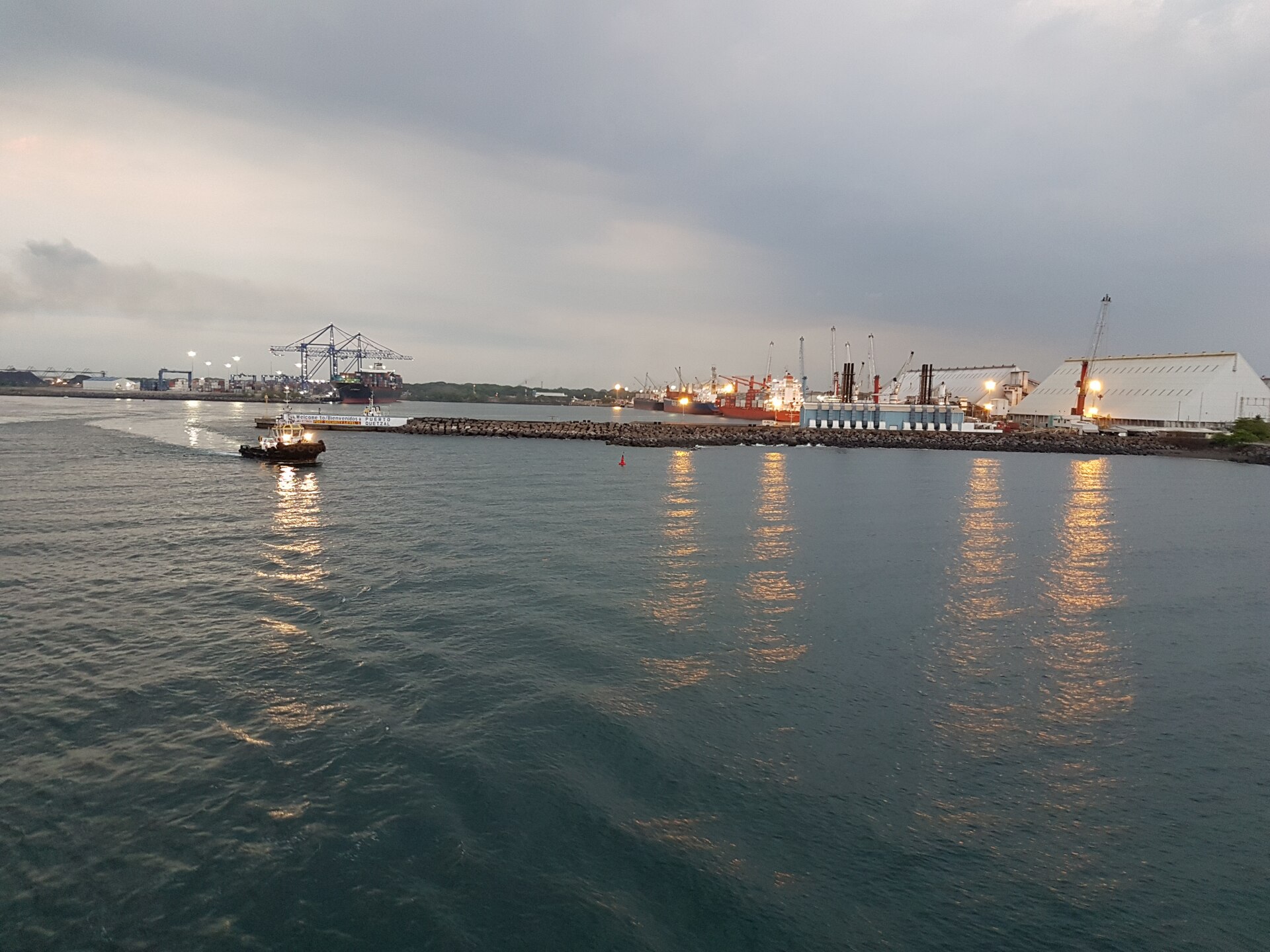
Puerto Quetzal is the main Pacific gateway. It handles close to half of national cargo and more than a third of containers.
On the Caribbean side sit Santo Tomas de Castilla and Puerto Barrios. Together they carry the trade that moves towards the United States and Europe.
How the Bill Got Stuck, and How It Moved
The Guatemala ports law took years, and the delay was political. La Hora reported in May 2026 that the parties Vamos and UNE, with smaller allies, held it up.
The disputes were about control. They covered who runs the port system, how inspections work, and how much autonomy the port unions keep.
Union demands reached the floor as amendments. Deputy Thelma Ramirez carried proposals from port unions seeking seats on the authority’s board.
Jorge Ayala, who chairs the Economy Commission, said unions wanted a place in the directorate. In the final text they did not get one.
Thirty-six amendments were folded into the approved version. Thirty-three were technical and three concerned governance.
What Business Says, and What Comes Next
Juan Carlos Zapata, director of the business think tank Fundesa, called the law excellent news. He pointed to investment and legal certainty as the gains.
He also urged speed on the next step. The first board of the new authority has to be appointed before anything else happens.
Expectations on timing differ. Port users quoted by Prensa Libre expect roughly two years for the full regulatory framework.
A vice-minister told La Hora it would take about one year. The honest answer is that nobody knows yet.
For shippers and importers across Central America, the practical test is simple. It is whether a container spends less time waiting off Puerto Quetzal in 2027 than it did in 2026.
More: Central America news in English, every day from The Rio Times.
Frequently Asked Questions
What is the Guatemala ports law?
It is Decree 20-2026, the General Law of the National Port System. It creates an autonomous National Port Authority and sets new rules for private investment in ports.
When does it take effect?
Congress approved it on August 5, 2026 and President Bernardo Arevalo signed it on September 2. It enters into force 30 days after publication, so at the start of October.
Does the law privatise Guatemala’s ports?
No. Private firms can hold contracts of up to 50 years, renewable once, to build and operate infrastructure, but ownership of public port assets does not transfer.
Which ports are affected?
Coverage includes Puerto Quetzal on the Pacific and Santo Tomas de Castilla and Puerto Barrios on the Caribbean, plus river and lake ports, terminals and access channels.
How busy are Guatemala’s ports?
The National Port Commission recorded 1,119,626 containers in 2025, an 11 percent rise, and 3,190 vessel calls. That is about 14 percent of Central American container movement.
Sources: La Hora, Prensa Libre, Infobae Guatemala, LexLatin, Comision Portuaria Nacional, Agexport, AmCham Guatemala, Fundesa, Rio Times.
This article was produced by The Rio Times’ automated newsroom system. How we use AI · Report an error · Editorial responsibility: Matthias Camenzind, Editor-in-Chief