Brazil Grain Exports Jump as Dryness Hits Mato Grosso Crops
Key Facts
- A weaker Brazilian real makes dollar-priced soy and corn cheaper for importers, allowing Brazilian farmers to accept lower dollar bids while preserving local-currency revenue.
- Persistent dryness in key Brazilian states like Mato Grosso is stressing the next soybean crop, supporting the soybean-tracking fund SOYB as traders anticipate tighter export availability.
- Chinese crushers maintained firm near-term soybean import programs, preventing SOYB from falling further despite wider global growth uncertainty.
- Strong Brazilian safrinha corn shipment expectations capped rallies in CORN, as Asian and Middle Eastern buyers shifted demand from US origins to cheaper Brazilian supply.
- Argentine farmers are treating stored wheat as a hedge against a depreciating peso, slowing forward sales and intermittently tightening regional export flows to support WEAT.
- High corn prices are encouraging livestock feeders to substitute cheaper wheat into rations, a cross-commodity dynamic linking the WEAT’s move directly to the corn market.
Today’s Focus
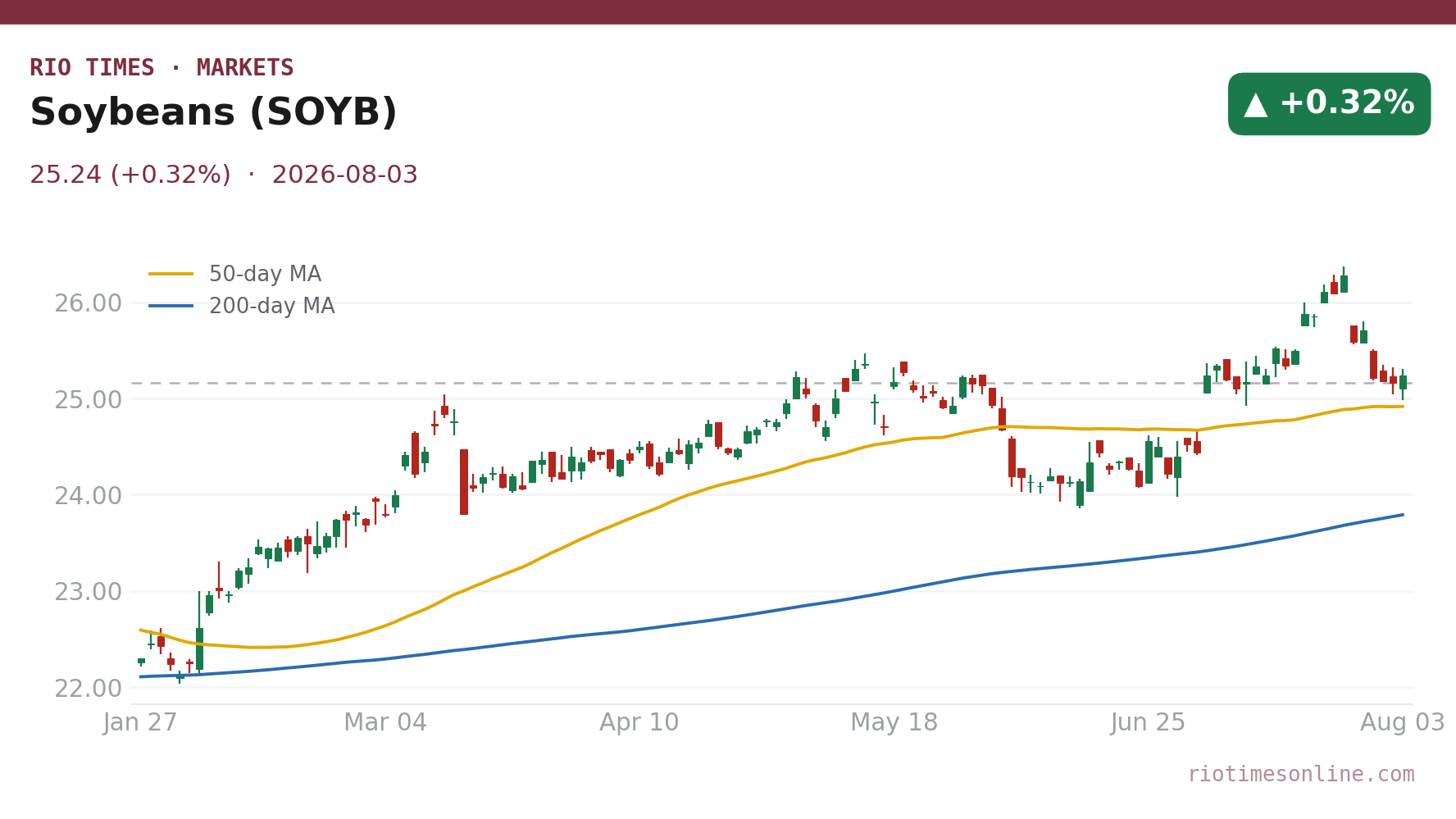
Grain-tracking funds rallied, with wheat leading the advance. The WEAT fund settled at US$24.26, jumping 1.89%, while CORN added 1.59% to US$17.93. The soybean-tracking SOYB fund lagged with a modest 0.32% gain, closing at US$25.24.
The moves were anchored in South America, where dry weather in Brazilian states like Mato Grosso is threatening the next soybean crop. This risk, combined with steady Chinese import demand, provided a floor for SOYB and lent general strength to the complex. A weaker Brazilian real was the session’s hidden engine, making dollar-denominated exports cheaper for global buyers.
Argentina’s influence was starkest in wheat. Farmers there are hoarding grain as a shield against a rapidly depreciating peso, tightening near-term supply. This dynamic, alongside a push from livestock feeders substituting wheat for expensive corn, sent WEAT sharply higher despite ample Black Sea competition.
What matters today. Brazilian crop weather and a weaker real are tightening South American grain supply, just as Chinese demand holds firm, collectively lifting US-dollar-denominated grain-tracker funds.
01 The session in one read
A rally in wheat and corn, driven by tightening supply from the Southern Hemisphere, set the tone for the grain complex. The soybean fund lagged but held firm above US$25.24 as a cocktail of dry Brazilian weather and consistent Chinese buying offset pressure from a weaker Brazilian real.
Argentina played a pivotal role in the wheat market, where farmers treating stored grain as an inflation hedge slowed exports and helped push WEAT up 1.89%. The corn fund CORN gained +1.59%, buoyed by the broad strength but capped by heavy competition from the Brazilian safrinha crop.
Persistent dryness in Brazil’s primary soybean belt and Argentine farmers’ reluctance to sell wheat into a weak peso are creating a near-term supply squeeze that directly benefits grain-tracking funds. With Chinese crushers still actively booking cargoes from ports like Santos and Paranaguá, the export engine in Latin America is busier than seasonal norms, keeping a sturdy platform under SOYB, CORN and WEAT even as US harvest expectations remain benign. The variable to watch now is any expansion of Argentina’s wheat export registry; a sudden rush of farmer sales would quickly test WEAT’s recent highs.
02 The board
Wheat was the session’s leader. The wheat-tracking fund WEAT charged 1.89% higher to settle at US$24.26, making it the strongest performer in the agricultural space. This move was not isolated; it reflected direct feed-substitution links as expensive corn pushed livestock buyers toward cheaper wheat rations.
The corn-tracking fund CORN settled at US$17.93, gaining +1.59%. The advance remained constrained by the weight of Brazil’s massive second-crop corn program, with the weaker real allowing Brazilian exporters to undercut US grain on global markets. The soybean-tracking fund SOYB lagged the complex with a 0.32% uptick, finishing at US$25.24 as crop stress and currency effects largely neutralised each other.
| Asset | Level | Change |
|---|---|---|
| Soybeans (SOYB) | US$25.24 | +0.32% |
| Corn (CORN) | US$17.93 | +1.59% |
| Wheat (WEAT) | US$24.26 | +1.89% |
Source: RT close, 2026-08-03. Where a commodity has no spot feed, an exchange-traded tracker or leading producer is shown as a labelled proxy.
Live Market IntelligenceThe live market board
Rio Times · Live Market Intelligence
Latin America — Cross-Market Board
| Instrument | Last | Change | YoY | Prev. | High | Low | Volume |
|---|---|---|---|---|---|---|---|
| IBOV | 185,229.17 | -0.41% | +21.85% | 185,992.03 | 168,310 | 167,142 | — |
| IPSA | 11,381.18 | +1.30% | — | 11,235.60 | 11,210 | 10,984 | 1,513,213,483 |
| IPC MEX | 63,375.93 | -0.78% | +12.17% | 63,873.32 | 66,121 | 65,405 | 108,886,187 |
| MERVAL | 3,021,926 | -1.29% | +30.51% | 3,022,485 | 3,042,365 | 2,991,150 | — |
| COLCAP | 2,548.22 | +1.05% | — | 9.04 | 9.05 | 9.02 | 4,133 |
| BVL PERÚ | 60,023.65 | -1.13% | — | — | — | — | — |
| USD/BRL | 5.16 | +0.01% | -5.13% | 5.16 | 5.18 | 5.14 | — |
| EUR/BRL | 5.95 | +1.01% | -5.83% | 5.89 | 5.98 | 5.94 | — |
| USD/MXN | 17.06 | -0.24% | -8.58% | 17.10 | 17.08 | 17.01 | — |
| USD/CLP | 913.98 | +0.04% | -5.67% | 913.65 | 915.11 | 906.68 | — |
| USD/COP | 3,140 | +0.03% | -22.04% | 3,139 | 3,141 | 3,105 | — |
| USD/PEN | 3.36 | -0.66% | -4.82% | 3.38 | 3.38 | 3.35 | — |
| USD/ARS | 1,493 | +0.10% | +12.96% | 1,491 | 1,494 | 1,480 | — |
| USD/UYU | 40.27 | +1.24% | +1.80% | 39.77 | 40.27 | 40.23 | — |
| USD/PYG | 5,939 | +1.68% | -19.54% | 5,841 | 5,939 | 5,925 | — |
| USD/BOB | 11.64 | -0.76% | +72.04% | 11.73 | 11.72 | 11.64 | — |
| USD/DOP | 58.34 | +1.25% | -3.44% | 57.62 | 58.34 | 58.04 | — |
| USD/CRC | 445.92 | +0.89% | -9.71% | 441.97 | 448.50 | 445.92 | — |
03 What moved it
Weather risk in Brazil was the primary catalyst. Dryness in Mato Grosso and Rio Grande do Sul raised red flags for the next soybean harvest, lifting the soybean-tracking fund SOYB as buyers hedged against a smaller export surplus from the world’s largest shipper. This Brazilian crop anxiety spilled over into the broad grain complex.
Currency dynamics amplified every move. The depreciation of the Brazilian real inflated local-currency revenue for farmers, giving them room to cut dollar prices on soy and corn and still profit. While this can pressure US-centric trackers like CORN, the tightening supply narrative, reinforced by Chinese crushers maintaining aggressive soybean purchases, overpowered the bearish currency signal to lift the entire board.
04 The Latin American read
For Brazil, the real’s weakness is a strategic export weapon, but dryness is a growing fear. If rains fail to materialise in the Centre-West, traders holding SOYB at US$25.24 are betting that China’s state-backed crushers will need to pay a higher premium for Brazilian beans, overshadowing the currency-driven price cut.
In Argentina, the economic crisis is hijacking standard grain marketing. Storing wheat has become an essential financial strategy for farmers facing triple-digit inflation and a crashing peso. This deliberate hoarding of WEAT’s underlying asset, against a backdrop of steady Mercosur and North African import demand, explains the fund’s sharp 1.89% rally.
05 The names to watch
Brazil’s export logistics hinge on weather in Mato Grosso and the flow through Port of Santos, directly influencing SOYB’s direction. Any formal downgrade in the state’s crop forecast will likely add firepower to the soybean-tracking fund’s current level of US$25.24.
Argentina’s export registrations for wheat are the critical swing factor for WEAT. A sudden policy shift or forced farmer selling to generate cash could unlock a flood of physical grain onto the market, quickly challenging the fund’s position at US$24.26. For CORN, watch the pace of China’s sorghum and barley buying; a pivot away from those substitutes signals imminent corn import bookings.
06 The outlook
The grain complex is positioned for a South American weather premium, with fund flows into SOYB, CORN and WEAT likely to remain sensitive to any rainfall maps released for central Brazil. The interaction between Argentine farmer holding strategies and China’s feed mill procurement schedules will define whether the current wheat rally extends or stalls.
07 What to watch
- Argentine wheat export speed: Argentine farmers delaying sales are propping up WEAT; monitor weekly export registration data to see if hoarding cracks.
- Brazil’s Central-West weather: Mato Grosso dryness is the main risk factor for SOYB; stunted planting would extend the rally in the soybean-tracking fund.
- Chinese feed demand shifts: Any increase in China’s sorghum or barley imports signals a post-holiday appetite that soon benefits CORN.
- Brazilian real trajectory: Further real weakness pressures dollar-denominated CORN and SOYB levels by making Brazilian FOB offers impossible for other origins to match.
Frequently Asked Questions
Why did WEAT jump more than SOYB?
Argentine farmers are hoarding wheat as an inflation hedge, tightening near-term supply, while soybeans faced a cap from a weaker Brazilian real.
How does Brazil’s weather affect US grain-tracker funds?
Brazil is the world’s largest soybean exporter, so dry weather stunting its harvest raises global prices, directly lifting the US-listed SOYB fund.
What role does China play in these moves?
China is the dominant global soybean buyer and a tactical corn customer; its active crusher demand anchored SOYB and contributed to the broader grain strength.
Are these figures the actual commodity spot prices?
No, SOYB, CORN and WEAT are exchange-traded funds that track the price of each grain, not the physical bushel price itself.
This article was produced by The Rio Times’ automated newsroom system. How we use AI · Report an error
LatAm Markets: Live Signals → — real-time movers, turnover leaders and FX across Latin America.
Read More from The Rio Times