Gold Dips to US$4,429 and Silver to US$66.17 After US Jobs Data
Key Facts
- Gold settles lower: Gold closed at US$4,429/oz, down 1.14% on Friday, September 4, 2026.
- Silver follows suit: Silver settled at US$66.17/oz, down 1.22% for the session.
- Payrolls drive move: US added 162,000 jobs in August, supporting higher rates for longer.
- Real yields matter: A firm dollar and higher real yields make gold less attractive.
- Mexico faces pressure: Mexico, top silver producer, feels every price swing.
- The catch: Mexico and Peru lead silver mining, so pullback clouds Andean investment.
Today’s Focus
Gold and silver fell on Friday, September 4, 2026. A stronger-than-expected US jobs report made investors think the Federal Reserve, the US central bank, won’t cut rates soon.
The gold price settled at US$4,429 an ounce, down 1.14%. Silver closed at US$66.17 an ounce, a loss of 1.22%.
The US economy created 162,000 jobs in August. That was far more than markets expected.
The news pushed the dollar up. It also lifted Treasury yields after inflation.
Higher yields make gold and silver costlier to hold. These metals pay no interest.
For Latin America, the drop matters most in Mexico and Peru. They are the world’s two largest silver producers.
A lower silver price cuts export earnings. It can also delay new mines in both countries.
Dollars from metal sales support local budgets and jobs there.
What matters today. Strong US payrolls lifted real yields and the dollar, in the market’s reading. That combination weighed on gold, silver, and the revenue outlook for Mexico and Peru.
01 The session in one read
Gold and silver prices fell on Friday, September 4, 2026. Traders reacted to a stronger-than-expected US jobs report.
Gold settled at US$4,429 an ounce, down 1.14%. Silver closed at US$66.17 an ounce, down 1.22%.
The August payrolls number showed 162,000 new US jobs, enough to keep pressure on the Federal Reserve to hold rates firm. That lifted the dollar and real Treasury yields, making precious metals less attractive because they pay no income.
Friday’s 162,000-job August payrolls report gave the Federal Reserve more room to keep interest rates high, in the market’s reading. Gold and silver both slipped during the session.
The move was calm, not panicked. Both metals stayed inside their recent trading ranges after the data came out.
Next week’s US inflation report is the one to watch. A hot inflation number would strengthen the case for higher-for-longer rates and test whether gold can hold near US$4,400.
02 The board
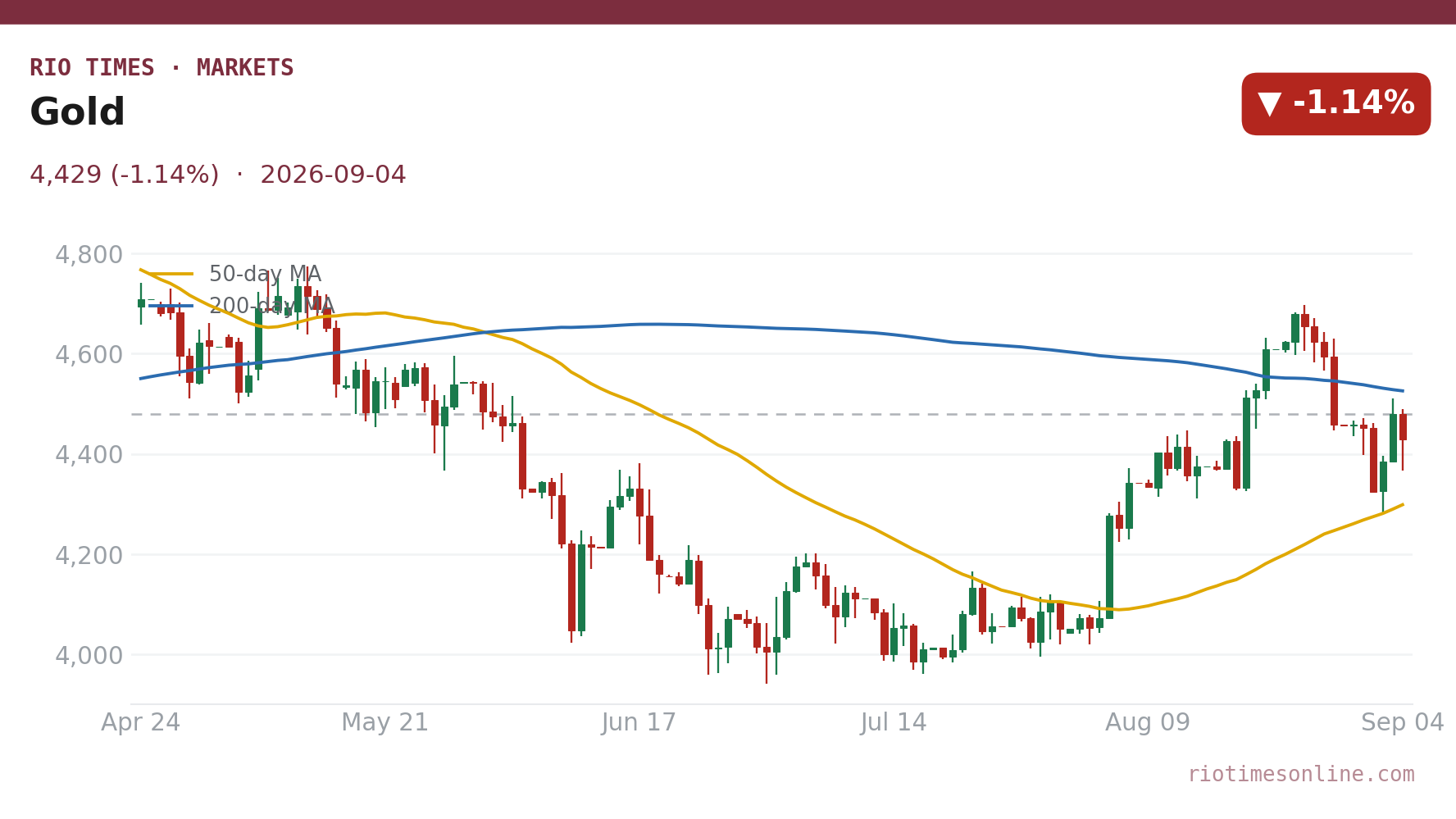
The board tells the story in two clean lines. The gold proxy ended at US$4,429 an ounce, down 1.14%.
The silver proxy settled at US$66.17 an ounce, down 1.22%. Both moves were notable but not chaotic.
They show profit-taking, not a bearish rout.
The gap between the two moves was narrow. That is typical when one big report, like US payrolls, drives trading.
Silver fell a bit more in percentage terms. That shows it reacts more to industrial demand and its role as money.
| Asset | Level | Change |
|---|---|---|
| Gold | US$4,429/oz | -1.14% |
| Silver | US$66.17/oz | -1.22% |
Source: RT close, 2026-09-04. Where a commodity has no spot feed, an exchange-traded tracker or leading producer is shown as a labelled proxy.
Live Market IntelligenceThe live market board
Rio Times · Live Market Intelligence
Latin America — Cross-Market Board
| Instrument | Last | Change | YoY | Prev. | High | Low | Volume |
|---|---|---|---|---|---|---|---|
| IBOV | 204,116.29 | -1.15% | +21.85% | 206,495.23 | 168,310 | 167,142 | — |
| IPSA | 10,746.44 | -2.18% | — | 10,985.55 | 11,210 | 10,984 | 1,513,213,483 |
| IPC MEX | 70,249.54 | +1.43% | +12.17% | 69,258.58 | 66,121 | 65,405 | 108,886,187 |
| MERVAL | 3,017,221 | — | +30.51% | 3,022,485 | 3,042,365 | 2,991,150 | — |
| COLCAP | 2,529.36 | -1.21% | — | 9.04 | 9.05 | 9.02 | 4,133 |
| BVL PERÚ | 59,561.23 | -4.00% | — | — | — | — | — |
| USD/BRL | 5.16 | +0.01% | -5.13% | 5.16 | 5.18 | 5.14 | — |
| EUR/BRL | 5.95 | +1.01% | -5.83% | 5.89 | 5.98 | 5.94 | — |
| USD/MXN | 17.06 | -0.24% | -8.58% | 17.10 | 17.08 | 17.01 | — |
| USD/CLP | 913.98 | +0.04% | -5.67% | 913.65 | 915.11 | 906.68 | — |
| USD/COP | 3,140 | +0.03% | -22.04% | 3,139 | 3,141 | 3,105 | — |
| USD/PEN | 3.36 | -0.66% | -4.82% | 3.38 | 3.38 | 3.35 | — |
| USD/ARS | 1,493 | +0.10% | +12.96% | 1,491 | 1,494 | 1,480 | — |
| USD/UYU | 40.27 | +1.24% | +1.80% | 39.77 | 40.27 | 40.23 | — |
| USD/PYG | 5,939 | +1.68% | -19.54% | 5,841 | 5,939 | 5,925 | — |
| USD/BOB | 11.64 | -0.76% | +72.04% | 11.73 | 11.72 | 11.64 | — |
| USD/DOP | 58.34 | +1.25% | -3.44% | 57.62 | 58.34 | 58.04 | — |
| USD/CRC | 445.92 | +0.89% | -9.71% | 441.97 | 448.50 | 445.92 | — |
03 What moved it
Traders pointed to the August jobs report as the trigger. It showed the US created 162,000 jobs, beating forecasts.
Markets read that as reason for the Federal Reserve to keep its key interest rate high. That view lifted the dollar and real yields.
When the dollar strengthens, gold and silver become more expensive for buyers using other currencies, reducing demand. At the same time, higher real yields make interest-bearing assets look better compared with metals that pay nothing.
Gold rose early this week as investors sought safety from world tensions. But Friday’s data turned attention back to interest rates.
Gold and silver then paused as traders waited for the next inflation report.
04 The Latin American read
Mexico is the world’s largest silver producer, and Peru ranks second. Together they supply much of the world’s silver.
Friday’s 1.22% drop trims the dollar value of future exports from both.
A softer silver price squeezes margins for Mexican miners like Fresnillo and Peñoles. It can also slow their expansions, especially in high-cost areas.
Peru’s producers, including Hochschild Mining and Buenaventura, face the same pressure. Local communities and regional governments there rely on mining royalties.
A strong dollar helps and hurts these exporters. It raises the value of their sales in local money.
But it also means global loans are harder to get. That often slows mining projects first.
Friday’s small drop in the dollar adds to this worry. It makes banks less willing to fund new silver mines in Latin America.
05 The names to watch
The cleanest exposure remains the exchange-traded proxies, with the gold-tracking price at US$4,429 and the silver-tracking price at US$66.17 after Friday’s close. Those vehicles dominate short-term flows from foreign investors who want the metal without a single-miner risk.
Mexican miners Fresnillo and Industrias Peñoles depend most on silver prices. Fresnillo is the world’s largest primary silver miner.
In Peru, Buenaventura and Hochschild Mining turn silver and gold prices into results. Both often move with the same interest rates and dollar factors that hurt metals on Friday.
Silver is both a precious metal and an industrial input. That matters for investors watching Latin America.
A stronger dollar and higher real yields can slow global manufacturing. That adds extra pressure on miners in Mexico and Peru.
06 The outlook
Gold and silver prices now depend on US inflation data. That data will confirm Friday’s jobs report signal.
If real yields keep rising, gold may fall below US$4,400. Silver could test lower levels in its recent range.
For Latin America, that means less revenue from silver exports. Miners in Mexico and Peru will find financing harder.
07 What to watch
- US core inflation: Next week’s consumer price reading will show whether real yields keep rising.
- Federal Reserve speakers: Any hint about the next rate move sets the dollar’s direction. Metals follow.
- Silver industrial demand: Factory data from the US and China will show whether industrial demand supports silver.
- Mexican and Peruvian mining earnings: Results from Fresnillo, Peñoles, Buenaventura and Hochschild will show how the softer silver price hits margins.
Frequently Asked Questions
Why did gold fall on Friday, September 4, 2026?
Gold prices dropped on Friday.
The reason: US payrolls rose by 162,000 jobs.
That news strengthened the US dollar.
It also pushed up real Treasury yields.
These are bond returns after inflation.
Higher yields make gold less appealing.
Gold pays no interest or dividends.
So investors often sell it when yields rise.
How much did the gold-tracking price drop?
The gold-tracking proxy settled at US$4,429 an ounce, down 1.14% for the session.
What happened to silver?
The silver-tracking proxy closed at US$66.17 an ounce, a loss of 1.22%, as traders trimmed positions ahead of further US inflation data.
Why does this matter for Latin America?
Mexico and Peru are the world’s top two silver producers.
A lower silver price cuts their export revenues.
It can also delay mining investment.
Market data: RT
This article was produced by The Rio Times’ automated newsroom system. How we use AI · Report an error · Editorial responsibility: Matthias Camenzind, Editor-in-Chief
LatAm Markets: Live Signals → — real-time movers, turnover leaders and FX across Latin America.