Global Economy Briefing — August 3, 2026
Global economy: Ahead of US factory orders and JOLTS job openings, global equities held firm and the dollar steadied. The data could shift rate expectations ...
Key Facts
- US Treasury yields firmed, pushing the 10-year yield to 4.74%, as traders squared positions ahead of a heavy week of American data that will test the soft-landing thesis.
- Wall Street notched gains, with the Nasdaq climbing 1.00% and the S&P 500 adding 0.70%, a buoyant session led by technology shares as the VIX fear gauge sank 6.44% to 15.99.
- The dollar index barely moved, sitting at 99.914 as markets awaited the JOLTS job openings print and the ISM manufacturing survey, twin releases that could reset the rate-path debate.
- Gold came under pressure, dropping 1.33% to $4,051 an ounce as the rise in bond yields and a steady dollar eroded the appeal of the non-yielding metal.
- Oil prices were set for scrutiny, with the weekly API crude stock report due later in the day, offering the next clue on US fuel demand after a summer of mixed consumption signals.
Today’s Focus
The new trading week starts with a waiting game. From the US west coast to Tokyo dealing rooms, the only consensus is that Monday’s session is a placeholder until the real fireworks begin—a cascade of American economic releases that collectively amount to a health check on the world’s largest economy. Monday brings the ISM manufacturing survey, with the JOLTS report on Tuesday on job openings, Wednesday the services ISM, and Friday the all-important monthly payrolls.
This concentrated data dump lands in a market already on edge. The S&P 500 and Nasdaq posted solid end-of-week gains, driven by a tech sector that treats any sign of economic resilience as a green light. Yet those same traders know that a hotter-than-expected JOLTS number, or a factory orders print that overshoots forecasts, could quickly reignite the ‘higher-for-longer’ interest-rate fears that rattled bond markets earlier this summer.
The bond market is already humming. The US 10-year Treasury yield edged up 1.35% on the session, settling at a chunky 4.74%, a level that makes borrowing more expensive and slowly tightens financial conditions even if the Federal Reserve stays on hold. This is the delicate loop the briefing will watch all week: strong data lifts stocks in the short run but lifts bond yields even more, eventually drawing capital away from equities—a tension that makes this data week one of the most consequential of the quarter.
What matters today. This week’s US data—starting with JOLTS and ISM manufacturing—will either reinforce the soft-landing narrative and support equities, or push bond yields higher and tighten financial conditions globally.

| Instrument | Level | Session |
|---|---|---|
| S&P 500 (US) | 7,490 | +0.70% |
| Ibovespa (Brazil) | 177,999 | +0.47% |
| USD/BRL | 5.0754 | +0.32% |
Global economy — Source: RT close, 2026-07-31. Figures rendered directly from the feed.
01 The world in one read
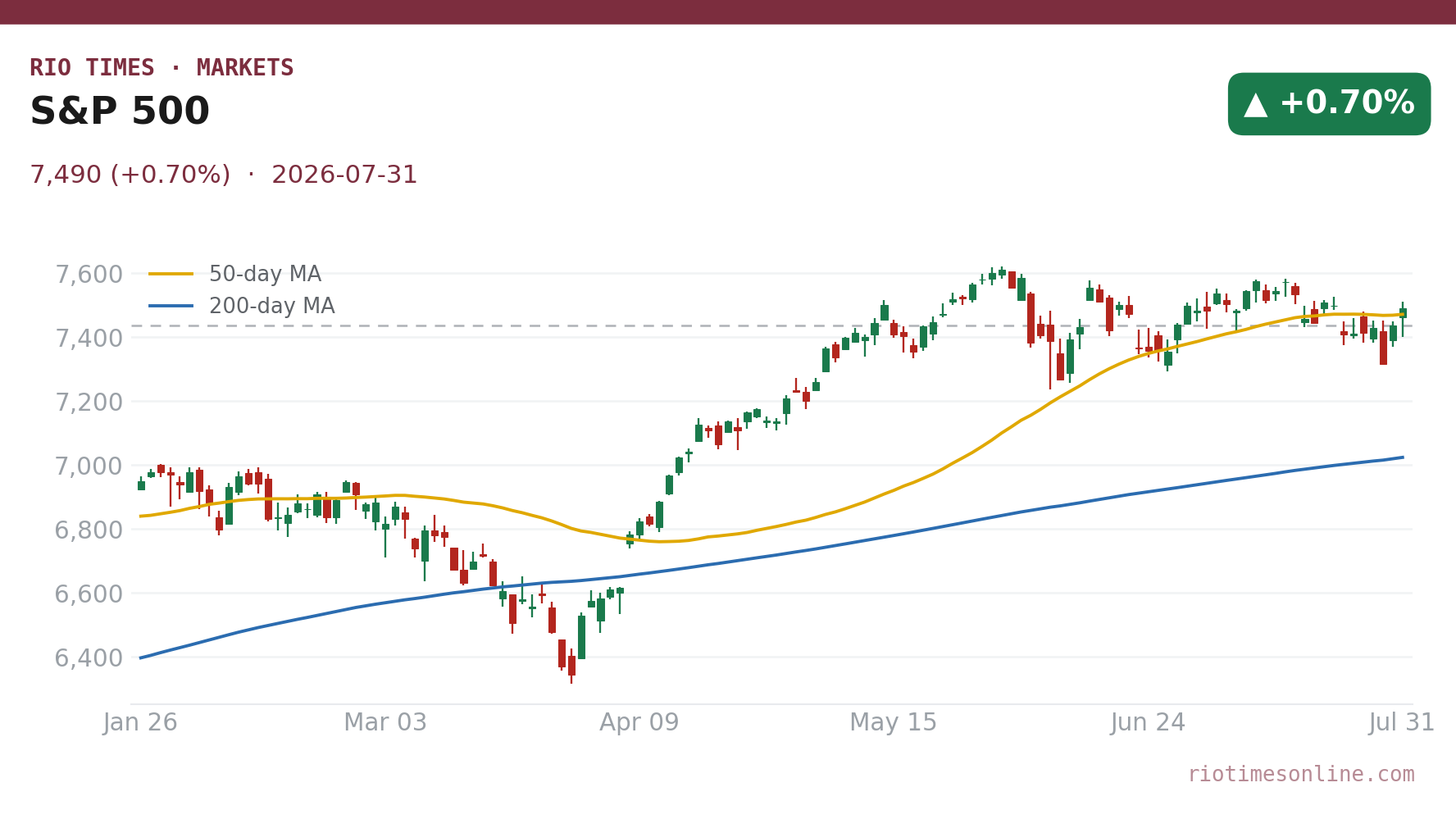
An uneasy calm settled over global markets to start a week that promises to reshape the interest-rate outlook. In New York, the S&P 500 rose 0.70% and the technology-heavy Nasdaq climbed a full 1.00%, gains that look confident until you notice that trading volumes were about a quarter below the month’s average. No one wanted to make a big bet before the data lands.
The bond market offered a clearer signal. The yield on the benchmark US 10-year Treasury note rose 1.35% on the session to settle at 4.74%, a level that has historically caused indigestion for growth stocks and emerging markets alike. A rising yield means the market is quietly demanding higher compensation for the risk of lending to the US government—a dynamic that can pull capital out of riskier corners of the world, including Latin America.
In Asia, trading was thin ahead of a Bank of Japan policy minutes release that might reveal how close the board is to lifting rates again. European bourses opened modestly higher, with Frankfurt’s DAX drawing support from a weaker euro, which makes the region’s exporters more competitive. The overall picture is one of a global investor community holding its breath, cash-heavy and waiting for the US numbers that will define the autumn’s playbook.
The VIX, often called Wall Street’s fear gauge, dropped 6.44% to 15.99, a reading that suggests options traders see little risk of a sharp near-term sell-off. That low level is both comforting and a warning: with so much event risk packed into a single week, complacency could be punished quickly if the JOLTS report or factory orders print comes in far from consensus.
Equity markets are pricing in a benign outcome where the US economy cools just enough to keep the Fed on the sidelines but not enough to crush earnings. The evidence is mixed: the VIX at 15.99 shows remarkable calm, yet the 10-year Treasury yield at 4.74% signals a bond market that is still deeply uneasy about sticky inflation and heavy government borrowing. The variable to watch is the JOLTS quits rate—a closely tracked proxy for worker confidence that tends to lead consumer spending by several months.
02 The global board
| Instrument | Level | Change | Read |
|---|---|---|---|
| S&P 500 | 7,490 | +0.70% | Tech leads; broad risk‑on tone |
| Nasdaq | 25,374 | +1.00% | Megacap strength resumes |
| Dow Jones | 52,485 | +0.53% | Industrials steady, financials mixed |
| VIX | 15.99 | −6.44% | Complacency or calm before the storm |
| DXY (US dollar) | 99.914 | +0.05% | Barely moved; waiting for data |
| Gold | $4,051 | −1.33% | Pressured by higher Treasury yields |
| US 10Y yield | 4.74% | +1.35% | Bond sell‑off resumes ahead of supply |
The table shows a classic ‘risk‑on’ posture in equities paired with a cautious tick higher in both the dollar and Treasury yields. The Nasdaq’s 1% gain was the standout, driven by a handful of megacap technology names that benefit from any narrative of resilient consumer spending. A 1.33% drop in gold reinforces that story: when yields rise, the opportunity cost of holding a zero‑yielding metal like bullion goes up, and some speculative money headed for the exit.
The dollar’s near‑flat session, with the DXY at 99.914, is best understood as the result of offsetting forces. A firm Treasury market supports the greenback, but the risk‑on mood in stocks normally pulls it lower. The two cancelled each other out, leaving currency markets to wait for the first concrete data point—Tuesday’s ISM manufacturing survey—before choosing a direction. For Latin American traders, that means the real and the peso start the week without any strong external push. Rio Times · Live Market Intelligence
Live Market IntelligenceGlobal Markets — Live Board
Global Markets — Live Board
Instrument Last Change YoY Prev. High Low Volume
SPX
7,751
+0.29%
—
—
—
—
—
NDX
29,799
+0.93%
—
—
—
—
—
DJI
53,810
+0.03%
—
—
—
—
—
RUT
3,041
+0.46%
—
—
—
—
—
US10Y
4.6760
-0.17%
—
—
—
—
—
VIX
14.60
-4.45%
—
—
—
—
—
DAX
26,331
-0.23%
—
—
—
—
—
FTSE
10,833
-0.10%
—
—
—
—
—
CAC
8,675
-0.46%
—
—
—
—
—
STOXX
659.48
-0.16%
—
—
—
—
—
NIKKEI
67,524
+0.83%
—
—
—
—
—
HSI
25,440
-0.83%
—
—
—
—
—
KOSPI
6,579
+3.68%
—
—
—
—
—
CSI300
4,691
+0.58%
—
—
—
—
—
NIFTY
24,436
-0.15%
—
—
—
—
—
TSX
36,619
+0.39%
—
—
—
—
—
GOLD
4,461
+1.78%
+33.20%
4,383
4,503
4,421
139,824
SILVER
65.59
+1.26%
+73.05%
64.77
66.98
64.81
46,406
03 The main event — US data week opens with JOLTS and ISM
Tuesday marks the start of a four‑day data programme that will either confirm or puncture the soft‑landing consensus. First up is the ISM manufacturing purchasing‑managers index (PMI), a survey of factory purchasing managers that acts as a real‑time temperature check on American industry. The consensus forecast of 54 suggests expansion, though slightly slower new‑order growth would be the ideal Goldilocks reading.
Simultaneously, the Bureau of Labor Statistics releases the Job Openings and Labor Turnover Survey, known universally as JOLTS. Markets expect 7.25 million job openings, a small decline from the prior 7.59 million. The number that seasoned traders watch even more closely is the quits rate—the share of workers voluntarily leaving their jobs—which has historically been one of the best leading indicators of wage pressure. A quits rate that stays above 3.05% would signal that workers are still confident they can find better pay elsewhere, a dynamic that makes the Fed’s inflation fight harder.
Also landing on desks is the factory orders report, which measures the dollar volume of new orders for manufactured goods. A consensus rise of 0.5% would reverse a chunk of last month’s 1.3% decline and, more importantly, the core number excluding the volatile transportation category is expected to show a healthy 0.5% gain. Together, these three reports—JOLTS, ISM and factory orders—form a triad that can move the dollar, the bond market and global equities within minutes of their release.
04 Policy and data
The Federal Reserve’s policy trajectory hangs on the data arriving this week. There is no rate decision at this meeting, but every FOMC member will be watching the same JOLTS and ISM numbers that the market is, using them to calibrate their speeches in the days ahead. The 10‑year Treasury yield at 4.74% already imposes a meaningful tightening of financial conditions even without a formal rate hike—a point that Fed governor Christopher Waller made in a speech during late July.
In Europe, German retail sales data disappointed, with the monthly reading expected to show a 0.5% decline. The figure reinforces the narrative of a eurozone economy that is struggling to find its footing, keeping pressure on the European Central Bank to signal additional easing before year‑end. The Schatz auction, Germany’s two‑year government bond sale, will test demand for short‑dated European paper later in the session.
Asia’s overnight calendar is anchored by the Bank of Japan’s monetary policy meeting minutes, which could reveal the intensity of internal debate over the timing of the next rate increase. Japan also releases average cash‑earnings data—estimated at a 3.4% year‑on‑year rise—which feeds directly into household spending and the inflation outlook. In China, the absence of major data releases means the yuan and Shanghai stocks will take their cue from the global risk mood and commodity prices.
05 Commodities and currencies
Gold’s 1.33% drop to $4,051 an ounce was the clearest commodity signal of the session, reflecting the gravitational pull of rising bond yields. Silver fell even more sharply, off 2.18% to $57.79 an ounce, a reminder that the industrial metal is often more sensitive to liquidity conditions than its golden cousin. A rising‑yield environment tends to strengthen the dollar and make dollar‑priced commodities more expensive for foreign buyers, a double headwind.
The oil market is focused on the American Petroleum Institute’s weekly crude‑stock report, due late in the US session. The prior week showed a build of 3.3 million barrels, and traders will be looking for signs that summer driving demand is absorbing supply. Brent and WTI crude prices have been range‑bound but sensitive to economic‑growth signals, meaning Tuesday’s ISM manufacturing print could indirectly move the oil market as much as the inventory data itself.
In the currency space, the dollar index remained essentially flat at 99.914, a pause after a week in which the greenback has been gently declining. The Mexican peso, Chilean peso and Colombian peso all start the week without any strong directional push from the broad dollar, leaving them exposed only to local data and commodity prices. The Colombian peso had an especially strong prior session, with USD/COP falling 2.46%, a move that reflects both a softer dollar and some improving sentiment around the government’s fiscal management.
06 The Latin American read-through
The Ibovespa, Brazil’s benchmark stock index, rose 0.47% in a session that closely tracked the New York tape. In a sign of how global this all is, the divergence signal shows the Brazilian board moving almost in lockstep with the S&P 500, confirming that Friday’s trading was driven less by domestic catalysts than by a broad risk‑on wave washing across emerging markets. The real weakened fractionally, with USD/BRL at 5.0754, a 0.32% move that is barely above the day‑to‑day noise.
Among the standouts on B3, Brazil’s stock exchange, Banco Santander Brasil’s units (SANB11) soared 13.3% on turnover of R$714 million, an eye‑catching move that reflects a mix of earnings‑season positioning and a rotation into financials. The biggest loser was EZTEC (EZTC3), a mid‑sized construction and development company, which fell 3.7% on thin volume of R$18 million—a reminder that the domestic real‑estate sector remains sensitive to the high Selic rate.
Monday’s economic data will test the Brazilian market more directly. The S&P Global manufacturing PMI is expected at 49.7, which would land just barely in contraction territory and would be the weakest reading in months. The central bank’s weekly Focus survey of economists will also land, likely maintaining a cautious inflation forecast that limits any near‑term prospect of Selic cuts. Across the region, Mexico’s manufacturing PMI is seen at 51.5, comfortably in expansion, while Colombia’s Davivienda PMI is forecast at 53—reinforcing the picture of a multi‑speed Latin American recovery where commodity exporters are holding up better than manufacturing-heavy economies.
For the strategy desks in São Paulo, Santiago and Mexico City, the real action this week sits in Washington, not Brasília. The JOLTS report and the ISM survey will determine whether the dollar strengthens and US yields climb further, which would directly pressure Latin American currencies and could quickly reverse the Ibovespa’s recent recovery. The variable to watch is the quits rate: a hot number signals a tight US job market, a firmer dollar, and a more challenging funding environment for the Latin American names that are trading on borrowed time and borrowed dollars.
07 What to watch
- US JOLTS job openings: A quits rate above 3.05% would signal persistent wage pressure, pushing Treasury yields higher and strengthening the dollar—a direct headwind for emerging‑market currencies and equities.
- ISM manufacturing PMI: Any print above 55 could convince traders the US economy is re‑accelerating, which would likely send the 10‑year yield towards 4.80% and rattle rate‑sensitive sectors globally.
- German retail sales and Schatz auction: Weak European data plus firm demand for German government paper would widen the transatlantic bond‑yield gap, weakening the euro and potentially boosting the dollar by default.
- API weekly crude stock change: A larger‑than‑expected inventory draw would lift oil prices, providing a tailwind for Latin American oil exporters but complicating the global inflation picture.
Background: US Lifts Mexico Cattle Ban After Screwworm Crisis.
Background: Dominican Republic Negotiates to Soften a New 12.5% US Tariff.
Frequently Asked Questions
Why did stocks rise if bond yields also went up?
Typically, rising yields hurt stocks, but Friday’s move was driven by tech‑sector optimism and end‑of‑week positioning. A sustained rise in yields, however, would eventually pressure equities.
What is the JOLTS report and why does it matter?
The Job Openings and Labor Turnover Survey measures how many jobs are available and how freely workers are quitting. A high quits rate signals worker confidence and often leads to higher wages, which can keep inflation sticky.
How does a strong dollar affect Latin American markets?
A stronger dollar makes it more expensive for Latin American companies and governments to service dollar‑denominated debt. It also tends to push commodity prices lower, hurting exporters.
What is the Selic rate and why is it important to the briefing?
The Selic is Brazil’s benchmark interest rate, set by the central bank. It influences everything from mortgage costs to corporate borrowing, and its level relative to US rates helps determine whether foreign capital flows into or out of Brazil.
This article was produced by The Rio Times’ automated newsroom system. How we use AI · Report an error
LatAm Markets: Live Signals → — real-time movers, turnover leaders and FX across Latin America.