Key Facts
- Bitcoin settled at US$64,845, dipping 0.09% on Sunday as a contested fork proposal produced only two blocks before stalling.
- Ethereum fell 0.36% to US$1,909 while Solana bucked the trend, adding 0.32% to reach US$76.21.
- Brazil unveiled rules allowing banks to freeze suspicious crypto transactions for up to 24 hours targeting overseas transfers above US$10,000 effective January 1, 2027.
- The US Senate filed a motion to proceed on the CLARITY Act setting a mid-September vote on a bill that would regulate stablecoins and market structure.
- Trump Media abandoned its crypto treasury and prediction-market deals with Crypto.com shifting focus to media licensing and a planned merger in the fusion energy sector.
- A volunteer security team using AI scanned 150 Bitcoin repositories and disclosed more than a dozen critical vulnerabilities in core open-source infrastructure.
Today’s Focus
Bitcoin closed the Sunday session virtually unchanged at US$64,845, a decline of just 0.09%. The narrow move masked a dramatic technical event: the much-discussed BIP-110 enforcement fork mined only two blocks before grinding to a halt as it attracted a mere 2.53% of total hashpower.
The breakaway chain now faces a roughly 350-day wait for a difficulty adjustment, leaving the main Bitcoin network wholly dominant. Ethereum slipped 0.36% to US$1,909, while Solana gained 0.32% to US$76.21 and XRP dropped 0.93% to US$1.0289.
In Brazil, regulators published final rules for a 24-hour freeze on suspicious crypto transfers above US$10,000 sent to overseas providers or self-custody wallets. The regulation, effective January 1, 2027, explicitly targets fraud and will reshape how exchanges serving Latin America’s largest economy monitor cross-border flows.
Washington also stirred: Senate Majority Leader John Thune filed a motion to proceed on the CLARITY Act, scheduling a mid-September vote on comprehensive stablecoin and market-structure legislation. Meanwhile, the US Treasury sanctioned two exchanges—one based in Georgia and the UAE—that it accused of laundering millions for Iran’s Revolutionary Guard.
What matters today. The combination of Brazil’s aggressive anti-fraud rules and Washington’s push for stablecoin law will force Latin American exchanges to upgrade compliance infrastructure immediately.

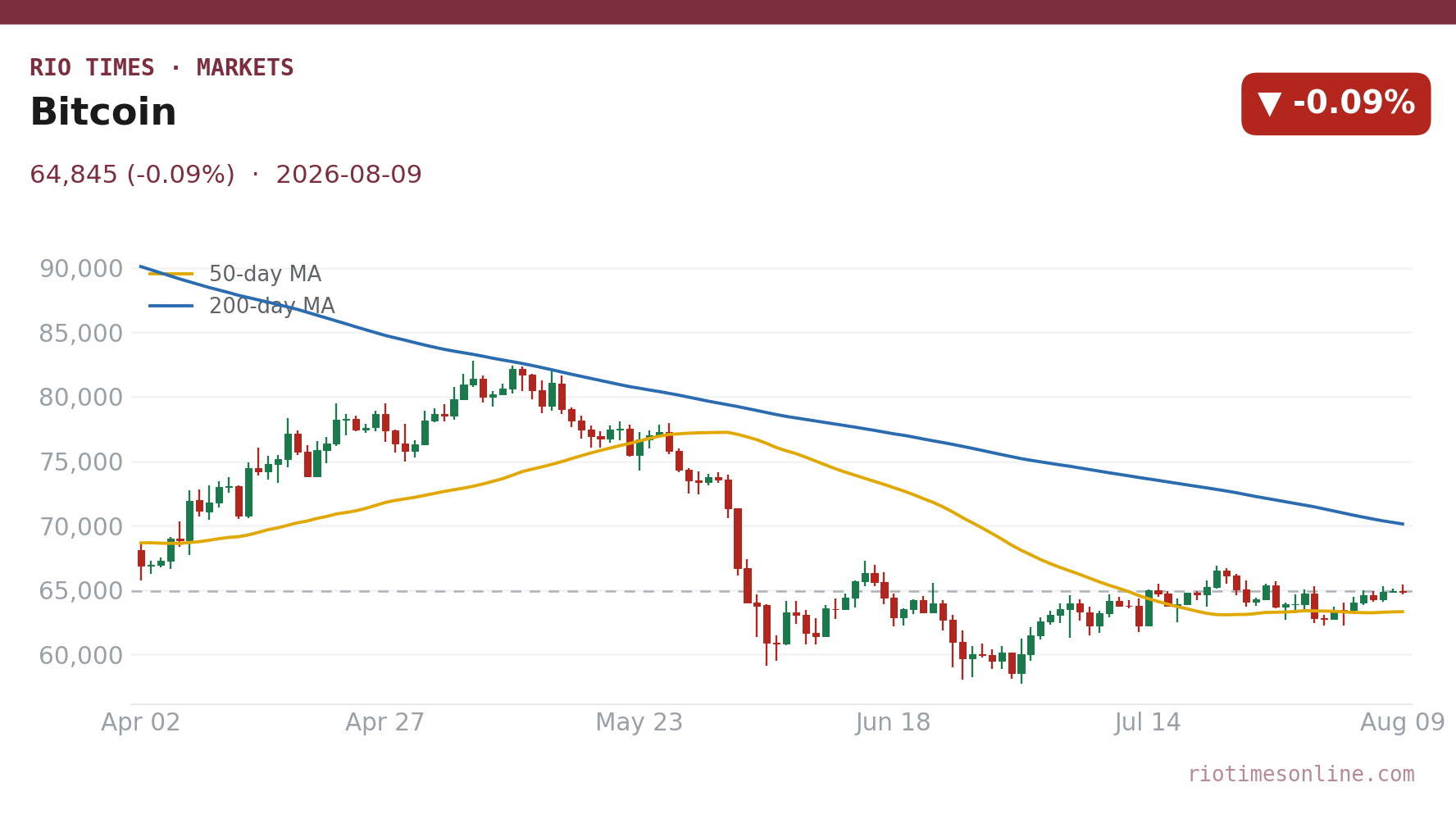
01 The session in one read
Bitcoin barely budged on Sunday, settling at US$64,845 for a fractional loss of 0.09%. But the calm price action concealed a noisy technical subplot: BIP-110, a proposed enforcement fork, mined just two blocks before supporters ran out of hashpower.
The fork needed majority miner backing to adjust its difficulty; instead it attracted only 2.53% of the network and now faces a months-long stall. The episode drained zero value from the main chain, which continued processing blocks without interruption.
The failed BIP-110 fork reinforces that Bitcoin’s consensus mechanism remains resistant to minority-led changes, a structural strength that will comfort institutional allocators. However, the policy calendar is the true driver: Brazil’s new 24-hour freeze rule creates an immediate engineering burden for exchanges operating across the Real corridor, while the CLARITY Act vote in mid-September could finally deliver a US framework for dollar-pegged stablecoins that dominate Latin American remittance corridors. The variable to watch is whether Brazilian onshore exchange trading volumes drop in Q4 as customers react to the looming January compliance deadline, or simply migrate to peer-to-peer rails that are harder to monitor.
02 The board
Ethereum slipped 0.36% to US$1,909. It continues drifting below the US$2,000 mark.
Solana was the only gainer among majors. It ticked up 0.32% to US$76.21.
XRP fell the most, dropping 0.93% to US$1.0289. The mixed moves reflect a market digesting regulatory headlines.
| Asset | Level | Change |
|---|---|---|
| Bitcoin | US$64,845 | -0.09% |
| Ethereum | US$1,909 | -0.36% |
| Solana | US$76.21 | +0.32% |
| XRP | US$1.0289 | -0.93% |
Source: RT close, 2026-08-09. Where a commodity has no spot feed, an exchange-traded tracker or leading producer is shown as a labelled proxy.
Live Market IntelligenceThe live market board
Rio Times · Live Market Intelligence
Latin America — Cross-Market Board
| Instrument | Last | Change | YoY | Prev. | High | Low | Volume |
|---|---|---|---|---|---|---|---|
| IBOV | 183,476.86 | -0.27% | +21.85% | 183,965.91 | 168,310 | 167,142 | — |
| IPSA | 11,255.90 | -0.39% | — | 11,299.82 | 11,210 | 10,984 | 1,513,213,483 |
| IPC MEX | 64,992.23 | +1.13% | +12.17% | 64,264.16 | 66,121 | 65,405 | 108,886,187 |
| MERVAL | 2,893,751 | -1.57% | +30.51% | 3,022,485 | 3,042,365 | 2,991,150 | — |
| COLCAP | 2,584.72 | -0.95% | — | 9.04 | 9.05 | 9.02 | 4,133 |
| BVL PERÚ | 59,934.37 | +1.27% | — | — | — | — | — |
| USD/BRL | 5.16 | +0.01% | -5.13% | 5.16 | 5.18 | 5.14 | — |
| EUR/BRL | 5.95 | +1.01% | -5.83% | 5.89 | 5.98 | 5.94 | — |
| USD/MXN | 17.06 | -0.24% | -8.58% | 17.10 | 17.08 | 17.01 | — |
| USD/CLP | 913.98 | +0.04% | -5.67% | 913.65 | 915.11 | 906.68 | — |
| USD/COP | 3,140 | +0.03% | -22.04% | 3,139 | 3,141 | 3,105 | — |
| USD/PEN | 3.36 | -0.66% | -4.82% | 3.38 | 3.38 | 3.35 | — |
| USD/ARS | 1,493 | +0.10% | +12.96% | 1,491 | 1,494 | 1,480 | — |
| USD/UYU | 40.27 | +1.24% | +1.80% | 39.77 | 40.27 | 40.23 | — |
| USD/PYG | 5,939 | +1.68% | -19.54% | 5,841 | 5,939 | 5,925 | — |
| USD/BOB | 11.64 | -0.76% | +72.04% | 11.73 | 11.72 | 11.64 | — |
| USD/DOP | 58.34 | +1.25% | -3.44% | 57.62 | 58.34 | 58.04 | — |
| USD/CRC | 445.92 | +0.89% | -9.71% | 441.97 | 448.50 | 445.92 | — |
03 What moved it
Brazil’s central bank and securities regulator finalized rules on freezing suspicious crypto transfers. They allow financial institutions to block transfers for up to 24 hours.
The measure applies to transactions above US$10,000. It covers transfers to overseas virtual-asset providers or self-custody wallets.
The new rules take effect on January 1, 2027.
In Washington, Senate Majority Leader John Thune filed a motion early Saturday. This move advances the CLARITY Act toward a mid-September vote.
The bill would create a federal framework for stablecoin issuance. It also addresses digital-asset market structure.
These pillars directly affect dollar-denominated stablecoins. Such coins are widely used in Latin America.
A sharp corporate reversal also rippled through the market. Trump Media & Technology Group said it is unwinding two deals with Crypto.com.
The firm is abandoning a crypto treasury strategy. It also ended a prediction-market partnership.
The company cited a strategic pivot to media licensing. It also plans a merger with a fusion-energy company.
04 The Latin American read
For Argentina, where stablecoin adoption has surged as a hedge against triple-digit inflation, the CLARITY Act’s progress matters enormously. A clear US regulatory seal on dollar-pegged stablecoins like USDC would reduce legal uncertainty for the millions of Argentines who already use them for savings and everyday payments.
Brazil’s new fraud-freeze rules will force exchanges such as Mercado Bitcoin, Foxbit and the local arms of Binance and OKX to build real-time monitoring systems that can flag and pause suspect outflows to non-custodial wallets. The US$10,000 threshold captures a large share of remittance corridors connecting Brazil to Portugal, Paraguay and the United States.
In El Salvador, where Bitcoin remains legal tender, the stalled BIP-110 fork is a non-event for the national treasury’s holdings and the Chivo wallet infrastructure. The episode instead serves as a demonstration that Bitcoin’s architecture resists capture by splinter factions, reinforcing the asset’s credibility as a long-term sovereign reserve.
05 The names to watch
US spot Bitcoin ETFs just had their best week since April. They pulled in roughly US$1 billion in net inflows.
The vehicle to watch is BlackRock’s iShares Bitcoin Trust. It typically captures the largest share of institutional flows during accumulation windows.
Robinhood’s crypto chief Johann Kerbrat signaled a bigger push into digital assets. He told Decrypt the company aims to show customers it cares.
The platform’s Latin American user base is concentrated in Brazil. It could benefit from an expanded token menu if regulators approve additional listings.
06 The outlook
The coming week will test whether the US$1 billion inflow into spot Bitcoin ETFs is durable. Or if it’s just tactical positioning before the CLARITY Act vote.
Brazilian exchanges will consult compliance teams on the January 2027 freeze rules. They’ll weigh the operational cost of those rules.
That internal calculus may slow product launches across the Real economy. It could also shift their pacing.
07 What to watch
- Brazilian exchange volumes: Watch whether onshore trading dips as customers react to the 24-hour freeze rules taking effect in January 2027, or shifts to peer-to-peer channels.
- CLARITY Act procedural clock: The mid-September Senate vote on advancing the bill will determine whether a stablecoin framework lands before the congressional recess, directly affecting USDC and USDT usage in Argentina.
- Ethereum’s US$2,000 resistance: Repeated failures to reclaim the US$2,000 level could signal exhaustion among buyers who piled in during the ETF-driven rally earlier in the year.
- Trump Media fallout: The unwinding of two Crypto.com partnerships removes a high-profile corporate adopter and may dampen broader sentiment around publicly listed companies holding crypto treasuries.
Frequently Asked Questions
What is BIP-110 and why did it fail?
BIP-110 is a Bitcoin improvement proposal that sought to add enforcement mechanisms against spam transactions. The fork failed because it attracted only 2.53% of miner support, leaving it stuck at Bitcoin’s full difficulty with a roughly 350-day wait for adjustment.
What does Brazil’s new rule do?
Brazil’s financial regulators finalised rules allowing banks to freeze suspicious crypto transfers for up to 24 hours when transactions exceed US$10,000 and are sent to overseas providers or self-custody wallets. The rule takes effect January 1, 2027.
What is the CLARITY Act?
The CLARITY Act is a US Senate bill that would create a federal framework for issuing stablecoins and regulating digital-asset market structure. Senate Majority Leader John Thune filed a motion to proceed in early August, setting a mid-September vote.
How did the major cryptocurrencies perform on Sunday?
Bitcoin settled at US$64,845 (down 0.09%), Ethereum at US$1,909 (down 0.36%), Solana at US$76.21 (up 0.32%), and XRP at US$1.0289 (down 0.93%).
This article was produced by The Rio Times’ automated newsroom system. How we use AI · Report an error
LatAm Markets: Live Signals → — real-time movers, turnover leaders and FX across Latin America.
Read More from The Rio Times