Key Facts
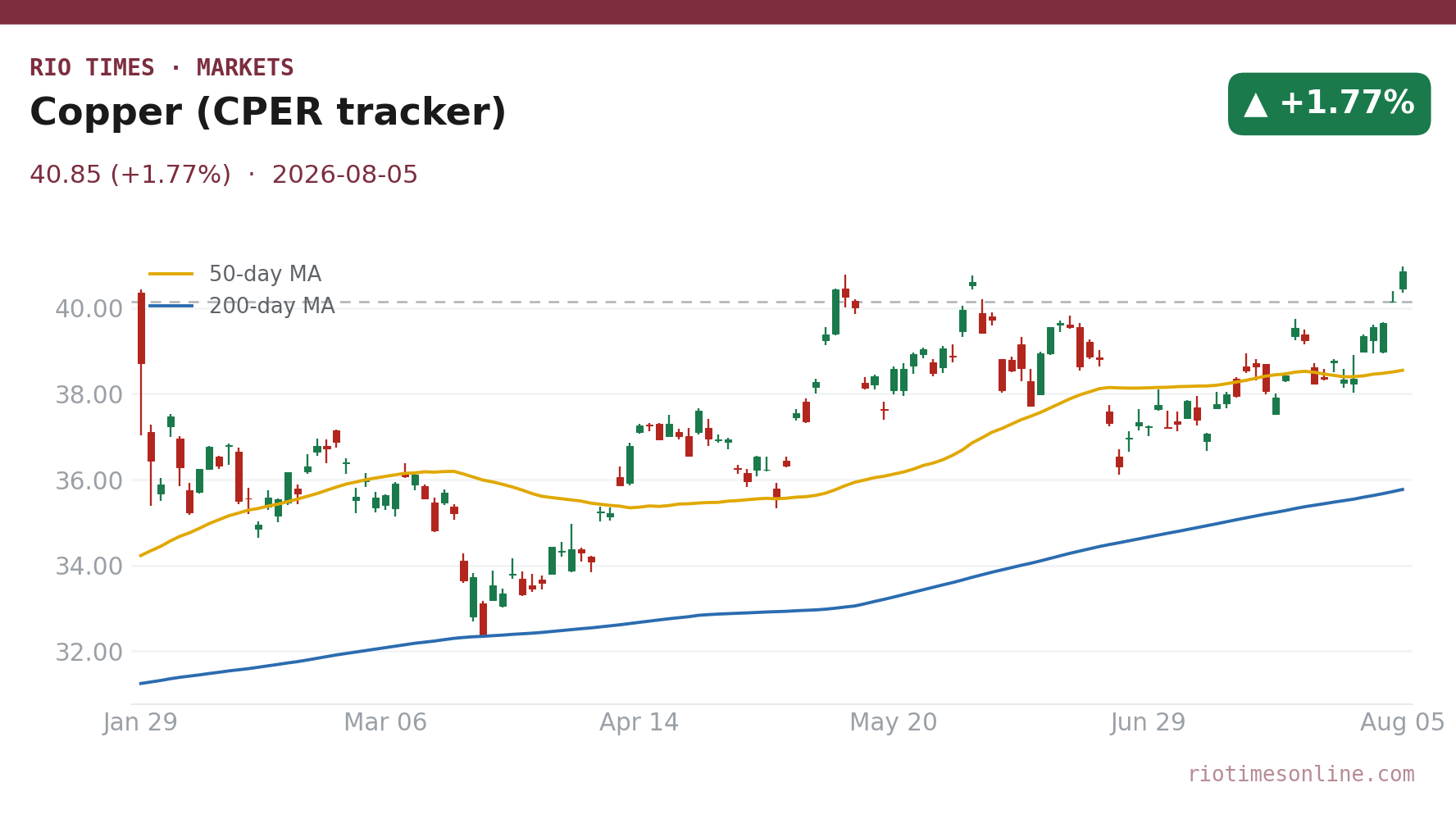
- The United States Copper Index Fund (CPER), a copper futures-tracking instrument, settled at US$40.85, a daily gain of 1.77 per cent, reflecting derivative-market pricing rather than spot copper.
- Freeport-McMoRan shares jumped 3.11 per cent to US$69.39, making the miner with large operations in the Americas and Indonesia the session’s standout gainer.
- Southern Copper settled at US$197.00, up 0.94 per cent, as the producer with significant Peruvian and Mexican assets caught a bid alongside climbing futures.
- Chile remains the world’s largest copper producer, led by state-owned Codelco, the globe’s number-one copper-mining company by output.
- Peru is one of the world’s top three copper producers, with mines run by Freeport-McMoRan, Southern Copper and others driving national export earnings.
- Gains came as traders weighed softer short-term Chinese demand signals against constrained mine supply and the accelerating pull of the energy transition on future copper needs.
Today’s Focus
Copper proxies advanced on Wednesday, August 5, 2026, as financial investors bought into the long-term supply squeeze narrative even as near-term Chinese consumption signals softened. The United States Copper Index Fund (CPER), which tracks a portfolio of copper futures contracts, settled at US$40.85, a daily rise of 1.77 per cent.
Freeport-McMoRan, a top global miner with vast Americas operations, jumped 3.11 per cent to US$69.39, while Southern Copper, a heavyweight in Peru and Mexico, added 0.94 per cent to US$197.00. The moves highlight a market looking through a cyclical China wobble toward a structural mismatch between mine output from Chile and Peru and rising global electrification demand.
China, the world’s largest copper consumer, generates demand through electrical equipment, construction, and transport—all sectors sensitive to manufacturing and property data. On the other side, concentrated supply from Chile’s Codelco-led industry and Peru’s multinational-run mines faces persistent project delays, community friction, and underinvestment, reinforcing expectations of tighter copper balances ahead.
What matters today. The August 5 advance was powered by investors betting the energy transition will outlast any dip in Chinese industrial activity, tightening the long-term physical market.

01 The session in one read
Copper instruments gained ground on Wednesday, August 5, 2026, led by a sharp 3.11 per cent jump in Freeport-McMoRan to US$69.39. The United States Copper Index Fund (CPER), which holds copper futures, not physical metal, settled at US$40.85.
Southern Copper rose 0.94 per cent to US$197.00. The gains came as traders balanced China’s faltering near-term manufacturing signals against a longer-run conviction that constrained South American supply will fail to meet accelerating demand from global electrification.
The session carried a default-bullish tenor for copper, where every pullback in Chinese demand data is met by positioning for inevitable grid and electric-vehicle buildout. The risk is that CPER’s futures-based structure can amplify moves disconnected from warehouse copper availability, especially in contango. Watch Chinese property-sector credit disbursement next—fresh weakness there would test whether the green-demand bid can hold prices at these levels.
02 The board
The three-tracker board shows a clear tilt toward financial copper exposure. CPER’s 1.77 per cent advance to US$40.85 reflects the price and rolling costs of U.S.-traded copper futures, placing it squarely in the derivatives world rather than the spot market for physical cathodes.
Freeport-McMoRan’s 3.11 per cent surge to US$69.39 marked the session’s most forceful expression of bullishness, amplified by its massive Americas footprint. Southern Copper’s more modest 0.94 per cent rise to US$197.00 suggests investors rewarded, but did not chase, its concentrated Peruvian and Mexican production base.
| Asset | Level | Change |
|---|---|---|
| Copper (CPER tracker) | US$40.85 | +1.77% |
| Southern Copper | US$197.00 | +0.94% |
| Freeport-McMoRan | US$69.39 | +3.11% |
Source: RT close, 2026-08-05. Where a commodity has no spot feed, an exchange-traded tracker or leading producer is shown as a labelled proxy.
Live Market IntelligenceThe live market board
Rio Times · Live Market Intelligence
Latin America — Cross-Market Board
| Instrument | Last | Change | YoY | Prev. | High | Low | Volume |
|---|---|---|---|---|---|---|---|
| IBOV | 185,229.17 | -0.41% | +21.85% | 185,992.03 | 168,310 | 167,142 | — |
| IPSA | 11,381.18 | +1.30% | — | 11,235.60 | 11,210 | 10,984 | 1,513,213,483 |
| IPC MEX | 63,375.93 | -0.78% | +12.17% | 63,873.32 | 66,121 | 65,405 | 108,886,187 |
| MERVAL | 3,021,926 | -1.29% | +30.51% | 3,022,485 | 3,042,365 | 2,991,150 | — |
| COLCAP | 2,548.22 | +1.05% | — | 9.04 | 9.05 | 9.02 | 4,133 |
| BVL PERÚ | 60,023.65 | -1.13% | — | — | — | — | — |
| USD/BRL | 5.16 | +0.01% | -5.13% | 5.16 | 5.18 | 5.14 | — |
| EUR/BRL | 5.95 | +1.01% | -5.83% | 5.89 | 5.98 | 5.94 | — |
| USD/MXN | 17.06 | -0.24% | -8.58% | 17.10 | 17.08 | 17.01 | — |
| USD/CLP | 913.98 | +0.04% | -5.67% | 913.65 | 915.11 | 906.68 | — |
| USD/COP | 3,140 | +0.03% | -22.04% | 3,139 | 3,141 | 3,105 | — |
| USD/PEN | 3.36 | -0.66% | -4.82% | 3.38 | 3.38 | 3.35 | — |
| USD/ARS | 1,493 | +0.10% | +12.96% | 1,491 | 1,494 | 1,480 | — |
| USD/UYU | 40.27 | +1.24% | +1.80% | 39.77 | 40.27 | 40.23 | — |
| USD/PYG | 5,939 | +1.68% | -19.54% | 5,841 | 5,939 | 5,925 | — |
| USD/BOB | 11.64 | -0.76% | +72.04% | 11.73 | 11.72 | 11.64 | — |
| USD/DOP | 58.34 | +1.25% | -3.44% | 57.62 | 58.34 | 58.04 | — |
| USD/CRC | 445.92 | +0.89% | -9.71% | 441.97 | 448.50 | 445.92 | — |
03 What moved it
The honest driver was not copper at all. Wednesday was a metals-wide melt-up: gold leapt 5.03%, silver 4.65%, and the copper-miners ETF COPX ran 3.25% higher, well ahead of the 1.77% move in the copper futures tracker itself.
That gap matters for reading Freeport-McMoRan. Its 3.11% jump outpaced copper because Grasberg makes it one of the world’s largest gold miners too, so it caught the bullion bid as much as the copper one. Southern Copper, a purer copper play, managed only 0.94%.
Simultaneously, supply angst remains acute. Chile, the world’s top producer through state-owned Codelco, faces declining ore grades and multi-year project timelines. Peru, another of the top producers, hosts major operations from Freeport-McMoRan and Southern Copper, where community relations and permitting delays stretch the timeline for new output. The futures market saw this gap as worth bidding.
04 The Latin American read
Chile’s copper dominance means every cent of price movement feeds directly into the fiscal equation for Santiago. Codelco’s ability to deliver against ambitious production targets is a variable that global copper futures now price with a scarcity premium. In Peru, the board’s advance reinforces the economic centrality of large-scale mines run by foreign operators, making any shift in royalty rules or local permits an immediate supply-side catalyst.
For regional investors, the August 5 session shows copper behaving less as a cyclical industrial metal and more as a strategic commodity anchored by Latin America’s constrained geology. That framing elevates the sensitivity of CPER and the producer shares to political risk from the Andes.
05 The names to watch
Freeport-McMoRan’s 3.11 per cent jump makes it the immediate name to track, with its Peru-based Cerro Verde mine and Indonesian Grasberg operation tying the stock to both copper and gold dynamics. Southern Copper, up 0.94 per cent, has a concentrated Peruvian and Mexican portfolio that makes it a high-beta play on Andean mining stability.
CPER, at US$40.85, is the cleanest financial-exposure vehicle for those unwilling to bet on a single miner’s balance sheet. It will change with futures roll costs and macro flows, rather than the physical delivery of copper from Chilean or Peruvian ports.
06 The outlook
Copper’s path will hinge on whether Chinese stimulus translates into fresh orders for wire and tube, validating futures prices, or whether property weakness drags on sentiment. The longer energy transition projects stay on drawing boards while mines in Chile and Peru face output headwinds, the more compelling the bull case for copper proxies. CPER’s futures structure means that contango could modestly erode returns if the spot physical market loosens, a risk worth weighing.
07 What to watch
- China credit and housing data: Watch for any new lending or construction figures that would signal a recovery in the world’s largest source of copper demand.
- Codelco production updates: Any revision to Codelco’s output guidance will directly shift global supply assumptions given Chile’s number-one producer status.
- Peruvian community permits: Southern Copper and Freeport-McMoRan mine expansions depend on community and regulatory green lights in Peru, another of the world’s largest producing countries.
- CPER futures roll costs: The shape of the copper futures curve will determine whether CPER gains a tailwind from backwardation or a drag from contango.
Frequently Asked Questions
Why did copper proxies rise on August 5?
Investors bought into the long-term supply shortage narrative driven by energy transition demand, overlooking softer short-term Chinese industrial signals.
What is CPER and how does it differ from spot copper?
The United States Copper Index Fund (CPER) is an ETF that tracks copper futures contracts, not physical metal, reflecting derivative-market pricing and roll costs.
Why do Chile and Peru matter for copper?
Chile is the world’s largest copper producer and Peru is among the top three; policy, production and community developments in both countries directly shape global supply expectations.
How does the energy transition affect copper?
Solar, wind, electric vehicles and grid expansion all require large amounts of copper, underpinning forecasts of rising long-term demand despite cyclical economic wobbles.
This article was produced by The Rio Times’ automated newsroom system. How we use AI · Report an error
LatAm Markets: Live Signals → — real-time movers, turnover leaders and FX across Latin America.
Read More from The Rio Times