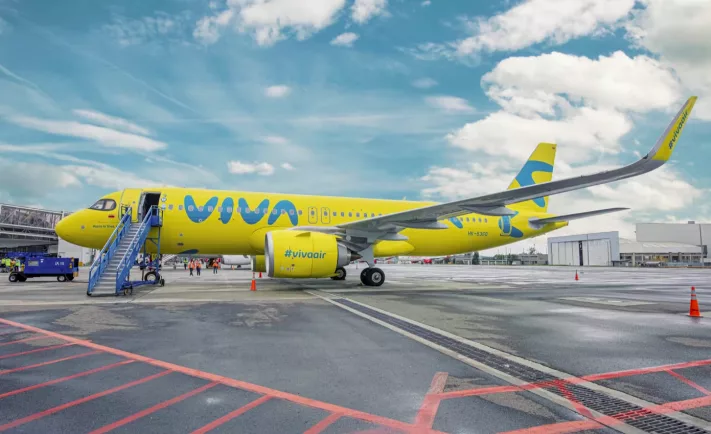
This Monday, Viva Air announced the immediate suspension of its operations.
This means that from now on, all its planes will be grounded and unable to operate any more routes.
Through a statement, the low-cost airline announced that the decision of Colombian Civil Air Transporters to accept as interested third parties five companies in the evaluation process of the integration of the low-cost with Avianca “will result in further delays in making a decision, so Viva is forced to announce, unfortunately, the suspension of its operations with immediate effect”.
The five companies are Ultra Air, Latam Airlines, Wingo, Aerolineas Argentinas, and JetSmart.
During the cessation of operations, Viva will continue negotiations with creditors under the procedures of Decree 560, a corporate recovery process, and reported that it would work to preserve its ability to restart operations at a future date, assuming the Civil Air Transporters immediately approves the pending alliance.
The company indicated that for seven months, it has been waiting for a decision from this air authority and that during that time, it has presented numerous pieces of evidence to the National Government to demonstrate that it is in a critical financial situation, assuring that the only way it can continue flying is for the Aerocivil to allow it to become part of a stronger and well-capitalized group of airlines.
“Instead, its decision today calls into question the future of low-cost air service in Colombia and jeopardizes the jobs of more than 5,000 Colombians who directly and indirectly depend on Viva,” the airline emphasized.
In this regard, the organization stated that it had had countless meetings with senior members of the Executive to explain the critical economic situation it was going through.
Also, the government received more than five financial updates to demonstrate that Viva qualified to treat its request under the “exception of company in crisis” scheme, which showed the urgency of a definition.
“A series of conditionalities that would preserve competition and air connectivity in remote areas were presented to the Civil Air Transporters, including the elimination of up to 105 slots (takeoff and landing slots) at El Dorado Airport in Bogota, the survival of the brand and its low-cost model, code-sharing to allow regional connectivity for Satena passengers and maintaining Viva’s interline agreements,” the firm added.
In this process, Viva’s aircraft lessors also met with the Executive to explain that they would not continue to wait for a decision, causing, in a short time, the loss of more aircraft from its fleet.
“For weeks now, the Civil Air Transporters has had everything necessary to issue a decision. They have had the full legal capacity and authority to issue that decision without further delay,” Viva Air stressed.
LATAM AIRLINES AND JETSMART WANT TO BUY VIVA AIR
Both Latam Airlines and JetSmart have expressed their intention to acquire Viva Air; two proposals that Avianca has emphatically rejected.
In an interview with Bloomberg Línea, the CEO of Latam Airlines Colombia, Santiago Álvarez, stated that “the first step is to carry out the financial analysis and being aware that speed is required in this process, we already have the internal team, the law firm, and the investment bank ready to move quickly in this process once the conversations between the parties begin”.
For its part, JetSmart, with services in the South American market since 2017 and with domestic operations in Chile, Argentina, and Peru, communicated last February 7 its intention to enter into negotiations to acquire 100% of the shares of Viva Air.
With information from Bloomberg
Editorial responsibility: Matthias Camenzind, Editor-in-Chief · Editorial standards · Report an error