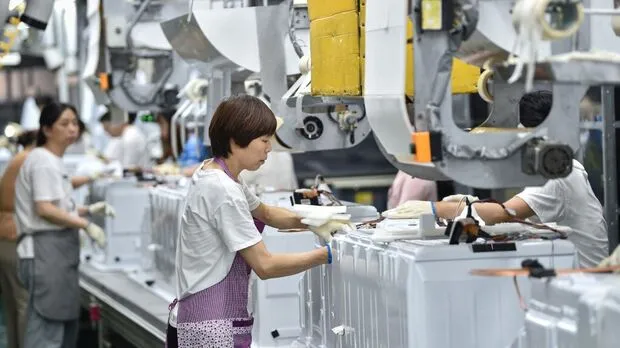
In May, China’s manufacturing activity contracted unexpectedly, with the Purchasing Managers’ Index (PMI) falling to 49.5 from April’s 50.4, signaling economic concerns.
This decline, reported by the National Bureau of Statistics (NBS), underscores weak business sentiment, influenced by sluggish domestic demand and the faltering property sector.
The PMI, indicating contraction when below 50, has only shown growth three times in the past year. Concurrently, the new order index, reflecting manufacturing demand, fell by 1.5 points.
Similarly, the non-manufacturing business activity index dropped slightly by 0.1 points to 51.1, primarily impacted by downturns in real estate and finance.
The construction sector also saw a decrease, with its index down by 1.9 points to 54.4.
Economists at Capital Economics and Morgan Stanley expressed concerns. The former expects limited momentum in recovery.
It anticipates the need for more fiscal support and property stimulus despite structural challenges.
The latter pointed out that increased manufacturing investment could lead to deflationary pressures, affecting corporate profitability and nominal GDP growth.
The ongoing property market slump has eroded consumer confidence significantly, prompting government interventions.
These include lending programs to manage housing oversupply and easing mortgage conditions to support homebuyers.
The International Monetary Fund (IMF) has adjusted its GDP growth forecast for China to 5% for 2024 and 4.5% for 2025.
However, it stressed the importance of further supportive policies, especially for the housing sector.
Growing tensions with the US and EU over excess industrial capacity escalate trade barriers, adding to economic challenges. This includes a 100% US tariff on certain Chinese imports.
Additionally, the first contraction in new export orders in three months and rising input costs have further complicated the economic landscape.
China faces mounting challenges in its manufacturing and broader economic sectors.
The need for effective policy responses and strategic reforms becomes increasingly critical to sustaining growth and stability.
This article was produced by The Rio Times’ automated newsroom system. How we use AI · Report an error
Read More from The Rio Times