Chile’s Foreign Minister Spent Five Days in China Talking About Artificial Intelligence
Chile · Technology
Key Facts
- —What happened Chile’s foreign minister spent five days in China discussing artificial intelligence and digital economy cooperation.
- —How big a jump Bilateral trade reached US$67.1 billion in 2025, but the visit focused on data centres and chips, not copper.
- —The real story Santiago sees technology ties as the next step for a relationship historically built on copper, cherries and salmon.
- —The catch No technology treaty or AI agreement was signed; only a set of understandings and intentions were published.
- —Where it touches The visit covered Beijing and Shanghai, with Huawei operating two data centres in Chile and a third announced.
- —What comes next Watch the frozen Chile–China Express cable project, which would physically link Chile to China’s technology bloc.
Copper was not the headline. What Santiago went to Beijing for this time was data centres, chips and the digital economy.
Chile China artificial intelligence cooperation was the headline theme of a five-day visit by foreign minister Francisco Pérez Mackenna, who was in Beijing and Shanghai from 18 to 22 August at the invitation of his counterpart Wang Yi. For a relationship built on copper, cherries and salmon, that is a notable change of subject — and it tells you what the government of José Antonio Kast thinks Chile needs next.
Who he saw and what they discussed
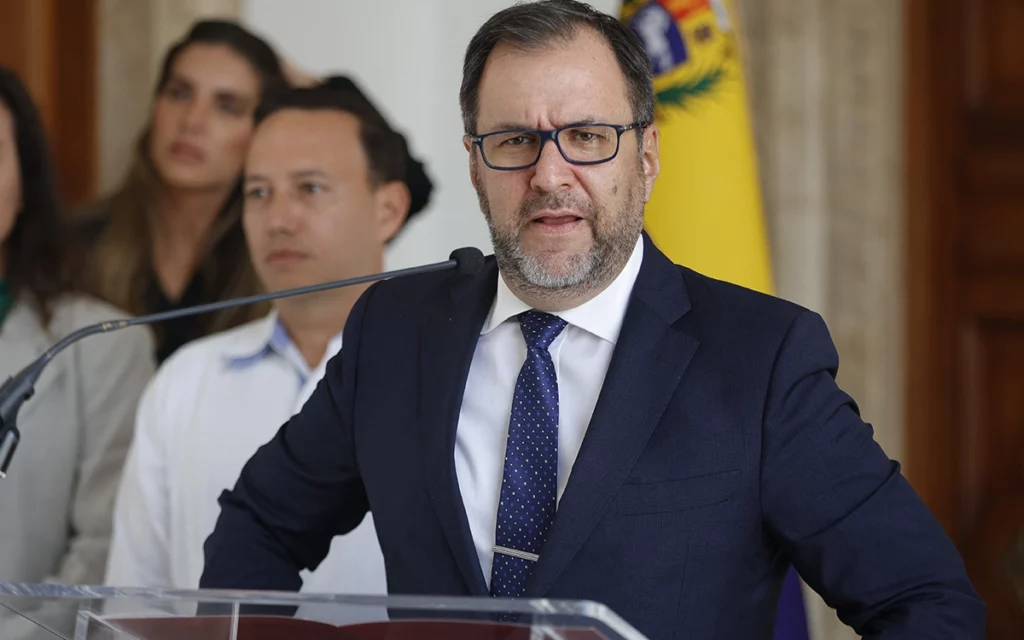
Pérez Mackenna met Wang Yi, vice-premier He Lifeng, Zhou Haibing of the National Development and Reform Commission, and science minister Yin Hejun. That combination is deliberate. Wang Yi handles diplomacy, He Lifeng handles the economy, the NDRC handles industrial planning and Yin Hejun handles research funding.
The published agenda covered artificial intelligence, the digital economy, scientific and technological innovation, talent training, and deeper integration of industrial chains — meaning Chinese manufacturers building further up or down the supply chain inside Chile rather than simply buying raw material from it.
On the business side, a session under the ‘Choose Chile’ banner — a standing investment-promotion programme, not a China-specific one — brought the minister together with executives from major Chinese companies in Beijing, across mining, agrifood, energy, infrastructure, telecoms and banking. Bilateral trade was US$67.1 billion in 2025.
What was not signed
It is worth being precise here, because a lot of coverage is not. No technology treaty or headline agreement on artificial intelligence was announced during the visit. What was published was a set of understandings and an intention to deepen cooperation.
Nor was there movement on submarine cables. Humboldt, the transpacific fibre link Chile has promoted as strategic infrastructure, is a Google joint venture with the Chilean state agency Desarrollo País and runs to Sydney, not Asia; it was approved in June and is due to be laid this year.
The one concrete document signed on 20 August came from a different trip altogether: agriculture undersecretary Francesco Venezian, on his own Asia tour, signed a memorandum with China’s General Administration of Customs on phytosanitary rules for Chilean fresh fruit. Useful, unglamorous, and about fruit rather than silicon.
What Chile China artificial intelligence cooperation could actually build
Chile has a genuine case to make. It has abundant solar and wind generation in the north, cold water and stable geology in the south, an investment-grade sovereign rating and the region’s most reliable electricity grid. Those are the four things a hyperscale data centre operator asks about.
The country has been marketing itself as the ‘data hub of the Americas’ for several years. Huawei operates two data centres there and has announced a third, worth about US$100 million. Google, Microsoft and Amazon have all committed capacity.
The complication is water and consent. Data centre projects around Santiago have run into permitting resistance over water use, and Chile’s environmental assessment system is slow by design. A memorandum in Beijing does not solve that.
The mining backdrop nobody left behind
The trip came a week after Chile’s mining ministry pressed its own case at home. Daniel Mas, who serves as both economy and mining minister under Kast, has set a target of six million tonnes of annual copper production, telling a Clapes UC seminar on 13 August that the aim is to unlock investment and reach that level with higher productivity. Chile produced 5.415 million tonnes in 2025.
The pipeline is large. Cochilco’s 2025–2034 investment portfolio runs to about US$104.5 billion, the biggest in more than a decade, and the CBC counts US$87.7 billion of investment projects for 2026–2030 with 41% of that in mining. By mid-August, Mas said 16 mining projects worth around US$24 billion had entered environmental review since the government took office in March — more than 83% of everything submitted nationally.
China buys most of that copper. Which is why a foreign minister can spend a week in Beijing talking about artificial intelligence and still be, in effect, protecting the copper relationship.
What it means for people in Chile
If the digital agenda advances, the visible effects will be industrial rather than consumer: construction jobs, electricity demand and pressure on water rights. Data centres employ few people once built.
The more immediate consequence is geopolitical. Chile is doing this while its trade relationship with Washington is strained over tariffs, and every step closer to Chinese technology in critical infrastructure narrows its room to manoeuvre later. The peso closed at about 925 to the US dollar on 20 August, weaker on the day after the central bank reported second-quarter GDP fell 0.2% year on year — a domestic problem, not a verdict on the trip.
Watch instead for the Chile–China Express cable, the China Mobile-backed link that would run from Hong Kong to Valparaíso and which the Kast government has left frozen in the defence and foreign ministries. That is the project where the abstract question of which technological bloc Chile belongs to becomes a physical thing lying on the seabed.
More: Chile news in English, every day from The Rio Times.
Frequently Asked Questions
What did Chile and China agree on artificial intelligence?
They agreed to deepen cooperation on artificial intelligence and the digital economy, but no specific treaty or signed technology agreement was announced during the 18-22 August visit.
Who is Chile’s foreign minister?
Francisco Pérez Mackenna, serving in the government of José Antonio Kast. He travelled to China at the invitation of Chinese foreign minister Wang Yi.
Was anything signed on submarine cables?
No. Humboldt, the transpacific cable, is a Google and Desarrollo País joint venture running to Sydney and unrelated to this visit. The China-backed Chile–China Express link remains frozen. The one document signed on 20 August was an agricultural memorandum, from a separate Chilean delegation.
Connected Coverage
Chile Copper Output Hits Worst Q2 Since 2007
Chile Economy Shrinks 0.2% as Mining Slump Drags Down Growth
Chile Green-Lights US$2.9 Billion in New Investment Projects in July
Sources: Emol — Chilean foreign minister travels to China; Chinese Ministry of Foreign Affairs; Cochilco — mining investment portfolio
This article was produced by The Rio Times’ automated newsroom system. How we use AI · Report an error
Read More from The Rio Times