Brazil’s Financial Morning Call for Wednesday, August 12, 2026
Today’s Focus
B3 futures indicate a tentative opening on Wednesday with the real trading at a defensive 5.1629 per US dollar. The weaker currency, which makes imported goods pricier and complicates the central bank’s inflation battle, is the immediate focus for traders after the spot dollar jumped more than 1% in the previous session.
The morning’s main domestic catalyst is the June services-sector report at 9 a.m. BRT — but the session will hinge on the US July CPI print at 9:30 a.m. BRT (8:30 a.m. in New York), the read that shapes Fed-cut expectations and, with it, the real. A flat prior reading of 1.0% year-on-year has left investors anxious for signs that consumer spending, a pillar of Brazil’s growth, can hold up as high interest rates bite.
A fresh profit print from exchange operator B3SA3, almost exactly matching LSEG-compiled estimates, will set the tone for financial-sector names. Meanwhile, Oi’s decision to delay multiple 2025 filings throws a shadow over the troubled telecom’s equity story.
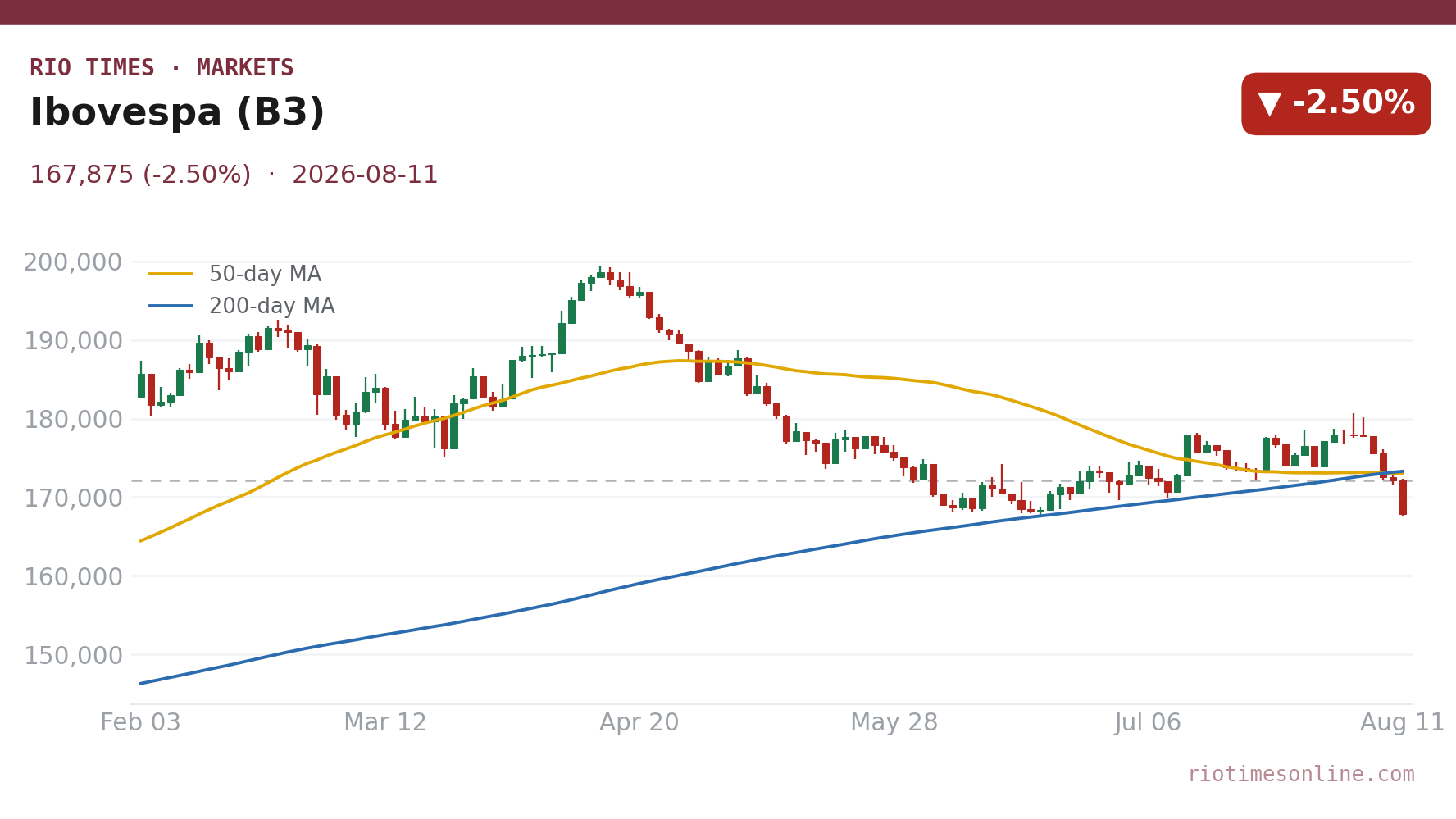
Underneath it all, the Copom rate path hangs in the balance. With the US Federal Reserve’s next move uncertain and the real under pressure, local traders are pushing back expectations for any Selic cut this year, a repricing that has driven the Ibovespa more than 15% below its 52-week high.
What matters today. Whether today’s services data signals a resilient economy—or gives investors another reason to push back Selic-cut expectations and sell Brazilian assets.

Today’s Economic Events
| Instrument | Level | Session |
|---|---|---|
| Ibovespa (Brazil) | 167,875 | -2.50% |
| S&P 500 (US) | 7,728 | -0.32% |
| USD/BRL | 5.1629 | +1.04% |
Ibovespa — Source: RT close, 2026-08-11. Figures rendered directly from the feed.
01 The setup in one read
Traders returning to their desks on Wednesday morning are likely to find a B3 in wait-and-see mode. The real’s overnight level of 5.1629 per US dollar is the clearest alarm bell—a currency under that much pressure, having jumped more than one percent in the last settled session, tightens financial conditions automatically, making the central bank’s job harder and corporate dollar debt more expensive.
The domestic data calendar offers a critical checkpoint. At 9 a.m. BRT, the statistics office releases the June service-sector growth figures. The prior year-on-year reading was a tepid 0.4%, and markets expect a modest improvement to around 2.35% annually. That number must clear a low bar to reassure investors that domestic demand is not buckling under the weight of a 14.00% Selic rate.
Corporate news is unusually active for a midweek morning. B3SA3, the stock exchange operator itself, posted a recurring net profit of R$1.4 billion for the second quarter, a figure that landed almost exactly on consensus estimates compiled by LSEG. The result puts a spotlight on how well the exchange’s diversified revenue streams—from listing fees to data services—can offset the drought in equity-trading volumes that typically accompanies a bear market.
Elsewhere, Oi (OIBR3) has delayed four quarterly filings from 2025, citing an internal review that remains in progress. For a company still navigating a complex judicial recovery, any delay in financial transparency tends to weigh heavily on the equity. On the regulatory front, Anvisa’s move to allow medicine sales through large marketplaces could open a new front in the battle between pharmacy chains and e-commerce platforms.
The weight of evidence points to a cautious session. A real trading above 5.16 and a six-day losing streak on the Ibovespa show deep investor unease. The services print lands at noon; if it beats the subdued consensus, it might steady financial and consumer shares, but a miss would amplify the gloom and push the currency closer to its 52-week extremes. The variable to watch is the USD/BRL response to the services number—a fresh break above 5.20 would signal that the market is pricing a harder landing for Brazilian assets.
02 Where Brazil is set to open
| Instrument | Last close | Indicated | Watch today |
|---|---|---|---|
| Ibovespa future | 167,875 | — | Services data, real stability |
| USD/BRL (spot) | 5.1629 | — | Retail flow, central bank rhetoric |
| DI Jan 2030 futures | — | — | Copom repricing trajectory |
The Ibovespa’s last close at 167,875 leaves the benchmark deep in correction territory, more than 15% below its 52-week high. Pre-market indications for futures were not yet firm at the time of writing, but the overnight drift in the real suggests equity markets will open on the back foot, with financials and consumer-discretionary names—which suffer most when the Selic stays high—facing the stiffest headwinds.
The currency is the immediate pressure gauge. Spot USD/BRL closed at 5.1629, and any move above 5.20 early in the session would signal that foreign investors are reducing Brazilian exposure, forcing local funds to hedge more aggressively and pushing up the entire interest-rate curve. Rio Times · Live Market Intelligence
Live Market IntelligenceBrazil Morning Call — Live Board
Brazil Morning Call — Live Board
Instrument Last Change YoY Prev. High Low Volume
IBOV
183,476.86
-0.27%
+21.85%
183,965.91
168,310
167,142
—
USD/BRL
5.16
+0.01%
-5.13%
5.16
5.18
5.14
—
EUR/BRL
5.95
+1.01%
-5.83%
5.89
5.98
5.94
—
SELIC
14.00%
—
—
—
—
—
BRENT
88.88
-0.03%
+34.42%
88.91
90.07
88.12
29,713
WTI
83.11
-0.11%
+31.57%
83.20
84.35
82.40
166,848
IRON ORE
161.91
—
+58.10%
161.91
161.91
1
GOLD
4,461
+1.78%
+33.20%
4,383
4,503
4,421
139,824
SILVER
65.59
+1.26%
+73.05%
64.77
66.98
64.81
46,406
LITHIUM
75.20
+1.47%
+62.95%
74.11
75.80
75.08
89,275
SOY
1,184
+3.20%
+17.05%
1,148
1,199
1,168
163,179
CORN
480.50
+10.02%
+29.34%
436.75
480.75
459.50
341,248
WHEAT
655.00
+3.93%
+29.70%
630.25
657.75
631.50
128,793
COFFEE
317.25
-5.51%
+0.67%
335.75
321.20
313.55
21,747
SUGAR
16.43
-1.79%
-3.01%
16.73
17.11
16.22
171,992
ORANGE JUICE
138.55
-0.47%
-45.38%
139.20
141.05
137.50
703
COTTON
85.03
+2.33%
+26.78%
83.09
82.90
81.96
16,546
BEEF
223.60
-3.93%
-5.18%
232.75
226.40
223.00
16,126
CATTLE
339.10
-3.16%
-1.82%
350.17
345.50
338.60
10,164
COCOA
5,719
+3.18%
-34.96%
5,543
5,779
5,574
26,773
PETR4
41.64
-0.05%
+35.19%
41.66
41.97
41.15
41,499,400
VALE3
72.97
+0.83%
+30.75%
72.37
73.54
72.66
17,658,000
SUZB3
41.33
+2.35%
-23.55%
40.38
41.48
40.35
3,914,900
KLABIN
17.69
+0.80%
-2.95%
17.55
17.74
17.48
2,057,400
SLCE3
13.34
+0.30%
-12.25%
13.30
13.42
13.20
1,454,200
ABEV3
14.89
-0.80%
+21.91%
15.01
15.07
14.81
16,453,100
ITUB4
38.60
-1.03%
+4.57%
39.00
39.34
38.39
29,487,800
BBDC4
16.85
+0.36%
+3.50%
16.79
16.90
16.67
19,416,900
BBAS3
19.37
+0.47%
+0.73%
19.28
19.44
19.16
11,069,200
B3SA3
14.26
-0.21%
+12.73%
14.29
14.47
14.11
33,037,800
WEGE3
47.59
+0.49%
+29.99%
47.36
48.08
47.36
3,364,600
PRIO3
59.14
-0.19%
+50.67%
59.25
59.81
58.74
3,325,600
RENT3
34.68
-0.09%
+0.84%
34.71
34.96
34.35
7,979,100
AZZA3
15.89
-2.63%
-53.76%
16.32
16.42
15.82
1,330,300
CSNA3
4.30
+0.47%
-42.65%
4.28
4.41
4.26
10,076,100
GGBR4
24.69
+2.19%
+51.38%
24.16
24.85
24.18
7,047,600
ENEV3
24.21
-1.38%
+70.49%
24.55
24.64
23.99
9,297,000
LREN3
11.87
-1.33%
-28.65%
12.03
12.17
11.83
9,683,300
03 On the B3 radar today — services data, B3 results and Oi’s filing delay
| Item | When | Why it matters |
|---|---|---|
| Brazilian Service Sector Growth (YoY, Jun) | 12:00 BRT | First real-time gauge of Q2 domestic demand; low bar at 2.35% expected |
| Brazilian Service Sector Growth (MoM, Jun) | 12:00 BRT | Momentum check after a flat 0.1% prior reading |
| B3SA3 Q2 results | After market close Aug 11 | R$1.4bn profit in line with LSEG estimates; sets tone for financial-sector sentiment |
| OIBR3 filing delay | Ongoing | Four 2025 quarterly reports postponed; flags governance risk |
| Business Confidence (Jul) | 14:00 BRT | Expected to edge up to 44.8; a leading indicator for capital spending |
| Anvisa marketplace ruling | Ongoing | Regulatory shift opens drug sales on big e-commerce platforms |
The services print at noon is the statistical anchor of the session. Economists expect a year-on-year expansion of 2.35%, which would be a sharp acceleration from the prior 0.4% and signal that, for all the noise, Brazilian households are still spending on haircuts, transport and digital services. A miss, however, would feed the narrative that the economy is stalling faster than the central bank anticipated.
Corporate-watchers have two homegrown stories to digest at the open. B3SA3’s profit, almost exactly matching the R$1.46 billion consensus, is a steady-as-she-goes result that should shield the stock from a broader market selloff. In contrast, Oi’s announcement that its 2025 financial review remains incomplete sends a signal that the telecom’s path to full recovery is still obstructed by operational and legal hurdles.
04 Copom and the macro backdrop
The market’s Copom wager has turned unequivocally hawkish. After the central bank’s latest minutes reinforced a cautious stance on inflation, and with the real weakening past 5.16, traders have all but priced out any Selic cut at the next policy meeting. The implicit message from the interest-rate futures curve is that the benchmark rate of 14.00% could stay locked in place well into the first half of 2027.
A contributing factor to this repricing is the global backdrop. US 10-year Treasury yields hover near 4.70%, and while the Federal Reserve’s new chair Kevin Warsh has highlighted AI as a potential disinflationary force, his own St. Louis Fed colleagues have warned that AI is no guarantee of lower inflation—meaning the Fed may itself be slower to ease, keeping the dollar strong against emerging-market currencies.
Locally, the inflation picture remains uncomfortable. The IMF’s latest Article IV report estimates that Brazil’s headline inflation will still be running at 5.6% by the end of 2026, well above the central bank’s 3% target. With the services sector—one of the stickiest corners of inflation—under scrutiny today, any upside surprise could harden expectations that Copom’s next move, if any, would be a hike rather than a cut.
The Congressional agenda adds a layer of political noise. The lower house postponed voting sessions after a PT party leader fell ill, delaying progress on the government’s concentrated legislative push. For investors, any signal that fiscal reform is stalling tends to raise the risk premium embedded in the yield curve and the currency.
05 Corporate stories to watch today
B3SA3 is the home team that sets the mood. Its second-quarter recurring net profit of R$1.4 billion, in line with market expectations, demonstrates that Brazil’s exchange operator can churn out steady earnings even when the benchmark stock index is deep in the red. The real test will be whether the company’s management signals confidence in the equity-listing pipeline, or points to a prolonged drought of initial public offerings.
Oi’s filing delay is the kind of corporate-governance red flag that spoils the morning for arbitrage-focused funds. By postponing four quarterly 2025 statements, the telecom leaves minority shareholders without a clear view of its post-restructuring cash-flow trajectory. Until those numbers are published, OIBR3 will likely trade on rumor and technical flow.
Anvisa’s revocation of old rules that kept medicines off large marketplaces is a potentially far-reaching regulatory shift. Platforms like Mercado Livre and Shopee can now legally compete for a slice of Brazil’s massive over-the-counter drug market, directly challenging brick-and-mortar pharmacy chains. This story will take time to play out in earnings, but the first read-through for the market is a negative one for large listed drugstore operators that have long relied on restricted competition.
Heineken’s local CEO Maurício Giamellaro told Brazil Journal in an interview that the company has finally solved its supply constraints after investing more than R$6 billion in new breweries. The shift from rationing beer to actively chasing volume growth in a weak consumer environment suggests the premium-beer segment may be nearing a price war, with implications for Ambev and for the broader consumer-goods basket on B3.
06 The levels to watch at the open
For the Ibovespa, the 167,875 close is a fragile floor. A breach below 167,000 would take the index to levels not seen since early 2025 and trigger additional stop-loss selling from systematic funds. On the upside, a move back toward 170,000 would require a perfect confluence of a firm services print, a stable real, and a benign US inflation reading.
USD/BRL is the true sentiment barometer. Expect any move above 5.20 to cascade into a broader selloff across the Bovespa, with the real’s 52-week high of 5.5901 acting as the ultimate resistance that traders never want to test. A retreat toward 5.10, conversely, would relieve pressure on the entire market and could spark a sharp, if short-lived, rally in banks and retailers.
07 What to watch
- USD/BRL behavior around 5.20: A break above this psychological level would signal capital outflow and force a repricing of the whole B3 curve.
- Services sector data (12:00 BRT): The consensus expects 2.35% YoY; a miss gives concrete evidence that the economy is slowing fast.
- B3SA3 trading reaction: An in-line profit in a bear market tests whether investors still value B3’s near-monopoly franchise.
- OI (OIBR3) price action: A filing delay tends to trigger stop-losses; watch for trading-volume spikes in the first hour.
Background: Tanzania’s CNG Push Gains a Homegrown Champion in Energo.
Background: Kenya Moves to Release Mineral Royalty Payouts to 32 Counties.
More: Brazil news in English, every day from The Rio Times.
Frequently Asked Questions
Why is the Brazilian real weakening?
Persistent inflation worries, a high US interest-rate environment and domestic fiscal uncertainty are all pushing the real toward the 5.20 range against the dollar.
What does the services data tell us about the Selic?
Services inflation is the stickiest part of Brazil’s price index. A strong number today means the central bank is even less likely to cut the Selic soon.
Why did Oi shares drop attention today?
Oi postponed four 2025 quarterly reports, citing an ongoing review. Delayed financial reporting often raises governance and liquidity concerns.
Is the Ibovespa in a bear market?
It is down more than 15% from its 52-week high, which typically meets the definition of a deep correction and signals sustained negative sentiment.
This article was produced by The Rio Times’ automated newsroom system. How we use AI · Report an error
LatAm Markets: Live Signals → — real-time movers, turnover leaders and FX across Latin America.