Argentina: all the pipes of the Néstor Kirchner gas pipeline have been delivered; how the work is progressing
By Mariano Espina
“The last trucks with the pipes with seams for the GPNK have left the Tenaris Siat plant,” says a statement released on Tuesday with the signature of Paolo Rocca, CEO of the Techint Group.
The company was responsible for the pipes of the four lines of the first stage of the Néstor Kirchner Gas Pipeline, which already follows the route from Tratayen, Neuquén, to Salliquelo, province of Buenos Aires.
The joint venture between Techint and Sacde won the bids to construct the first 440 kilometers of the Néstor Kirchner gas pipeline.
The remaining 133 kilometers were awarded to BTU S.A.

These 620 kilometers will connect Vaca Muerta, the second largest shale gas reservoir in the world, with the province of Buenos Aires, allowing Argentina to import less gas to supply peak demand.
The Secretary of Energy, Flavia Royón, said last week that the June 20 date for the start of operations of this key work, financed by the Argentine State at a cost of over $239.165 billion, still stands.
Gas pipeline in numbers: according to Bloomberg Línea, about 52,000 pipes were transported in 13,000 trucks.
“The exigency and urgency of this challenge meant taking Tenaris Siat to record levels never recorded in its history,” says Rocca in the statement released on Tuesday.
The Techint group was a key player in this project.
Not only because of the seamless pipes but also because it participates in the construction of the work in three of the four lines, 487 kilometers, in a joint venture with Sacde, a company owned by Marcelo Mindlin, CEO of Pampa Energía. Both groups are also gas producers in Vaca Muerta.
The first section of the Néstor Kirchner gas pipeline, if completed by June 20 of this year, will allow a saving of 11 million cubic meters of gas per day, according to specialists’ calculations.
In addition to the domestic supply, according to Royón, this work will increase “the transportation capacity by 30% and will facilitate exports to regional markets”.
“Towards 2024 and 2025, we will be able to do without imports from Bolivia, and it is strategic because it is facing a strong decline; it is something that worries us, but the dialogue is constructive”, said Royón last week in the framework of the IDEA Energy Experience.
According to Sergio Massa, Minister of Economy, at the same event, incorporating the Néstor Kirchner gas pipeline this year will allow Argentina to save US$2 billion in imports.
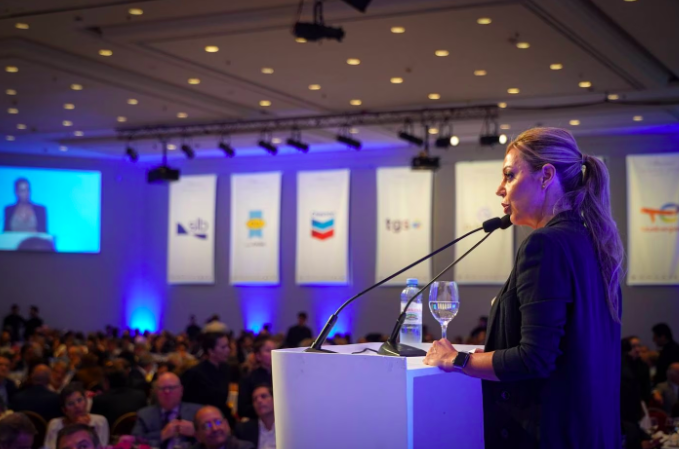
Through the Gas 5 Plan, tendered this year, the Argentine Government has already guaranteed the gas that will be transported through the pipeline.
According to government estimates, this Gas Plan will allow subsidies savings of US$19.5 billion over the next five years.
THE FOLLOWING COMPANIES WERE AWARDED
The Government informed that the companies awarded in Rounds 4 and 5 of the Gas Ar Plan were: YPF, Shell, Pampa Energía (PAMP), PAE, CGC, Pluspetrol, Tecpetrol, Total, Exxon Mobil (XOM), Petrobras (PBR), Vista (VIST) and Wintershall Dea.
The Government’s next step will be to advance the second stage of the gas pipeline, which will link the Buenos Aires and Santa Fe provinces and seek to take the gas to the center and north of the country.
For this project, the Ministry of Economy is negotiating loans from multilateral organizations, but it is also analyzing a private financing scheme in which the companies will participate.
With information from Bloomberg
Read More from The Rio Times