
The Brazilian real (BRL) has been highly volatile against the US dollar (USD) so far in 2022, shifting from being one of the top performers against the greenback earlier in the year to a selloff that made it one of the biggest underperformers among emerging market currencies.
What has driven the volatility, and what is the outlook for the foreign exchange (forex) pair for the rest of the year?
This article looks at the real’s performance against the US dollar and some analysts’ latest USD/BRL forecast.
WHAT DRIVES THE USD/BRL PAIR?
The USD/BRL forex pair refers to the exchange rate for the US dollar, the base currency, against the Brazilian real, the quote currency. The exchange rate shows the value of one US dollar in Brazilian real.
As with other currencies, the value of the Brazilian real is affected by the country’s economic growth, cross-border trade, and monetary policy, such as interest rates, which determine its attractiveness as an investment. As Brazil is a net exporter of commodities, the value of the BRL is also affected by the demand for commodities.
Brazil was one of the first countries to be considered an emerging market, forming the BRICS group along with Russia, India, South Africa, and China. As such, overall sentiment on emerging market economies and currencies can also affect the value of the Brazilian real.
The US dollar is the global reserve currency and is affected by sentiment on the world economy and economic activity within the US, including manufacturing and employment rates. The dollar acts as a safe haven for investors during times of economic and geopolitical uncertainty.
All these factors have come into play in determining how the USD/BRL pair performed this year.
HISTORICAL USD/BRL PERFORMANCE
The Brazilian real was introduced as Brazil’s official national currency in July 1994, replacing the cruzeiro real. The real immediately strengthened against the US dollar to a rate of 1.20 as the country’s economic growth attracted inflows from foreign investors. Brazil’s central bank then anchored the real to the US dollar to stabilize it.
The real was partially floated against the dollar in 1999 when the Russian debt default spread and investors pulled their funds from emerging markets, including Brazil, setting off a currency crisis that saw the real plummet from 1.20 to 2.15 against the US dollar.
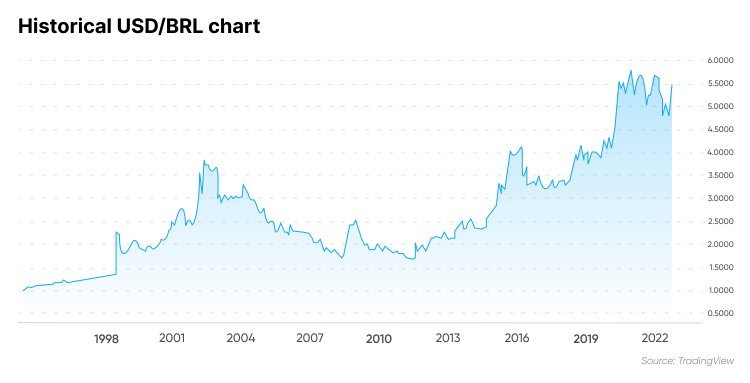
The USD/BRL exchange rate was around 1.76 at the start of 2008, but with the global financial crisis, the real entered a long-term downward trend against the dollar. The USD/BRL rate surpassed 5.00 at the start of 2020, with each real worth as little as US$0.18 as the Covid-19 pandemic drove investors to the dollar’s safe haven.
But BRL has halted the downward trend, trading largely within the US$0.17-0.20 range within the last two years and reaching a two-year high approaching US$0.22 in April this year.
2022
The real started off 2022 as one of the top-performing currencies, surprising market analysts by gaining as much as 21% against the dollar in the first quarter.
Analysts at French bank BNP Paribas noted in April that the real benefited from at least three factors: rising commodity prices; a rebalancing among investors away from US technology stocks and Russian assets towards other markets such as Brazil; and relatively high-interest rates after nine hikes took the key policy rate from 2% to 11.75% in a year.
“In sum, these three factors have contributed to the rise in portfolio inflows by non-residents into Brazil. And when we look at the foreign exchange transactions — whether they are for commercial or financial purposes – we see that market participants have been net purchasers of real over the first quarter to the tune of about US$9 billion – which represents about US$3 billion more than for all of 2021 combined.”
However, after reaching a peak in early April, the real has retreated against the US dollar, which at the same time has reached a 20-year high against a basket of currencies. From its 21% year-to-date gain against the dollar on 4 April to a rate of 4.59, the real had retreated to a 5.7% gain at the time of writing on 19 July.
The US dollar has rallied on growing concerns that the US Federal Reserve’s hawkish turn on interest rates since March could see the world’s largest economy enter a recession. Concerns about the impact of Covid-19 restrictions in China on manufacturing activity have also weighed on sentiment in recent months.
The real has begun underperforming against Latin American currencies, with the Mexican peso, for example, climbing in response to strong remittances, rising interest rates, and a potential increase in manufacturing activity from US companies relocating production from China.
While the Mexican central bank is eyeing at least six more rate increases, the Central Bank of Brazil is tapering off its rate hikes.
More importantly, traders and observers are looking toward the Brazilian presidential election in October, which is expected to see President Jair Bolsonaro pushing forward government expenditure to gain support as he trails former President Luiz Inácio Lula da Silva in polls.
In July, Brazil passed a constitutional amendment enabling the government to increase welfare spending by R$41.3bn (US$7.7bn) in an attempt to offset the impact of high fuel prices. There was previously a ban on increasing or introducing social benefits during an election year.
With the Brazilian real at a rate of 5.37, what is the USD/BRL forecast for the real against the dollar for the remainder of the year and beyond? How will the election affect the value of the Brazilian real/US dollar pair as it approaches?
HOW WILL THE PAIR PERFORM IN THE FUTURE?
“Recently, pressure has been building on Latin American Forex. CLP (Chile), BRL (Brazil), and COP (Colombia) are June’s biggest underperformers in the EM FX space. Historically, Latin American FX has been vulnerable to tighter US financial conditions, but this time other factors are also at play,” analysts at Danske Bank wrote in late June.
“While Latin American commodity exporters have been hit by rising global recession risks, political and fiscal uncertainty are also on the rise as left-wing forces are regaining ground across the region: Chile and Colombia both recently elected left-wing presidents, and Brazil is heading towards October election with Lula leading the polls.”
Wells Fargo analyst Brendan McKenna sees potential for the real to shed further value, writing in a USD/BRL forecast: “The Brazilian real has been exceptionally volatile the last few years; however, our framework suggests the Brazilian currency, for the time being, is trading at fair value and is aligned with economic and political fundamentals.
Over the course of the current global market downturn, the Brazilian real has sold off 15%, equivalent to the upper bound of the moderately vulnerable potential depreciation range. We believe the currency will hover around current levels in the short-term, with the currency possibly gathering depreciation momentum as we approach the presidential election in October.”
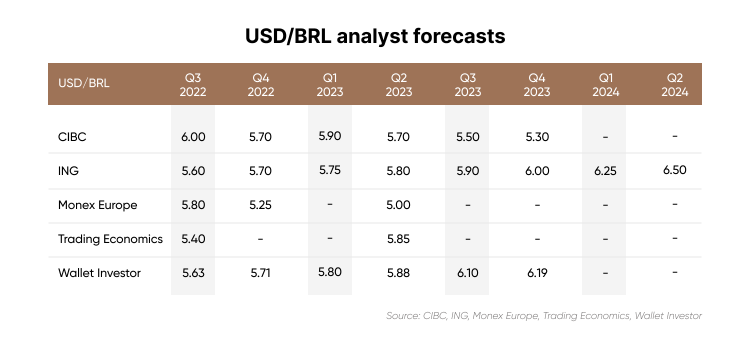
In their monthly outlook, analysts at UK-based foreign exchange company Monex Europe wrote in their USD/BRL prediction that “both domestic and external developments over the course of June have turned us substantially more bearish on BRL”, adding:
“The main development over the past month has been the downturn in global growth conditions and the contraction in manufacturing output, which is set to weigh on Brazil’s terms-of-trade profile. Having been one of the main driving forces behind the real’s appreciation over the past six months, especially since the onset of war in Ukraine, falling iron ore and crude oil prices are set to pose major headwinds to the real over the second half of the year.
“Additionally, the recent hawkish shift by the Federal Reserve has further compressed Brazil’s yield differential, especially once factoring in CDS premiums. Finally, on a domestic level, the Brazilian real’s tendency to depreciate in the run-up to Presidential elections due to increased political and fiscal uncertainty will likely add further upward pressure on the USDBRL rate over the coming months…
Following the election, domestic risk should abate, and combined with our expectation for broad dollar weakness, BRL should begin to appreciate once again. This is visible in our 6 and 12-month forecasts, which see USDBRL returning back to 5.25 and 5.00.”
However, other analysts, such as at Dutch bank ING and algorithm-based forecasting service Wallet Investor, indicated in their USD/BRL forecast for 2022 that the real could steadily weaken and surpass 6.00 to the dollar by the end of next year.
ING predicted that the rate could reach 6.50 by the end of 2024, pointing to a bearish USD/BRL forecast for 2025. Analysts have yet to issue a USD/BRL forecast for 2030.
When consulting forecasts for currencies or other assets, remember that analysts can and do get their predictions wrong. We recommend you always research and consider the latest market trends and news, technical and fundamental analysis, and expert opinion before making any investment decisions.
Keep in mind that past performance is no guarantee of future returns. And never invest money you cannot afford to lose.
More: Brazil news in English, every day from The Rio Times.
Live Market IntelligenceBrazil — Live Market Board
Rio Times · Live Market Intelligence
Brazil — Live Market Board
-0.95%
164,796.05
-0.95%
69,490.83
+1.26%
10,449.80
+0.96%
2,848,945
—
2,452.46
—
| Instrument | Last | Change | YoY | Prev. | High | Low | Volume |
|---|---|---|---|---|---|---|---|
| IBOV | 164,796.05 | -0.95% | +6.13% | 166,376.43 | — | — | — |
| USD/BRL | 5.93 | -0.33% | +9.76% | 5.95 | 5.93 | 5.92 | — |
| SELIC | 13.75% | — | — | — | — | — | |
| PETR4 | 41.30 | -3.21% | +26.92% | 42.67 | 42.35 | 41.27 | 46,638,500 |
| VALE3 | 58.41 | -0.12% | -10.26% | 58.48 | 59.19 | 57.67 | 15,724,500 |
| ITUB4 | 39.73 | -0.85% | +2.77% | 40.07 | 40.09 | 39.47 | 28,876,800 |
| BBDC4 | 13.71 | -0.87% | -27.07% | 13.83 | 13.92 | 13.63 | 55,251,200 |
| BBAS3 | 14.20 | -0.70% | -34.98% | 14.30 | 14.48 | 14.12 | 35,327,200 |
| B3SA3 | 14.16 | -0.84% | +1.29% | 14.28 | 14.45 | 13.90 | 59,066,700 |
| ABEV3 | 15.94 | -0.87% | +15.76% | 16.08 | 16.04 | 15.85 | 29,145,900 |
| WEGE3 | 49.91 | -2.39% | +15.56% | 51.13 | 51.22 | 49.55 | 11,200,800 |
| PRIO3 | 58.22 | -3.29% | +51.06% | 60.20 | 60.61 | 58.22 | 10,658,000 |
| SUZB3 | 55.19 | -0.24% | +15.03% | 55.32 | 56.40 | 54.41 | 9,811,700 |
| RENT3 | 28.74 | -0.42% | -33.12% | 28.86 | 29.23 | 28.36 | 8,868,900 |
| AZZA3 | 14.58 | -0.34% | -49.36% | 14.63 | 14.89 | 14.17 | 3,743,100 |
| CSNA3 | 3.48 | +1.46% | -57.09% | 3.43 | 3.48 | 3.28 | 42,458,800 |
| GGBR4 | 25.34 | -2.01% | +36.31% | 25.86 | 25.84 | 25.18 | 10,744,600 |
| ENEV3 | 26.07 | -0.57% | +36.49% | 26.22 | 26.20 | 25.75 | 14,203,600 |
This article was produced by The Rio Times’ automated AI newsroom. Editorial responsibility: Matthias Camenzind, Publisher and Editor-in-Chief. The Rio Times also runs Ask Rio Times, which answers from 100,000+ of our own articles, the daily Latin America Power Map, and prediction-market odds on elections and markets.. How we use AI · Report an error
Brazil runoff, Sunday, October 25: Brazil runoff date. Latest: Brazil runoff polls, Flávio 51%, Lula 49%.