Flip 2026 Program: Exile, Zadie Smith and a Supreme Court Justice

Culture
Key Facts
Flip 2026, Brazil’s most important literary festival, has revealed a program built around a single restless idea — home, and what it means to lose one.
The 24th edition of the Festa Literaria Internacional de Paraty runs from July 22 to 26 in the colonial coastal town of Paraty, between Rio de Janeiro and São Paulo, and the organisers laid out the full lineup at a press conference in São Paulo. It is one of the few moments when Brazilian literature, under-translated and under-read abroad, commands real international attention.
For readers unfamiliar with the festival, Flip has become the most visible platform for Brazilian writing on the global stage, drawing publishers, agents and journalists from across the world. The choice of theme and honoree each year signals what conversations Brazilian literary culture wants to have with itself and with foreign audiences.
Flip 2026: a program about exile and unstable homes
The new curator, Rita Palmeira, has organised 21 literary tables around the notion of the house and the nation as shifting, political territory. Many of the foreign guests no longer live in the countries where they were born.
That thread runs through the honoree as much as the guests. The festival celebrates Orides Fontela, a spare, philosophical poet who died in 1998 and who knew real hardship, including spells without a home, and every main panel takes its title from a line of her verse.
The decision to honor Fontela carries weight beyond her literary achievement. Choosing a poet who experienced homelessness and economic precarity as the festival’s symbolic center raises questions about who gets remembered in Brazilian letters, and whose struggles are acknowledged in a country with deep inequalities.
The names, and a justice among them
The international roster is heavyweight — led by the English novelist Zadie Smith, the Franco-Algerian Kamel Daoud, who won France’s Goncourt prize in 2024, and the Angolan poet Ana Paula Tavares, a recent Camoes laureate, many of them writers who carry displacement in their own biographies.
The Goncourt is France’s most prestigious literary prize, while the Camoes is the highest honor in Portuguese-language literature, awarded jointly by Portugal and Brazil. These are writers at the peak of international recognition, and their presence underscores Flip’s ambition to be more than a regional event.
The Brazilian side is just as pointed — Supreme Court justice Carmen Lucia will take part to launch a new book on democracy and the vote, an appearance freighted with meaning as the country works through the trials of those accused of plotting a coup.
Her appearance blurs the line between literature and public life in a way that is typical of Brazilian festivals, where writers and intellectuals are expected to engage with the political moment. Whether this deepens the conversation or distracts from the literary program remains an open question each year.
Alongside them sit established Brazilian names such as the novelist Milton Hatoum, a member of the Academy of Letters, the doctor and writer Drauzio Varella, and Itamar Vieira Junior, whose fiction has travelled widely.
The displacement theme keeps surfacing in the pairings, with Hatoum sharing a table with the Libyan-American writer Hisham Matar to discuss how dictatorships mark families, and further guests such as the Franco-Mauritian Nathacha Appanah and the Catalan Eva Baltasar widening the festival’s map of uprooted voices. The festival opens on July 22 with a tribute panel to Fontela led by the critic Augusto Massi and the poet Marilia Garcia.
A festival that reaches beyond Paraty
Flip has grown into a fixture of the world literary calendar since the British publisher Liz Calder founded it in 2003, modelling it on Britain’s Hay Festival. This year the two are formally linked, with Flip partnering Hay as part of a UK-Brazil season marking 200 years of relations between the countries.
The partnership raises the festival’s profile in English-speaking markets, which could matter for Brazilian authors seeking translation deals. Whether it also shifts the balance of which voices get heard, and in whose language, is worth watching as the relationship develops.
For visitors, the festival is also a reason to discover Paraty itself, a preserved town of whitewashed houses and cobbled streets. Tickets opened to the general public on the festival site, with a first popular batch at R$50 (US$9.70) for a full ticket and R$25 (US$4.80) for concessions, and the main panels stream free online.
Frequently Asked Questions
When is Flip 2026 and where?
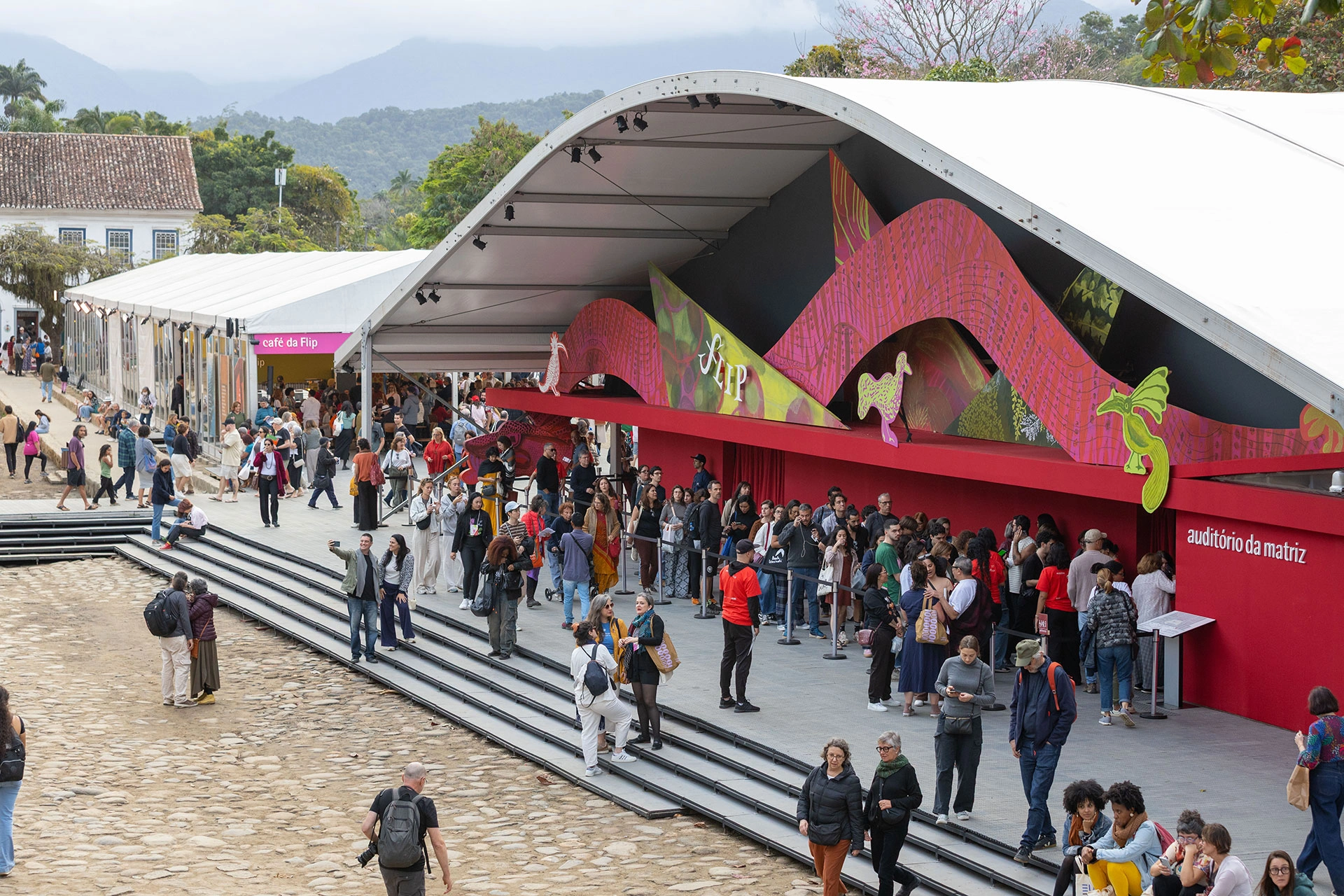
Flip 2026, the 24th Festa Literaria Internacional de Paraty, runs from July 22 to 26 in Paraty, a colonial town on the coast of Rio de Janeiro state between Rio and São Paulo. The main panels are held at the Matriz auditorium and streamed free on the festival’s site and YouTube channel, with parallel events spread across the town.
Who are the main authors at the festival?
The honoree is the late Brazilian poet Orides Fontela, and the program features international names including Zadie Smith, Kamel Daoud and Ana Paula Tavares, alongside Brazilian figures such as Milton Hatoum, Drauzio Varella and Supreme Court justice Carmen Lucia. The curator, Rita Palmeira, has organised the 21 main panels around the theme of home and displacement.
How much are tickets?
The festival opened sales with a popular first batch at R$50 (US$9.70) for a full ticket and R$25 (US$4.80) for concessions, before prices rise in later batches. Many activities around the festival are free, and the main panels are streamed online at no cost, so following Flip from abroad costs nothing.
Connected Coverage
› FLIP, Brazil’s Biggest Literary Festival, Honors a Cult Poet This July
This article was produced by The Rio Times’ automated newsroom system. How we use AI · Report an error · Editorial responsibility: Matthias Camenzind, Editor-in-Chief
Read More from The Rio Times