Bitcoin Dips Below US$64,300 as XRP Slides 2.58%
Key Facts
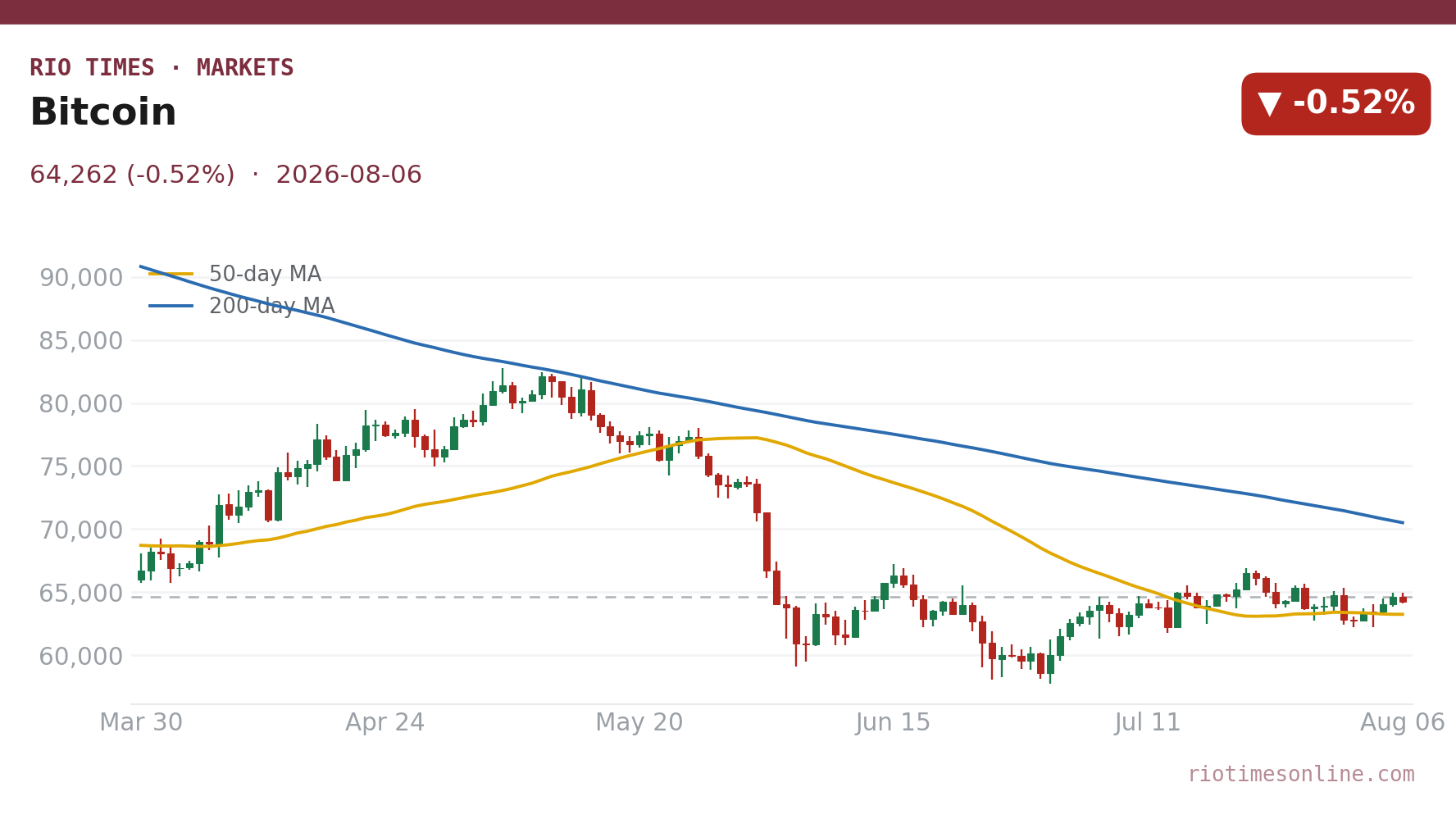
- Bitcoin settled at US$64,262, slipping 0.52% on the session, with thinner volumes than seen during the week’s earlier ETF-driven inflows.
- XRP led the retreat among majors, closing at US$1.0337 after a 2.58% drop, even as on-chain data flagged whale accumulation near the US$1 handle.
- Ethereum was the most resilient, off just 0.23% to US$1,902, as the MetaMask launch of a self-custodial AI wallet kept the ecosystem in focus.
- Russia finalised its first crypto law, legalising trading through a central bank-supervised licensing regime while keeping payments in crypto banned for everyday goods.
- Wintermute secured US registration as an SEC and FINRA broker-dealer, signalling institutional readiness for tokenised securities expansion.
- Physical security threats are surging, with crypto wrench attacks on pace for a record year and US$30 million already stolen in 2026, according to blockchain analysts.
Today’s Focus
Crypto markets drifted lower on Thursday, August 6, 2026, with all four tracked majors in the red. Bitcoin eased 0.52% to US$64,262. The decline was orderly but broad, with XRP taking the sharpest knock, down 2.58% to US$1.0337. Ethereum proved the anchor, slipping just 0.23% to US$1,902, while Solana fell 1.87% to US$72.58.
The retreat unfolded against a noisy policy backdrop. The US Senate lined up a floor vote on the CLARITY crypto bill, aiming to define digital-asset taxonomy before the August recess. In Moscow, Vladimir Putin signed Russia’s first law governing crypto trading, creating a licensed market strictly separate from domestic payments. Separately, Wintermute’s new US-registered entity underscored how market infrastructure is maturing even as spot prices consolidate.
For Latin America, stablecoin development and on-the-ground adoption mattered more than intraday price wiggles. USDC issuer Circle detailed Arc, a new layer-1 blockchain built for stablecoin-native finance, a direct challenge to the high-fee rails that make remittance corridors from the US to El Salvador and Brazil so costly. An independent audit project also filed 4,962 findings across 390 Bitcoin codebases, of which 720 were high severity—a stark reminder for LatAm fintechs building on Bitcoin rails.
What matters today. Stablecoin infrastructure is accelerating just as legacy crypto prices pause, tightening the contest for Latin America’s US$174-billion remittance corridor.
01 The session in one read
Digital assets traded with a defensive tilt on Thursday, August 6, 2026, as investors weighed a busy stretch of legislative and infrastructure news against summer-thinned liquidity. Bitcoin settled at US$64,262, a 0.52% loss that kept the crypto benchmark within the narrow band it has occupied since the start of August. The session lacked a single catalyst; instead, a cluster of developments—from Russia’s first crypto law to Wintermute’s US market-maker registration—competed for traders’ attention without providing a decisive directional spark.
Ethereum held up better than peers, shedding just 0.23% to US$1,902. The announcement that ConsenSys-backed MetaMask is launching a self-custodial AI agent wallet, capable of on-chain trades within user-set limits, reinforced the Ethereum ecosystem’s push into programmable money. Meanwhile, XRP gave back 2.58% to US$1.0337 despite on-chain data showing whale addresses accumulating near the US$1 mark, and Solana fell 1.87% to US$72.58 as speculative interest in smaller-cap alts waned.
Thursday’s price action looks like a routine breather after a strong week of spot Bitcoin ETF inflows, rather than a turn in trend. The Wintermute registration and the US CLARITY bill vote point to a regulatory framework finally taking shape, while Russia’s law signals that even wary states now prefer licensing to prohibition. For Latin America, the real driver remains the stablecoin race: Circle’s Arc chain and MetaMask’s AI agent point to a near-future where a Salvadoran shopkeeper or a Venezuelan freelancer interacts with dollars on-chain without knowing they are touching a blockchain. The variable to watch is the US Senate vote on CLARITY: a positive surprise could break Bitcoin above its recent range.
02 The board
Four major crypto instruments registered modest losses. Bitcoin, the de facto reserve asset of the digital economy, dipped below its midweek level to US$64,262. Ethereum, the leading smart-contract platform, showed comparative strength at US$1,902, a decline of just 0.23% that left it barely above the psychologically important US$1,900 handle.
Solana, a high-throughput layer-1 that runs a vibrant stablecoin and payments ecosystem in Latin America, fell more sharply, closing at US$72.58, a 1.87% decline. XRP, the token widely used by Ripple for cross-border settlement, registered the session’s steepest drop, settling at US$1.0337 after a 2.58% fall. Trading patterns suggested de-risking ahead of the weekend and the scheduled US Senate vote on the CLARITY bill.
| Asset | Level | Change |
|---|---|---|
| Bitcoin | US$64,262 | -0.52% |
| Ethereum | US$1,902 | -0.23% |
| Solana | US$72.58 | -1.87% |
| XRP | US$1.0337 | -2.58% |
Source: RT close, 2026-08-06. Where a commodity has no spot feed, an exchange-traded tracker or leading producer is shown as a labelled proxy.
Live Market IntelligenceThe live market board
Rio Times · Live Market Intelligence
Latin America — Cross-Market Board
| Instrument | Last | Change | YoY | Prev. | High | Low | Volume |
|---|---|---|---|---|---|---|---|
| IBOV | 183,476.86 | -0.27% | +21.85% | 183,965.91 | 168,310 | 167,142 | — |
| IPSA | 11,255.90 | -0.39% | — | 11,299.82 | 11,210 | 10,984 | 1,513,213,483 |
| IPC MEX | 64,992.23 | +1.13% | +12.17% | 64,264.16 | 66,121 | 65,405 | 108,886,187 |
| MERVAL | 2,893,751 | -1.57% | +30.51% | 3,022,485 | 3,042,365 | 2,991,150 | — |
| COLCAP | 2,584.72 | -0.95% | — | 9.04 | 9.05 | 9.02 | 4,133 |
| BVL PERÚ | 59,934.37 | +1.27% | — | — | — | — | — |
| USD/BRL | 5.16 | +0.01% | -5.13% | 5.16 | 5.18 | 5.14 | — |
| EUR/BRL | 5.95 | +1.01% | -5.83% | 5.89 | 5.98 | 5.94 | — |
| USD/MXN | 17.06 | -0.24% | -8.58% | 17.10 | 17.08 | 17.01 | — |
| USD/CLP | 913.98 | +0.04% | -5.67% | 913.65 | 915.11 | 906.68 | — |
| USD/COP | 3,140 | +0.03% | -22.04% | 3,139 | 3,141 | 3,105 | — |
| USD/PEN | 3.36 | -0.66% | -4.82% | 3.38 | 3.38 | 3.35 | — |
| USD/ARS | 1,493 | +0.10% | +12.96% | 1,491 | 1,494 | 1,480 | — |
| USD/UYU | 40.27 | +1.24% | +1.80% | 39.77 | 40.27 | 40.23 | — |
| USD/PYG | 5,939 | +1.68% | -19.54% | 5,841 | 5,939 | 5,925 | — |
| USD/BOB | 11.64 | -0.76% | +72.04% | 11.73 | 11.72 | 11.64 | — |
| USD/DOP | 58.34 | +1.25% | -3.44% | 57.62 | 58.34 | 58.04 | — |
| USD/CRC | 445.92 | +0.89% | -9.71% | 441.97 | 448.50 | 445.92 | — |
03 What moved it
A patchwork of policy and product news shaped the session. The US Senate Banking Committee chair, Tim Scott, confirmed that the CLARITY crypto bill would receive a floor vote this week, ending months of procedural delay. The bill proposes to classify digital assets into clear categories and assign regulatory lanes, a framework that would finally give exchanges and stablecoin issuers a federal rulebook in the world’s largest capital market.
In Russia, President Putin signed the country’s first dedicated crypto law. The statute legalises digital-asset trading under a central bank licensing regime but maintains a ban on using crypto for everyday payments. Wintermute, one of the world’s biggest crypto market makers by volume, announced that its New York subsidiary had registered as a broker-dealer with the SEC and FINRA, letting it make markets in stocks, options and digital-asset ETFs. On the security front, a separate report flagged that wrench attacks—physical assaults to force crypto transfers—had already netted criminals US$30 million in 2026, with France identified as the top hotspot.
04 The Latin American read
For Latin America, the session’s most consequential news was not the price of Bitcoin but the swift evolution of the rails beneath it. Circle’s unveiling of Arc, a new layer-1 blockchain purpose-built for its USDC stablecoin, points to a world where cross-border transfers bypass the correspondent-banking network entirely. That is a direct competitive threat to the expensive legacy rails Brazilians, Argentines, and Salvadorans use when receiving money from family working abroad.
In El Salvador, where the state still holds a Bitcoin reserve—though private acceptance became voluntary in 2025—and remittances make up roughly a quarter of GDP, a dedicated stablecoin chain could convert dollar transfers from Los Angeles or Houston into on-chain settlements that cost a fraction of a cent. Brazil’s central bank, which has been crawling its own Drex digital-real project forward, faces a strategic choice: whether to compete with privately issued stablecoins on speed and interoperability or to integrate them. Argentina, where annual inflation still runs above 30%, remains one of the region’s heaviest per-capita users of stablecoins for everyday savings and freelance income, a habit the new MetaMask AI agent wallet will make even easier to sustain.
The Bitcoin AI security audit that filed 4,962 code findings, including 720 high-severity issues, carries a distinct warning for the region. Latin American fintechs increasingly build consumer-facing wallets and Lightning Network gateways on Bitcoin’s codebase. A serious exploit anywhere in that stack would hit the most vulnerable users hardest—the unbanked households using Bitcoin precisely because they lack access to formal institutions.
05 The names to watch
Keep an eye on XRP, now at US$1.0337. Despite the 2.58% daily drop, whale accumulation detected near the US$1 mark suggests deep-pocketed investors see value at these levels. A US CLARITY win could re-rate the token sharply, given it would clarify the legal status of tokens used in payment settlement.
Bitcoin’s quiet ETF inflows during a Coldcard wallet exploit have raised an intriguing question: whether some security-conscious investors are abandoning self-custody hardware for the perceived safety of regulated fund structures. If that trend holds, it would reshape exchange-traded product flows across Brazilian and Mexican stock exchanges, where crypto exchange-traded products have drawn steady retail interest.
06 The outlook
The outlook hinges on Washington. The CLARITY bill vote is the proximate catalyst that could push Bitcoin decisively above US$65,000 or, if it stumbles, see markets slip back toward the July lows. Beyond legislation, the quiet acceleration of stablecoin-native blockchains and AI-powered wallets suggests the industry is not waiting for permission slips. For Latin America—a region where practical utility trumps speculative narrative every time—that is the trend worth watching.
07 What to watch
- CLARITY bill vote: US Senate floor vote this week on digital-asset taxonomy could define the regulatory perimeter and move Bitcoin sharply.
- Stablecoin rails: Circle’s Arc chain launch challenges legacy remittance corridors. Watch for pilot programmes in El Salvador or Argentina.
- XRP accumulation: On-chain data shows whales buying near US$1; a CLARITY breakthrough could trigger a sharp mean-reversion rally.
- Physical security threat: Record wrench-attack year with US$30M stolen. Watch for new self-custody insurance products and wallet hardening features.
Frequently Asked Questions
Why did Bitcoin fall on Thursday?
Bitcoin eased 0.52% to US$64,262 on thin summer liquidity as traders de-risked ahead of the US CLARITY vote and absorbed a flurry of policy and infrastructure news without a single bullish catalyst.
What is the CLARITY bill and why does it matter?
The CLARITY bill is a proposed US law that would classify digital assets and assign regulatory responsibility. A Senate vote is scheduled this week, and passage would be the most significant federal crypto framework to date.
How does this affect Latin America?
Stablecoin infrastructure like Circle’s Arc chain and MetaMask’s AI agent wallet directly threaten high-fee remittance rails used by Brazil, Argentina, and El Salvador, promising cheaper, near-instant cross-border transfers.
What are crypto wrench attacks?
They are physical assaults where criminals force victims to transfer crypto holdings. Blockchain analysts report US$30 million stolen this way in 2026 so far, putting this year on pace for a record.
This article was produced by The Rio Times’ automated newsroom system. How we use AI · Report an error
LatAm Markets: Live Signals → — real-time movers, turnover leaders and FX across Latin America.
Read More from The Rio Times