Beatriz Gonzalez, The Great Colombian Artist of Grief Gets a Major European Show
Metropole · Arts
Key Facts
—Who. Beatriz Gonzalez, widely seen as one of Latin America’s most important artists, died in Bogotá on January 9 at 93.
—Why now. A major retrospective opens in Oslo on June 12, following a landmark show in London this spring.
—The subject. Much of her work wrestles with Colombia’s long armed conflict, and with grief, loss and memory.
—The method. She reworked images from newspapers, postcards and religious prints into a bold, graphic style.
—The landmark. Her best-known project lined nearly 9,000 cemetery niches in Bogotá with images of the war dead.
—The name. At home she is known simply as “La Maestra,” the master.
As a Colombia painter who spent six decades turning her country’s violence into images that refuse to look away, Beatriz Gonzalez is being honored across Europe this year, just months after her death, in shows that introduce a giant of Latin American art to audiences who may never have heard her name.
A farewell that became a homecoming
When Beatriz Gonzalez died in Bogotá on January 9 at the age of 93, Colombia lost the artist many of its own museums simply call “La Maestra,” the master. The United Nations human-rights office in the country paused to mark her passing, praising how she had made the victims of Colombia’s long armed conflict visible. For a painter, that is an unusual kind of obituary, and it hints at why her work matters far beyond gallery walls.
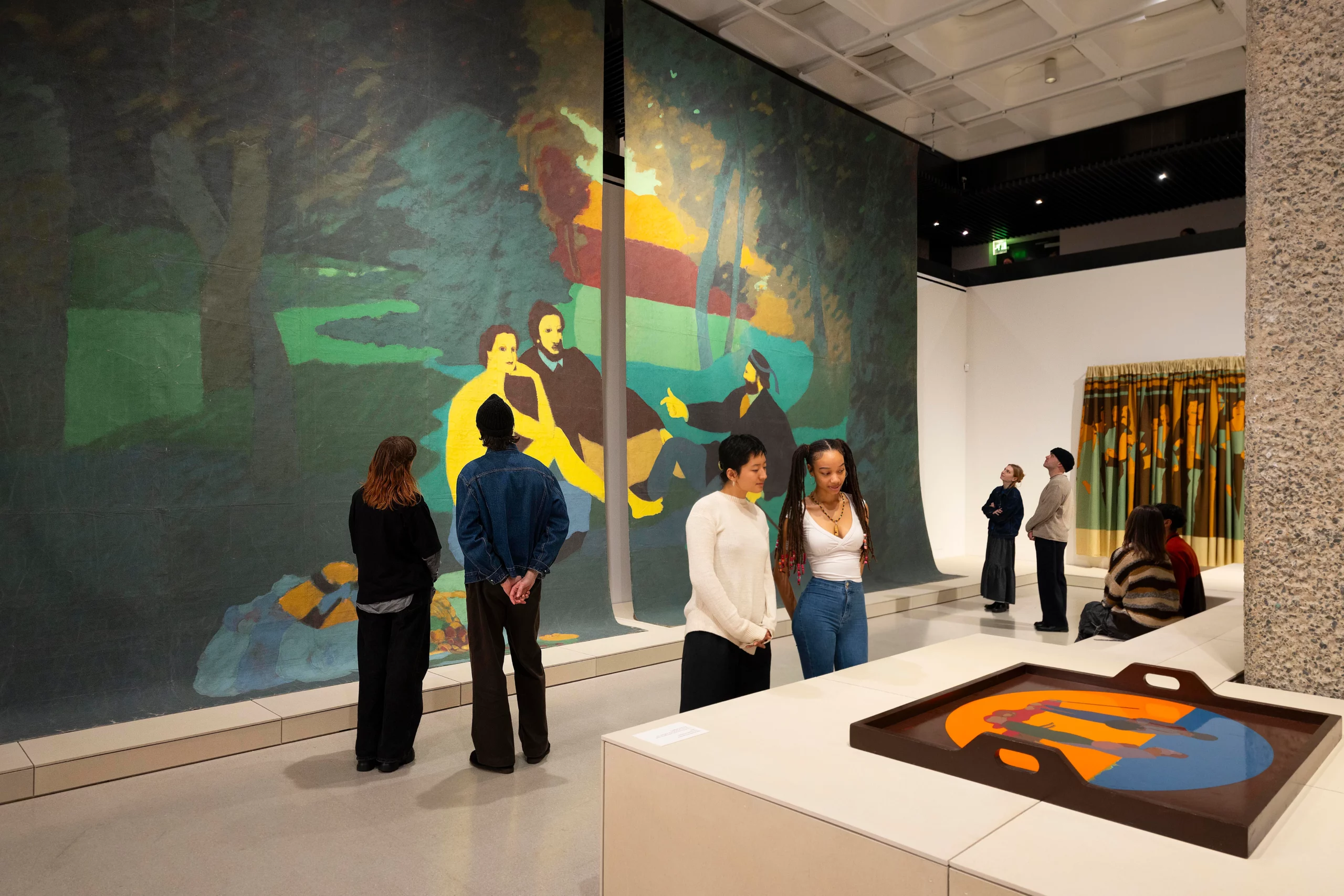
Now, in the months after her death, Europe is discovering her in earnest. A large retrospective opens on June 12 at the Astrup Fearnley Museet in Oslo and runs into the autumn. It follows a show this spring at London’s Barbican, billed as the first exhibition of her work in the United Kingdom and the biggest yet in Europe, gathering more than 150 pieces. Back home, Colombia’s National Museum has mounted its own tribute. The timing is bittersweet: a global audience is meeting an artist at the very moment she can no longer meet them.
The Colombia painter who reworked the everyday
Gonzalez was born in 1932 in Bucaramanga and first studied architecture before turning to art. What she developed over the following decades was a way of seeing that started not with grand historical scenes but with the throwaway images all around her: newspaper photographs, postcards, cheap religious prints, the kind of pictures that pass through ordinary hands every day. She would lift these and rework them in a flat, bold, brightly coloured style, part pop art, part something entirely her own.
In her early career the tone was often playful and sly. She poked at notions of good and bad taste, at the borrowed grandeur of European masterpieces reproduced for the masses, at the way images travel and change meaning when they reach a place like Colombia, far from the art capitals that made them. One famous gesture saw her cut up a cheap reproduction of a Renoir, a quiet jab at how the so-called centre of art is consumed at the periphery. It was funny, but it carried a serious question underneath: who gets to decide what counts as culture?
When the work turned to grief
As Colombia’s internal conflict ground on through the late twentieth century, killing and displacing hundreds of thousands, the humour in Gonzalez’s work gave way to mourning. She kept her method, pulling images from the press, but now those images were of massacres, of grieving relatives, of bodies carried through the countryside. She did not depict violence to shock. She depicted the aftermath, the human weight of loss, in a way that asked viewers to feel rather than merely register another headline.
This is the heart of her achievement, and the reason a foreign visitor should care. In a world where we scroll past images of suffering by the hundred, Gonzalez slowed them down. The curator of the London show described her work as urgently relevant to a society numbed by an endless feed of pictures. Her paintings take a single image of pain and hold it still, insisting that the person in it was real, that a death is not a statistic. That is a universal idea, even when its raw material is specifically Colombian.
The cemetery of the anonymous
Her most powerful work may be one that is not a painting at all. In Bogotá’s Central Cemetery stand rows of columbarios, the small niches where the remains of the poor and the unclaimed were once stored, and which had fallen into ruin and neglect. In a project known as “Auras Anonimas,” or Anonymous Auras, Gonzalez covered nearly 9,000 of these niches with stark, repeated images of figures carrying the dead, drawn from photographs of Colombia’s violence.
The effect transformed a forgotten, decaying corner into a vast public monument to the country’s unnamed victims, a place of mourning where there had been only indifference. It is the kind of art that does not hang on a wall to be admired but reshapes a real place and the way a city remembers. The site has since become a focus of preservation efforts, a sign of how deeply the work embedded itself in Colombia’s idea of itself.
More than a painter
Gonzalez was never only a maker of pictures. For fourteen years she worked at Colombia’s National Museum as a curator of art and history, researching its collections and rethinking how the country told its own story through its galleries. She was a historian and a critic too, and by all accounts a sharp-tongued one, unafraid to say what she thought and to start public arguments about art and memory. That blend of roles, creator, scholar and provocateur, helped make her a central figure in the building of a modern, self-critical culture in Latin America.
It also explains why her death drew tributes far beyond the art world, and why institutions from Medellín to Madrid have lined up to show her over the past decade. She helped a country look honestly at its own wounds, and gave the rest of the world a way to look too.
Why see her now
For a visitor in Europe this summer, the Oslo retrospective is a rare chance to encounter an artist who was a household name in her own country and is still too little known elsewhere. You do not need to know the details of Colombia’s history to feel what her work is doing; the grief, and the dignity she insisted on giving it, translate on their own. And for anyone who follows Latin America, the shows are a reminder that the region’s cultural exports are not only music and telenovelas but a serious, demanding body of art that asks hard questions about violence, memory and who gets remembered. Beatriz Gonzalez spent a lifetime answering them. The galleries are, at last, catching up.
More: Colombia news in English, every day from The Rio Times.
Frequently Asked Questions
Who was Beatriz Gonzalez?
She was a Colombian painter, printmaker, curator and art historian, born in 1932 and widely regarded as one of Latin America’s most important modern artists. Known at home as “La Maestra,” she died in Bogotá in January 2026 at the age of 93.
What is her work about?
She reworked everyday images, from newspapers to religious prints, in a bold graphic style. Early on her tone was playful and satirical, but as Colombia’s armed conflict deepened, her work turned to grief, memory and the human cost of violence.
Where can her work be seen in 2026?
A major retrospective opens at the Astrup Fearnley Museet in Oslo on June 12 and runs into the autumn. It follows a large show at London’s Barbican earlier in the year, while Colombia’s National Museum has staged its own tribute.
Connected Coverage
Mexico and Brazil Spar Over the Caramelo Street Dog
Colombia Economy 2026: Reforms, Coffee, Oil and Growth
This article was produced by The Rio Times’ automated newsroom system. How we use AI · Report an error · Editorial responsibility: Matthias Camenzind, Editor-in-Chief