Brazil · Retail
Key Facts
—Cost Advantage In-store pharmacies share rent, security, and utilities with the supermarket, slashing fixed costs by roughly 40% compared to standalone drugstores.
—Expansion Plan After a 25-unit pilot in São Paulo through 2026, Assaí has identified potential to open more than 250 pharmacies across its nationwide network.
—Margin Boost Pharmacy gross margins exceed food retail margins, promising a lift to Assaí’s overall profitability once the pharmaceutical business gains scale.
—Customer Flow Around 40 million shoppers visit Assaí stores each month, providing a massive, ready-made customer base for the new pharmacy operations.
—Market Replicability Medicine consumption for chronic conditions is similar across Brazilian regions, making the in-store pharmacy model highly replicable.
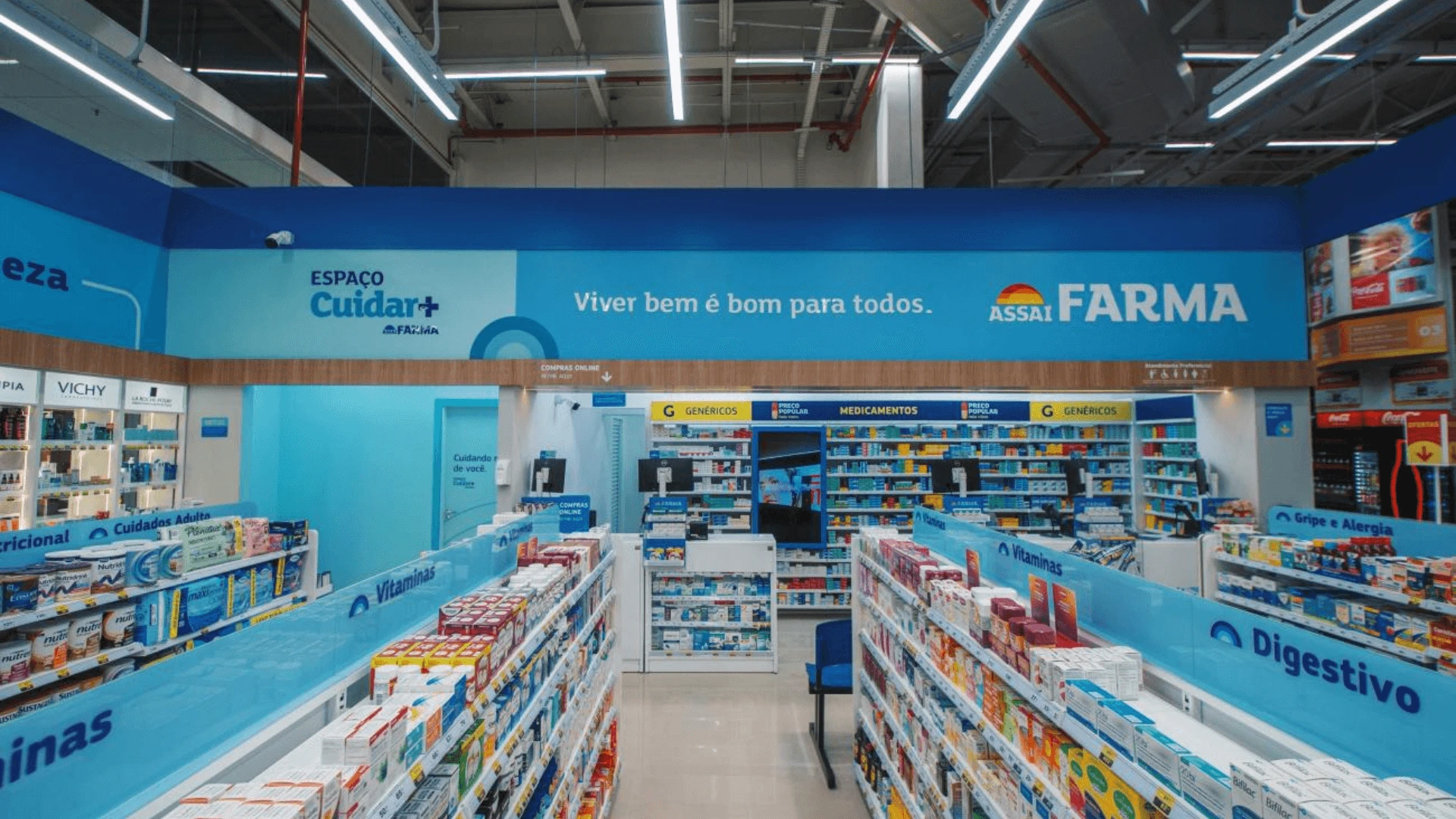
Assaí opens its first in-store pharmacy in São Paulo, marking the start of a strategy that targets 250 locations and aims to capture higher margins while leveraging the existing infrastructure of its cash-and-carry stores.
The First Pharmacy: Assaí Farma
Assaí Atacadista launched its proprietary pharmacy operation, Assaí Farma, on July 16, 2026, inside its Anhanguera store at Rua Samuel Klabin in the Bela Aliança neighborhood of São Paulo. It is the first pharmacy to operate within the sales area of a Brazilian food retailer since the sanction of Law No. 15,357/2026, which authorized such installations under strict sanitary and physical delimitation rules.
The store, open from 7 a.m. to 10 p.m. on weekdays and 8 a.m. to 8 p.m. on Sundays, carries weight-loss injection pens alongside a range of medications. According to Valor Econômico, around 93% of the items sold are new SKUs not previously offered by Assaí, signaling an initial expansion into pharmaceutical purchasing.
Reaching 250 Stores: A New Growth Avenue
The company plans to open 25 pilot pharmacies exclusively in São Paulo state during the second half of 2026, with five to six inaugurated in July and three more in August. Vagner Moraes, Assaí’s Director of Pharmacies, and Sérgio Leite, Director of Operations and New Businesses, have both stated that the company has identified potential to expand the model to more than 250 of its over 300 Brazilian stores in the medium to long term.
With 313 stores as of March 2026, Assaí’s focus on pharmacies represents a diversification strategy beyond its core cash-and-carry model. CEO Belmiro Gomes cited a target of reaching more than 250 pharmacies across Assaí’s nationwide network, framing the initiative as an adjustment to structural changes in consumer markets.
The Margin Logic: Cost-Efficiency and Profitability
A key rationale for the pharmacy expansion is the operation’s structural cost advantage. CEO Belmiro Gomes emphasized that fixed costs for a standalone store—including rent, property tax (IPTU), and security—are already covered by the supermarket’s existing overhead.
The company estimates that housing the pharmacy inside the store avoids roughly 40% of typical expenses, making the project a low-capital-expenditure initiative.
CFO Rafael Sachete noted that while a typical standalone pharmacy’s fixed costs average about 10% of sales, Assaí avoids that same pressure. Even though initial gross margins will trail large chains like RD Saúde due to smaller purchasing scale, the pharmacy’s margins are structurally higher than food margins.
Bank analysts project that at maturity, 250 pharmacies could generate around R$1.5 billion (about US$268 million) in gross revenue and R$133 million (about US$23.8 million) in EBITDA.
Why This Matters for Investors
The pharmacy push offers Assaí a capital-light route to higher profitability. By integrating pharmacies into stores it already operates, the company can increase revenue and the average customer ticket without a proportional increase in fixed costs, directly improving return on invested capital (ROIC).
This strategy also responds to a period of slower new-store expansion and debt reduction. Assaí has decelerated its core store openings to improve its net debt-to-EBITDA ratio, making low-cost projects like Assaí Farma a critical lever for growth and shareholder value.
Capturing a Planned Purchase Market
Assaí is specifically targeting recurrent-use medications rather than emergency drugstore visits, aligning with internal research showing 78% of its customers expressed intent to buy medicines while shopping. The company’s vast customer flow of about 40 million people per month ensures immediate exposure to this planned-purchase segment, which analysts believe will translate to an average monthly revenue per pharmacy of around R$622,000 (about US$111,000) at maturity.
Furthermore, the uniform nature of pharmaceutical consumption for chronic diseases across Brazil’s regions—from São Paulo to the Northeast—makes the in-store model easily replicable. This logistical simplicity and lower distribution cost for medicines, compared with food, reinforce the attractiveness of turning part of Assaí‘s footprint into a health and wellness shopping destination.
Frequently Asked Questions
How many in-store pharmacies does Assaí plan to open?
Assaí plans to open 25 pilot pharmacies in São Paulo state by the end of 2026 and has identified potential to expand to more than 250 locations across Brazil in the medium to long term.
What is the cost advantage of adding a pharmacy to a cash-and-carry store?
The model shares fixed costs like rent, property tax, and security with the existing store, reducing operational expenses by roughly 40% compared to a standalone drugstore. This avoids the typical 10%-of-sales fixed-cost burden borne by traditional pharmacies.
How do pharmacy margins compare to food retail margins for Assaí?
Pharmacy gross margins are structurally higher than food margins. While Assaí’s initial pharmacy margins may be lower than large drugstore chains due to scale, the shared-cost model is expected to enhance the company’s overall profitability as the segment grows.
Sources: Assaí Imprensa: Assaí launches proprietary pharmacy operation with 25 units planned for 2026, Valor Econômico: Assaí abre farmácia com venda de canetas emagrecedoras e potencial para atingir 250 lojas, UOL Economia: Assaí inaugura 1ª farmácia dentro de um supermercado e vê potencial para abrir outras 250, InvestNews: Assaí inaugura farmácia e mira até 250 lojas, Diário do Comércio: Assaí abre caminho para farmácias em supermercados, SAMAIS: Assaí terá sua primeira farmácia dentro da loja ainda neste mês
Connected Coverage
Brazil’s Oldest Machine Maker Romi Sees Orders Stir After a Brutal Slide
Cemex Posts a Record Quarter as Its New CEO’s Cost Cuts Bite
This article was produced by The Rio Times’ automated newsroom system. How we use AI · Report an error · Editorial responsibility: Matthias Camenzind, Editor-in-Chief
LatAm Markets: Live Signals → — real-time movers, turnover leaders and FX across Latin America.