Argentina and Germany advance in key energy, hydrogen and food agreements

RIO DE JANEIRO, BRAZIL – Yesterday, Argentina’s government took another step forward in its idea of increasing foreign investment and becoming a central player in Europe for the supply of energy and food under a specific political signal: ties were strengthened with Germany and there was talk of agreements aimed at establish what they called “a strategic alliance” with Berlin.
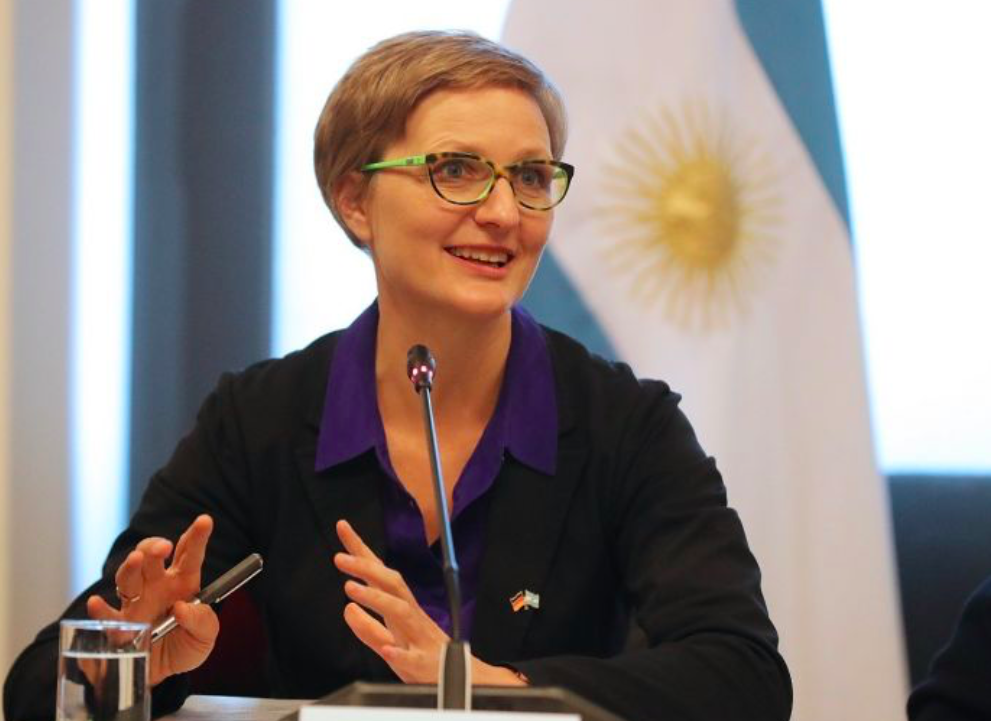
A delegation of German parliamentarians and businessmen led by the Secretary of State for Economy and Climate Protection of Germany, Franziska Brantner, met with the Minister of Economy, Martín Guzmán; the Secretary of Energy, Darío Martínez and with the Secretary of Strategic Affairs, Gustavo Béliz to “contribute to energy security, promote greater use of the available potential of renewable energies and open up new business and investment opportunities”, according to Argentina’s government, after the meeting that took place in the Casa Rosada.
Read also: Check out our coverage on Argentina
The Secretary of State for the Economy has a strong political weight in the German government after Chancellor Olaf Scholz and Brantner’s visit to Argentina was framed in the middle of a tour of Brazil and Chile with the idea of looking for partners to replace in Europe the lack of food and energy due to the war in Ukraine.

The objective of the conference, which brought together important representatives of the public and private sectors, was to promote bilateral relations, taking advantage of the strong complementarities that Germany and Argentina present in relation to energy matrixes to generate synergies, open new businesses, attract investments, and generate new sources of employment in the country.
“We must take advantage of and explore the different alternatives that can deepen the bilateral relationship between Germany and Argentina in energy matters,” said Béliz, recalling the recent meeting between President Alberto Fernández and Foreign Minister Olaf Scholz, in which both expressed their willingness to deepen the ties between the two countries.
From this point of view, the Secretary for Strategic Affairs announced that the idea of the meeting with Brantner and the business delegation that arrived in Buenos Aires was to close investment agreements in the green hydrogen, lithium and electromobility sectors.
There was also talk of deepening the issues of gas and the potential that Argentina has at an important moment for the world where the war in Ukraine is generating a serious lack of gas and oil in Europe.
In the Casa Rosada they commented to El Cronista that Alberto Fernández’s idea is to position Argentina as a substitute country for oil, gas and food that until now came to Europe from Russia and Ukraine.
For his part, Minister Guzmán reviewed the current situation with the German official and assured that “today we observe a particular geopolitical, geoeconomic and environmental context, and Argentina can contribute with specific solutions to problems facing the world.”
Guzmán also remarked: “opportunities present themselves and our country has the potential to contribute to global energy security with LNG in order to contribute to a more resilient and stable world, which will also strengthen Argentina.”
CLEAR GAME RULES
Thus, the Minister of Economy transmitted to the delegation of businessmen and officials from Germany that clear rules of the game are being designed in Argentina to “have more reliability in the conditions of supply and demand.”
Meanwhile, Franziska Brantner affirmed that “Argentina presents excellent natural conditions for a green transformation that we will only achieve together. Argentina is an important country for us on this path.”
The high-ranking German official added that her country “wishes to support and encourage the development of the green hydrogen industry” by contributing “with technical know-how and experience in state regulations and cooperating in the sustainable treatment of lithium.”
The work meeting between the delegations of both countries had the perspective of the business sector in the energy transition with the presentation of business in Vaca Muerta, renewable energy projects and hydrogen development.
Participated Sergio Affronti (CEO of YPF); Ricardo Markous (CEO of Tecpetrol); Marcos Bulgheroni (CEO of PAE); Daniel Funes de Rioja (president of the UIA and member of the Economic and Social Council) and Bárbara Könner (Vice-president of the Argentine-German Chamber of Commerce) among others.
The second meeting between both delegations in which the Argentina Productiva 2030 plan was discussed, had the presentation of its coordinator Daniel Schteingart; Martín Schapiro (specialist in lithium and sustainable mobility of the Ministry of Productive Development of the Nation); Rodrigo Rodriguez Tornquist (Undersecretary of the Secretariat for Strategic Affairs of the Nation); Santiago Sacerdote (director of Y-TEC + H2Ar Consortium) and Juan Martín Bulgheroni (vice president of PAE) among others.
Argentina seeks to move towards the energy transition while aspiring to play a leading role as an energy supplier, which allows it to enter the global value chain of the sector.
More: Argentina news in English, every day from The Rio Times.
Editorial responsibility: Matthias Camenzind, Editor-in-Chief · Editorial standards · Report an error