Bundibugyo Ebola Strain Kills 1,707 in DR Congo
DR Congo · Health
Key Facts
- 1,707 dead. DR Congo’s Ebola outbreak has killed 1,707 people out of 3,802 confirmed cases since 15 May.
- No approved vaccine. The Bundibugyo strain behind the outbreak has no licensed vaccine or specific treatment.
- Trials accelerated. The WHO is fast-tracking vaccine trials, and chief Tedros Adhanom Ghebreyesus arrived in Kinshasa on Tuesday.
- Ituri hit hardest. About 90% of cases are in Ituri province, and more than 100 health workers have been infected.
- Older origin. A new study suggests the outbreak may have begun in January in a mining town, months before detection.
The DR Congo Ebola outbreak has now killed 1,707 people, making it one of the deadliest in the country’s history. With the Bundibugyo strain lacking any approved vaccine, the WHO is racing to start trials while Ituri province absorbs about 90% of cases.
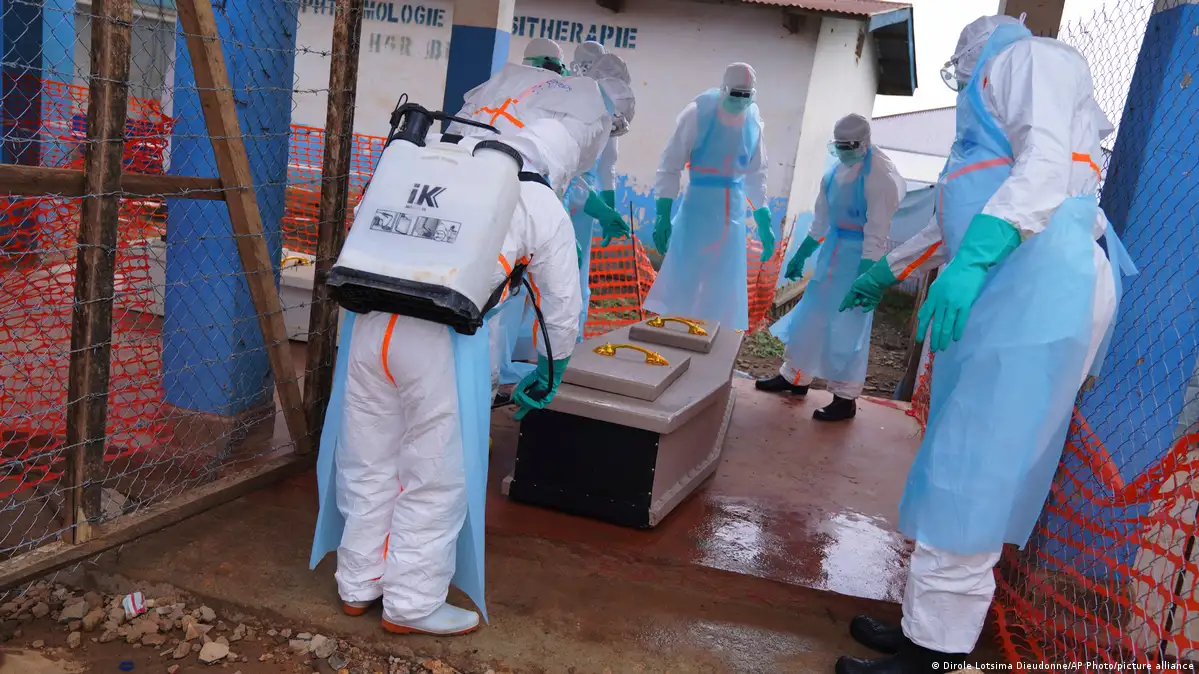
The death toll, confirmed this week, marks a grim acceleration in an outbreak declared in mid-May. Case numbers continue to climb despite a growing international response.
The outbreak is concentrated in the east of the country, where weak roads, armed groups and mobile mining populations make containment slow and dangerous.
How the DR Congo Ebola outbreak reached 1,707 deaths
The virus was confirmed on 15 May, but the toll has since risen at a pace that has alarmed health officials. Of 3,802 confirmed cases, 1,707 have proved fatal, a case-fatality rate near 45%.
The pattern of spread follows the region’s economic geography. Mining towns draw workers from across the province, and each pay cycle moves people, and the virus, between settlements. Those camps sit at the centre of a separate dispute, after a DR Congo deadline to hand mine workers equity stakes passed undelivered.
A study reported by Anadolu this week suggests the outbreak may actually have begun in January in a mining town. If confirmed, the virus circulated undetected for roughly four months.
A strain with no approved vaccine
The culprit is the Bundibugyo strain of Ebola virus. Unlike the Zaire strain behind the 2018–2020 Kivu epidemic, Bundibugyo has no licensed vaccine and no approved specific treatment.
That removes the tool that transformed the last major eastern outbreak, when ring vaccination contained spread around each new case. Response teams must rely instead on isolation, contact tracing and safe burials.
Care is supportive: fluids, oxygen and treatment of symptoms. Survival depends heavily on how quickly patients reach a treatment centre.
The race to trial a vaccine
The World Health Organization is now accelerating candidate vaccines towards trials. The agency’s chief scientist for emerging diseases, Vasee Moorthy, has said trial protocols are being advanced on an emergency timetable.
WHO director-general Tedros Adhanom Ghebreyesus arrived in Kinshasa on Tuesday to press the effort forward. His visit signals that the agency now treats the outbreak as a top-tier emergency. Donor money is scaling with it: on 5 August the United States pledged a further US$242 million for the DR Congo Ebola fight.
Trials in an active outbreak zone are logistically brutal. Cold chains, security clearances and consent processes must all function in territory where the state is thinly present.
Ituri under pressure
About 90% of confirmed cases are in Ituri province. More than 100 health workers have been infected, depleting the very workforce the response depends on.
In Mongbwalu, health staff have threatened to strike over pay and conditions. A stoppage there would cripple surveillance in one of the worst-affected zones.
The largest treatment centre yet is opening in Bunia, the provincial capital, according to France 24. It adds critical isolation capacity close to the outbreak’s core.
The regional and economic stakes
Eastern Congo borders Uganda, Rwanda and South Sudan, and cross-border trade continues even under health restrictions. The longer the outbreak runs, the higher the risk of a regional spillover. Ebola is not the only pathogen gaining ground either, with an invasive mosquito now pushing malaria into Africa’s cities.
The economic damage is already compounding. The Rio Times has tracked the cost of this crisis, including an estimated US$3.6 billion hit to African economies, alongside our earlier report, Ebola death toll passes 1,000 in DR Congo.
The outbreak also tests the wider contest over influence in Central Africa, mapped in our pillar analysis, The New Scramble for Africa in 2026, and on our Central Africa hub.
A region that has fought Ebola before
The east has lived this before. The 2018–2020 Kivu epidemic killed more than 2,200 people and taught hard lessons about community trust, safe burials and the vulnerability of response teams to attack.
That experience cuts both ways. Treatment-seeking is faster in towns that remember the last epidemic, but so is fatigue with restrictions that strangle trade and movement.
Response veterans warn that security is the difference-maker. Where armed groups operate, tracing and vaccination teams need negotiated access, and every security incident costs days the virus does not.
What to watch
First, whether vaccine trials begin on the emergency timetable the WHO has set. A successful Bundibugyo candidate would change the trajectory of this and future outbreaks.
Second, the Mongbwalu pay dispute. A health-worker strike in the epicentre would show up quickly in case numbers.
Third, the Bunia treatment centre’s capacity. If it fills within days of opening, the outbreak is outrunning the response.
Background: Crypto Fraud Wave Wipes Out Savings in Cape Verde.
Background: Africa–Latin America Trade Could Hit US$1 Trillion by 2030.
Connected coverage
More: DR Congo news in English, every day from The Rio Times.
Frequently Asked Questions
How many people has the DR Congo Ebola outbreak killed?
Congolese health authorities recorded 1,707 deaths from 3,802 confirmed cases between 15 May and early August 2026, a case-fatality rate of roughly 45%. About 90% of those cases are in Ituri province in the country’s east, where weak roads, armed groups and mobile mining populations have slowed containment.
Why is there no vaccine for the Bundibugyo Ebola strain?
Licensed Ebola vaccines protect against the Zaire strain, not Bundibugyo, and in May 2026 the WHO advised against relying on cross-protection. No vaccine or specific treatment is approved for Bundibugyo, so teams depend on isolation, contact tracing, safe burials and supportive care while candidate vaccines are fast-tracked into trials.
Has the outbreak spread beyond DR Congo?
Yes. Uganda confirmed an imported Bundibugyo case from DR Congo in May 2026 and went on to record 20 confirmed cases and two deaths, with its last case reported on 21 June. Uganda declared its outbreak over on 28 July 2026. Continued cross-border trade keeps the risk of further spillover live.
What should readers watch next in the DR Congo Ebola response?
Three markers. Whether WHO-backed vaccine trials hold to their emergency timetable. Whether the pay dispute in Mongbwalu becomes a health-worker strike in the epicentre. And how fast the new treatment centre in Bunia fills, because rapid saturation would signal the outbreak is still outrunning the response.
Sources: World Health Organization, Al Jazeera
This article was produced by The Rio Times’ automated newsroom system. How we use AI · Report an error
Read More from The Rio Times