The Twilight of the Dragon: China’s Looming Decline and Global Realignment
(Analysis) Many have long viewed the 21st century as an “Asian century,” dominated by a perpetually rising China. However, the 2020s may mark a turning point, with China’s meteoric ascent slowing and signs of a decline emerging. This pivotal shift could reshape the global order, moving from relative unity under globalization to intensified competition between rival blocs.
China’s economic growth is not just slowing—it’s faltering. Even using inflated official data, the Dragons’s economy is losing ground to the United States. Last year, the gap widened further, with China’s GDP now only two-thirds the size of the U.S., a sharp deviation from earlier projections that it would surpass the U.S. as the world’s largest economy.
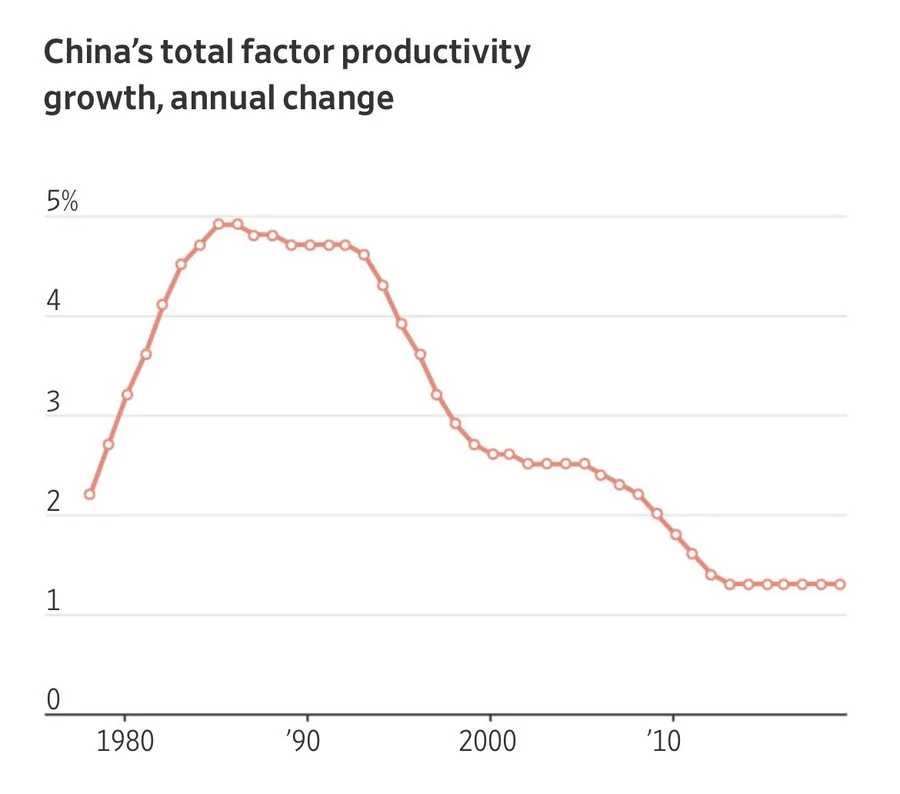
A Brookings Institution study estimated that between 2008 and 2016, China overstated its growth by 1.7 percentage points annually, inflating its economy by 12–16% by 2016. Today, the overstatement could easily range from 20 to 25%. Meanwhile, productivity growth has been stagnant or even negative for over a decade, highlighting a long-term decline in economic efficiency.
China’s surging capital output ratios—spending more to produce less—further reveal its inefficiency. Debt levels have soared to record highs, with the debt-to-GDP ratio now surpassing that of the United States. In the first half of 2024 alone, the debt burden rose by eight percentage points. Despite these alarming trends, a clear strategy for addressing this mounting debt remains elusive.
Social and Resource Strains
Domestically, economic challenges are mirrored by growing public dissatisfaction. For the first time in a generation, more Chinese citizens report a declining quality of life. Movements like “lying flat,” representing disillusioned youth unable to secure jobs matching their education, underscore these frustrations. Wealthy individuals are increasingly moving their assets and families abroad, reflecting eroding confidence in China’s future.
Simultaneously, resource scarcity is becoming a critical liability. Since the 1950s, 82% of China’s glaciers have retreated, with over 20% of their ice cover lost. Water scarcity has worsened, with nearly half of China’s population lacking access to safe drinking water.
Half of its rivers have disappeared, and 60% of its groundwater is too polluted for human use. Energy resources like oil and coal are dwindling, forcing China to become the world’s largest importer of energy and food. The cost of raw materials has skyrocketed, making economic growth three times more expensive than it was in the 2000s.
China’s demographic challenges are profound. Over the next decade, nearly 300 million people aged 50 to 60—equivalent to the U.S. population—will exit the workforce. By the late 2030s, the worker-to-retiree ratio is expected to plummet from 15:1 to just 2:1, straining economic and social systems. These demographic shifts threaten to undermine what was once a key driver of China’s rapid growth.
Geopolitical and Military Ambitions
Amid domestic and economic pressures, China is turning to assertive geopolitical and military strategies. The Pentagon has described its actions as “the most rapid expansion and ambitious modernization of its nuclear forces in history.” China is engaged in the most extensive peacetime military buildup in decades, with actual military spending estimated to be nearly three times higher than reported.
It has doubled its nuclear arsenal to 500 nuclear weapons and significantly ramped up the production of warships and ammunition, signaling its intent to project power well beyond its borders. China’s strategy increasingly relies on military coercion, particularly in the Taiwan Strait and the South China Sea.
It has staged aggressive military exercises around Taiwan, transitioning from economic integration efforts to overt military posturing. In the South China Sea, intensified naval and militia activities target contested territories, with incidents involving water cannons and lasers used against the Philippines. Along the Indian border, heightened tensions have led to deadly skirmishes.
Global Implications and Strategic Realignments
China’s economic slowdown is also sending ripples through the global economy. In the 2000s, China accounted for over one-third of global economic growth, serving as a key market for commodities and goods. Now, countries that once benefited from its rise are struggling economically and increasingly blaming China for their woes, further straining Beijing’s geopolitical relationships.
Simultaneously, China is strengthening ties with other authoritarian regimes, including providing support to Russia during the Ukraine war, reaffirming its alliance with North Korea, and extending aid to Iran. This strategy, aimed at “external balancing,” stretches Western forces thin and provides China access to advanced military technologies. However, it also increases tensions with the United States and its allies, raising concerns of prolonged rivalry.

While the U.S.-China relationship is entering a dangerous phase marked by heightened tensions, a full-blown conflict is not inevitable. Competition could spur innovation in areas like artificial intelligence, clean energy, and climate change mitigation. In the longer term, there is cautious hope that China’s military expansion will plateau and a future generation of leaders may prioritize economic stability over regional dominance, paving the way for negotiations and a more cooperative global environment.
Conclusion
China’s challenges—ranging from economic stagnation and demographic decline to geopolitical pressures—signal a turning point not only for the nation itself but for the global order. The next decade will be critical in determining whether these shifts lead to conflict or open opportunities for innovation and cooperation in a rapidly changing world.
The Twilight of the Dragon: China’s Looming Decline and Global Realignment
Read More from The Rio Times