Key Facts
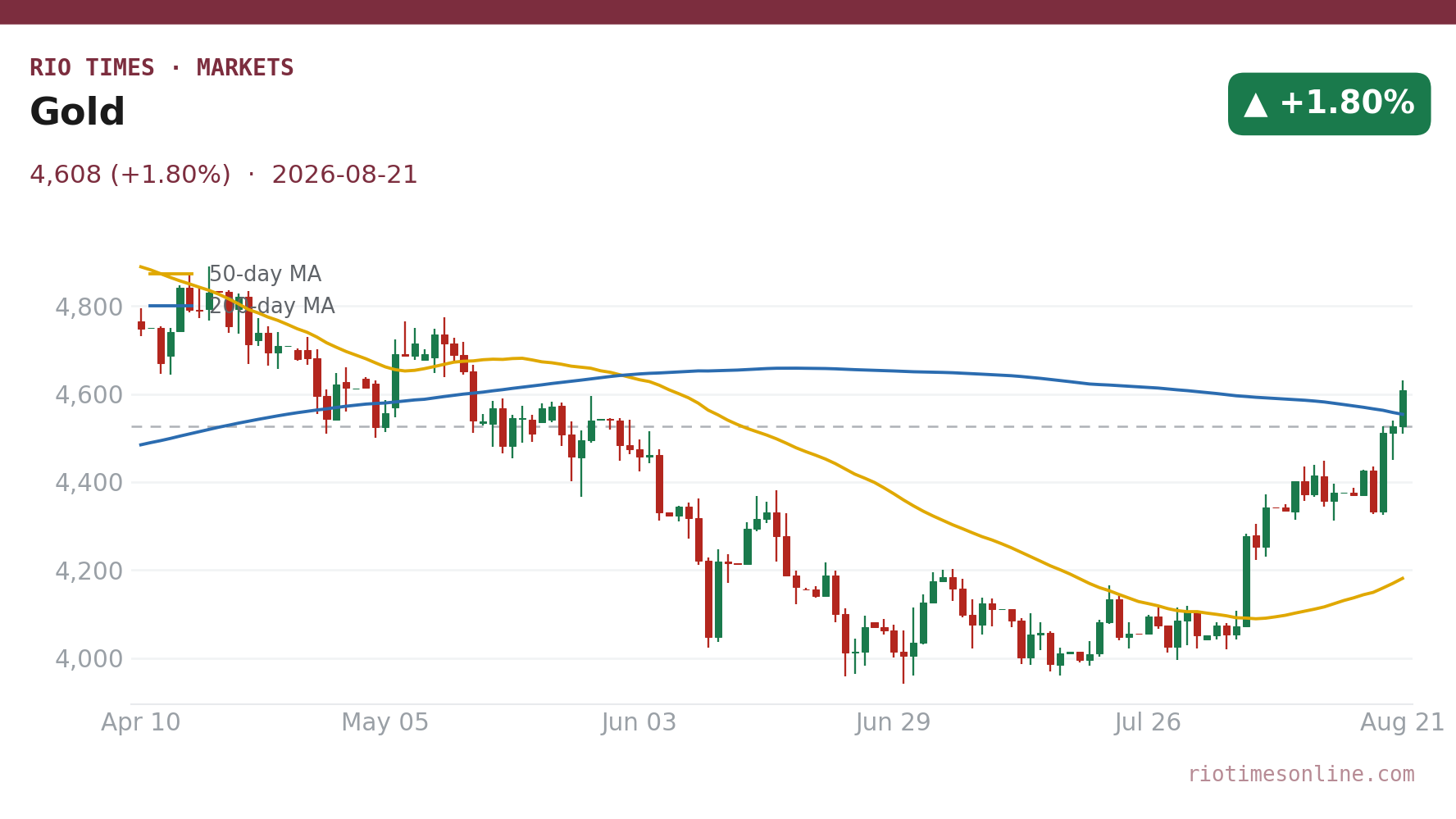
- —What happened Gold settled at US$4,608 an ounce on Friday, up 1.80 percent, while silver hit US$68.99, adding 1.15 percent.
- —How big a jump The gains came from a softer US dollar, which made dollar-priced metals cheaper for overseas buyers.
- —The real story Safe-haven demand from growth fears and geopolitical risk also fueled the rally, treating metals as a store of value.
- —The catch The rally is driven more by currency moves than inflation panic, so a sudden dollar rebound could reverse it.
- —Who it touches Mexico and Peru, top silver and gold miners, see wider margins and higher export earnings.
- —What comes next Investors should watch the dollar index, real Treasury yields, and Mexican and Peruvian mining data for the tailwind’s durability.
Today’s Focus
Gold settled at US$4,608 an ounce on Friday, August 21, 2026, a gain of 1.80 percent, while silver ended at US$68.99, up 1.15 percent. Both moves were powered by a softer US dollar, which makes dollar-priced metals cheaper for overseas buyers.
The rally also reflected continued safe-haven demand tied to concerns over slowing global growth and elevated geopolitical risk. Investors treated the metals as a store of value rather than an income asset, a logic that strengthens when real bond yields stop rising.
For Latin America, the session mattered directly. Mexico is the largest primary silver producer in the world, and Peru ranks among the top global miners of both silver and gold, so higher prices widen margins and lift tax and export earnings.
The read for investors is simple: as long as the dollar softens and real yields stay contained, the cash-flow tailwind for Mexican and Peruvian miners remains intact.
What matters today. A weaker dollar and safe-haven buying lifted both metals on Friday, directly improving the revenue outlook for Mexico and Peru, the region’s key precious-metal producers.
01 The session in one read
Gold settled at US$4,608 an ounce on Friday, August 21, 2026, a rise of 1.80 percent on the day. Silver closed at US$68.99 an ounce, adding 1.15 percent, keeping both metals firmly in the upper end of their recent ranges.
The driver was a softer US dollar, which lowers the cost of dollar-quoted metals for foreign buyers. Real, inflation-adjusted bond yields also stayed contained, reducing the opportunity cost of holding gold and silver, which pay no interest.
Safe-haven flows added momentum. With investors still focused on slowing global growth and geopolitical friction, the metals drew steady defensive demand from funds and Latin American savers looking for a store of value.
The session confirmed that gold and silver are being driven less by inflation panic and more by a softening US dollar and stable real yields. That is a constructive mix for Latin American producers because it raises realised prices without necessarily signaling a sharp global demand shock. The variable to watch next is whether the dollar stabilises early next week, which would test how much of Friday’s bid was purely currency-driven.
02 The board
Gold’s proxy trackers moved in line with the stronger tone. The board shows the metal-following instruments reflecting the 1.80 percent daily gain, with prices holding above the US$4,600 mark that has become the market’s reference point.
Silver’s 1.15 percent rise kept its proxies near the US$69 level. As the world’s top primary silver producer, Mexico sits at the centre of that move, while Peru’s dual exposure to silver and gold gives its miners a double lift.
| Asset | Level | Change |
|---|---|---|
| Gold | US$4,608/oz | +1.80% |
| Silver | US$68.99/oz | +1.15% |
Source: RT close, 2026-08-21. Where a commodity has no spot feed, an exchange-traded tracker or leading producer is shown as a labelled proxy.
Live Market IntelligenceThe live market board
Rio Times · Live Market Intelligence
Latin America — Cross-Market Board
| Instrument | Last | Change | YoY | Prev. | High | Low | Volume |
|---|---|---|---|---|---|---|---|
| IBOV | 205,079.25 | -0.17% | +21.85% | 205,430.33 | 168,310 | 167,142 | — |
| IPSA | 10,972.40 | +0.02% | — | 10,970.29 | 11,210 | 10,984 | 1,513,213,483 |
| IPC MEX | 68,969.69 | +0.06% | +12.17% | 68,929.72 | 66,121 | 65,405 | 108,886,187 |
| MERVAL | 3,017,221 | — | +30.51% | 3,022,485 | 3,042,365 | 2,991,150 | — |
| COLCAP | 2,521.34 | -1.75% | — | 9.04 | 9.05 | 9.02 | 4,133 |
| BVL PERÚ | 59,664.64 | +0.40% | — | — | — | — | — |
| USD/BRL | 5.16 | +0.01% | -5.13% | 5.16 | 5.18 | 5.14 | — |
| EUR/BRL | 5.95 | +1.01% | -5.83% | 5.89 | 5.98 | 5.94 | — |
| USD/MXN | 17.06 | -0.24% | -8.58% | 17.10 | 17.08 | 17.01 | — |
| USD/CLP | 913.98 | +0.04% | -5.67% | 913.65 | 915.11 | 906.68 | — |
| USD/COP | 3,140 | +0.03% | -22.04% | 3,139 | 3,141 | 3,105 | — |
| USD/PEN | 3.36 | -0.66% | -4.82% | 3.38 | 3.38 | 3.35 | — |
| USD/ARS | 1,493 | +0.10% | +12.96% | 1,491 | 1,494 | 1,480 | — |
| USD/UYU | 40.27 | +1.24% | +1.80% | 39.77 | 40.27 | 40.23 | — |
| USD/PYG | 5,939 | +1.68% | -19.54% | 5,841 | 5,939 | 5,925 | — |
| USD/BOB | 11.64 | -0.76% | +72.04% | 11.73 | 11.72 | 11.64 | — |
| USD/DOP | 58.34 | +1.25% | -3.44% | 57.62 | 58.34 | 58.04 | — |
| USD/CRC | 445.92 | +0.89% | -9.71% | 441.97 | 448.50 | 445.92 | — |
03 What moved it
Currency markets did much of the work. A weaker dollar makes gold and silver cheaper in euro, peso and sol terms, which tends to pull in non-US buyers and lift dollar prices.
The bond market helped too. When real yields fall or flatten, the penalty for holding a non-interest-bearing asset like gold shrinks, and that logic extended to silver as a monetary metal.
Finally, defensive positioning remained active. Gold near US$4,600 and silver near US$69 are levels that reflect demand for insurance against growth disappointments and political risk, not just a short-term tactical trade.
04 The Latin American read
Mexico is the largest primary silver producer in the world, which means a move toward US$70 an ounce feeds directly into export revenue and government mining income. The stronger silver price supports the margins of Mexican producers and the regional supplier chains around them.
Peru is a top-tier global miner of both silver and gold. Higher prices for both metals improve the cash-flow picture for Peruvian operators and can strengthen the country’s export earnings and local currency sentiment.
For foreign investors, the session was a reminder that Latin American mining equities and currencies often move with precious metals. When the dollar softens and metals rise, the region’s producer economies receive a double benefit.
05 The names to watch
The key names are the largest Mexico-focused silver producers, whose revenue is geared to the silver price, and the major Peruvian miners with combined gold and silver output. They are the clearest beneficiaries of Friday’s gains.
Investors should also watch the Mexican peso and Peruvian sol, which can follow metals strength, and the local equity indices where miners carry heavy weight. The transmission from commodity price to share price is rarely immediate, but the direction is set.
06 The outlook
The outlook depends on whether the dollar stays soft and real yields remain contained. If those conditions hold, gold and silver have room to consolidate above current levels, which would keep Mexican and Peruvian producers in a favourable margin environment. The main risk is a sudden dollar rebound, which would reverse the currency-driven bid and pressure both metals.
07 What to watch
- US dollar index: Watch whether the dollar rebounds, because a firmer greenback would remove the main support under gold and silver from Friday’s session.
- Real Treasury yields: A rise in inflation-adjusted yields would raise the cost of holding gold and silver and could stall the rally.
- Mexico silver export data: Higher silver prices should show up in Mexican mining revenue and trade figures, a direct check on the producer tailwind.
- Peru mining equities: Peruvian gold and silver miners should reflect the stronger metals complex in their cash-flow outlook and share prices.
Frequently Asked Questions
Why did gold rise on Friday?
Gold rose because a softer US dollar and contained real yields made the metal more attractive, while safe-haven demand continued.
Why did silver rise alongside gold?
Silver climbed as the weaker dollar and defensive flows supported the whole precious complex, with its industrial role adding extra demand.
How does this affect Mexico?
Mexico is the world’s top primary silver producer, so higher silver prices improve export revenue, tax receipts and mining margins.
How does this affect Peru?
Peru is a major global miner of silver and gold, so stronger prices for both metals boost cash flows and export earnings.
This article was produced by The Rio Times’ automated newsroom system. How we use AI · Report an error · Editorial responsibility: Matthias Camenzind, Editor-in-Chief
In depth
LatAm Markets: Live Signals → — real-time movers, turnover leaders and FX across Latin America.