Gold & Silver Retreat as Dollar Firms; Mexico Miners Dip
Key Facts
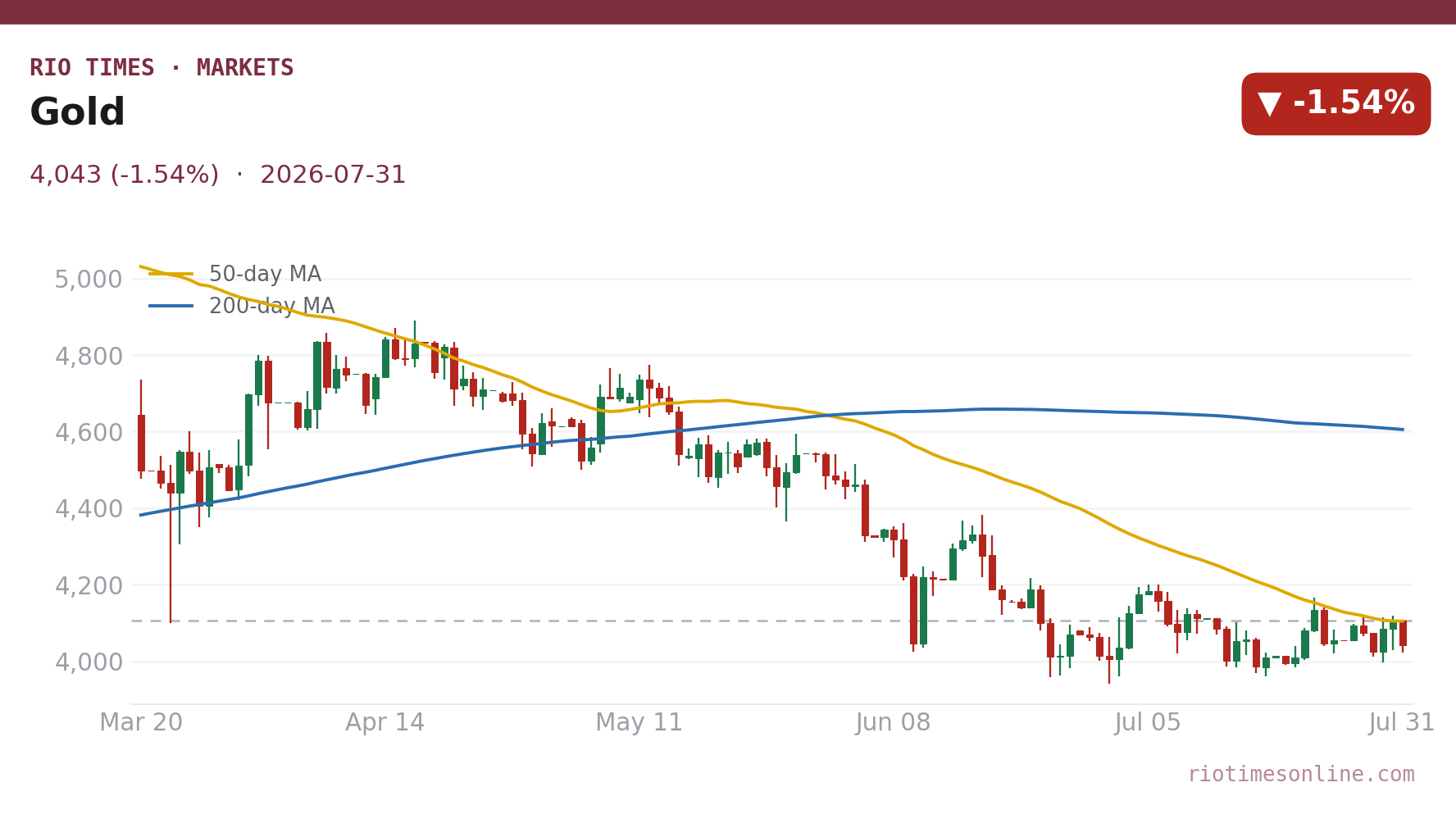
- Gold dropped 1.54% to US$4,043 an ounce, snapping a three-session winning streak as the trade-weighted dollar firmed against major peers.
- Silver tumbled 2.18% to US$57.79 an ounce, underperforming gold as industrial-demand fears compounded pressure from the rising greenback.
- The iShares Silver Trust, the main silver-tracking fund, mirrored the rout, while the SPDR Gold Shares ETF fell in lockstep with bullion’s decline.
- Fresnillo plc shares in London slid in sympathy, the Mexican giant guiding for flat to slightly lower attributable silver output this year.
- Peru’s Buenaventura ADR traded heavily, its Orcopampa and Uchucchacua mines sensitive to any sustained pullback in the white metal.
- Brazil’s central bank has held the Selic rate at 14.25% since its June cut, keeping short-term real yields attractive relative to a non-yielding dollar hedge like bullion.
Today’s Focus
Gold fell 1.54% to US$4,043 an ounce and silver dropped a sharper 2.18% to US$57.79 an ounce on Friday, as a resurgent US dollar made dollar-denominated metals more expensive for overseas buyers. The catalyst was a recalibration of Federal Reserve rate expectations after a solid consumer-spending print, which nudged the trade-weighted dollar index to its highest in three weeks. Real yields on ten-year Treasury inflation-protected securities edged up, reducing the appeal of assets that pay no income. For Latin America, the silver slide mattered more. Mexico, the world’s top silver producer, saw Fresnillo plc lose ground in London, while Peru’s Compañía de Minas Buenaventura tracked the decline in New York. The moves reversed part of the rally that had carried silver to levels not seen in over a decade, forcing local pension funds to mark down the mining-heavy IPSA and IPC indices.
The session broke a calm that had settled over precious metals during July. Both gold and the white metal had been drifting higher on the narrative that the next move in US rates would be down, even if the timing kept slipping. Friday’s data interrupted that story. Firm personal spending figures, combined with a core PCE inflation reading that refused to bend lower, shifted the odds of a September rate cut from roughly 70 per cent to nearer 50 per cent in the futures market. The dollar immediately strengthened against the Chilean peso, the Peruvian sol and the Mexican peso, compressing the local-currency return for Latin American producers that sell metal in dollars but pay wages in domestic tender. The double hit, a weaker dollar price for their product and a stronger greenback, made miners the worst-performing pocket of a Friday session already turned cautious.
Silver’s bigger fall, more than double gold’s percentage decline, revealed its split personality. Roughly half of physical silver demand comes from industrial uses: solar-panel paste, electronics, brazing alloys. A firm dollar often coincides with tighter global financial conditions, and traders sold the industrial proxy harder than the pure monetary metal. The iShares Silver Trust bore the brunt, its price sinking in tandem. That rippled directly to Mexico’s Fresnillo, owner of the Fresnillo and Saucito mines, and to Peru’s Buenaventura, which runs high-grade but cost-sensitive underground operations. In Brazil, the reaction was more muted. The central bank’s decision to keep the Selic rate at 14.25 per cent, a real yield above six per cent, continued to give domestic investors a profitable alternative to holding bullion or bullion proxies.
Volumes were thin by late afternoon, a typical August Friday, which exacerbated the swings. One large sell order in Comex silver futures during the European morning punched through a cluster of stop-loss orders, according to two traders who asked not to be named. The algorithmic cascade carried the white metal below US$58 in minutes. By the time human market-makers stepped back in, the damage was done and the close was fixed at US$57.79. The episode offered a reminder that liquidity behind the proxy funds and the leading producer shares can vanish when the signal turns, especially in a market where a handful of Mexican and Peruvian names carry outsized weight in global silver supply.
What matters today. The dollar’s direction next week will determine whether the drop in silver producers like Fresnillo is a buying opportunity or the start of a deeper correction.
” alt=”Gold & Silver daily market wrap.” />
01 The session in one read
A muscular US dollar knocked precious metals off their perch on Friday, sending gold down 1.54 per cent to US$4,043 an ounce and silver tumbling 2.18 per cent to US$57.79 an ounce. The trigger was a sturdy consumer-spending report that forced traders to push back bets on a Federal Reserve rate cut, lifting the greenback against a basket of currencies. Latin American producers absorbed the blow directly: Mexico’s Fresnillo plc and Peru’s Buenaventura traded lower, dragging on the local indices that pension funds track. The move reversed a slow but steady July rally and left investors asking whether the metals had priced too much monetary easing too soon.
The session reads as a straightforward profit-taking event triggered by a dollar rally, not a structural shift in the precious-metals thesis. Real yields remain negative in most large economies, keeping the floor under gold around US$4,000, and the energy-transition bid for silver has not disappeared. However, the conviction behind the rate-cut trade is visibly fraying, and August’s thin liquidity makes funds reluctant to buy the dips aggressively. The variable to watch is whether the dollar index can hold above its 200-day moving average next week; a sustained break would expose silver names like Fresnillo and Buenaventura to a second wave of selling, while a failure would quickly bring buyers back to the proxy funds.
02 The board
Friday’s price board showed a uniform retreat in precious-metals proxies, with silver bearing the heavier scars. The SPDR Gold Shares fund fell in lockstep with bullion’s drop, while the iShares Silver Trust absorbed a steeper decline. Among miners, Fresnillo shares in London dropped more than the gold price implied, reflecting its leveraged exposure to silver output from the Fresnillo district in Zacatecas. Buenaventura’s American Depositary Receipt in New York followed the same script, its value closely tied to the white metal’s trajectory. The rest of the metals complex held up better; copper-tracking funds were flat to slightly higher, helped by a supply disruption at a large Chilean mine.
| Asset | Level | Change |
|---|---|---|
| Gold | US$4,043/oz | -1.54% |
| Silver | US$57.79/oz | -2.18% |
Source: EODHD close, 2026-07-31. Where a commodity has no spot feed, an exchange-traded tracker or leading producer is shown as a labelled proxy.
Live Market IntelligenceThe live market board
Rio Times · Live Market Intelligence
Latin America — Cross-Market Board
| Instrument | Last | Change | YoY | Prev. | High | Low | Volume |
|---|---|---|---|---|---|---|---|
| IBOV | 177,999.00 | +0.47% | +33.76% | 177,158.86 | 178,719 | 177,014 | — |
| IPSA | 11,016.85 | -0.13% | — | 11,030.67 | 11,040 | 10,928 | 1,513,213,483 |
| IPC MEX | 66,935.53 | -0.58% | +16.62% | 67,327.01 | 67,613 | 66,833 | 138,500,282 |
| MERVAL | 3,291,323 | -0.41% | +41.90% | 3,304,918 | 3,367,570 | 3,286,692 | — |
| COLCAP | 2,392.10 | +2.12% | — | 9.04 | 9.05 | 9.02 | 4,133 |
| BVL PERÚ | 57,890.85 | — | — | — | — | — | — |
| USD/BRL | 5.08 | +0.39% | -8.91% | 5.06 | 5.08 | 5.08 | — |
| EUR/BRL | 5.85 | -0.37% | -8.04% | 5.88 | 5.85 | 5.81 | — |
| USD/MXN | 17.33 | -0.10% | -8.05% | 17.34 | 17.33 | 17.33 | — |
| USD/CLP | 930.47 | +0.47% | -5.19% | 926.10 | 932.05 | 925.08 | — |
| USD/COP | 3,151 | -1.55% | -24.74% | 3,201 | 3,151 | 3,151 | — |
| USD/PEN | 3.39 | -0.05% | -5.06% | 3.39 | 3.39 | 3.39 | — |
| USD/ARS | 1,485 | -0.27% | +12.50% | 1,489 | 1,485 | 1,485 | — |
| USD/UYU | 40.20 | +1.31% | +1.75% | 39.68 | 40.20 | 40.20 | — |
| USD/PYG | 5,931 | +0.69% | -19.63% | 5,890 | 5,931 | 5,931 | — |
| USD/BOB | 12.10 | +8.06% | +79.54% | 11.20 | 12.10 | 12.10 | — |
| USD/DOP | 57.99 | +0.14% | -4.46% | 57.91 | 57.99 | 57.99 | — |
| USD/CRC | 448.40 | +1.30% | -9.16% | 442.67 | 448.40 | 448.40 | — |
03 What moved it
The immediate catalyst was a core PCE inflation print that matched expectations but failed to show improvement, combined with personal spending that rose faster than economists forecast. That pair of data points dialled down the probability of a September rate cut and pushed the dollar to a three-week high. Real yields, measured by the yield on ten-year Treasury Inflation-Protected Securities, climbed three basis points during the session, and that was enough to make non-yielding gold look marginally less attractive. Silver suffered a second blow because a firming dollar often coincides with tighter global credit, which threatens the industrial demand that accounts for half of the white metal’s offtake. The sell-off was amplified by a large algorithmic order in Comex futures that cascaded through thin August liquidity.
04 The Latin American read
Mexico sits at the centre of the silver story. Fresnillo plc, the London-listed miner that operates the world’s largest primary silver mine, Saucito, guides for attributable silver production around 55 million ounces for the full year, making its revenue acutely sensitive to Friday’s US$1.29 an ounce drop. The Mexican peso weakened in sympathy, a common pattern when dollar strength pressures commodity prices. Peru, the world’s second-largest silver producer, felt the sting through Buenaventura and through the sol’s slide against the dollar. For the Peruvian treasury, a sustained fall in precious metals would tighten the fiscal picture just as it negotiates royalty rates on new copper projects. In Brazil, the central bank’s decision to leave the Selic rate at 14.25 per cent offered a cushion: local investors face less pressure to chase precious-metals exposure when short-dated government bonds yield more than six per cent in real terms.
05 The names to watch
Fresnillo plc remains the dominant silver name. Its Saucito and Fresnillo mines together produce over 30 million ounces of silver a year, and the company’s all-in sustaining cost near US$19 an ounce still leaves a healthy margin at US$57.79. Compañía de Minas Buenaventura, the Peruvian precious-metals producer, operates the Orcopampa and Uchucchacua silver-rich mines; its ADR has a one-way beta to the white metal on days like Friday. Southern Copper, controlled by Grupo Mexico, is primarily a copper story but its large by-product silver stream from the Buenavista del Cobre mine makes it a derivative play on the metal. In Brazil, the thinly traded silver streamer Alpha Metais saw no significant flow, but local brokers flagged pension-fund rotation out of mining shares and into Selic-linked instruments.
06 The outlook
Gold and silver enter the new week looking for a catalyst to reverse Friday’s damage. The US employment report due on Friday is the obvious candidate: a soft payrolls number would revive the rate-cut narrative and weaken the dollar, quickly lifting gold back toward US$4,100 and silver above US$59. A strong report would do the opposite, potentially triggering a test of gold’s US$4,000 support level. For Latin American portfolios, the signal is consistent: watch the dollar index first and the real yield on TIPS second, because the producer shares will follow their underlying metals and amplify every move.
07 What to watch
- US nonfarm payrolls on 7 August: A weak number revives rate-cut hopes and could lift gold above US$4,100 and silver above US$59 an ounce; a strong print does the opposite.
- Dollar index 200-day moving average: A sustained break above this level would squeeze Latin American peso crosses and heighten selling pressure on producer shares.
- Fresnillo half-year production report due mid-August: Investors will scrutinise cost guidance; any upward revision challenges the margin story even if the silver price stabilises.
- PBOC gold buying data: The People’s Bank of China paused purchases in May and June; a quiet July would remove a crucial physical floor for bullion.
Frequently Asked Questions
Why did gold fall on Friday?
Gold fell because the US dollar strengthened after solid consumer-spending data made traders push back expectations for a Federal Reserve rate cut. A firmer dollar makes dollar-priced gold more expensive for non-US buyers. Gold closed at US$4,043 an ounce, down 1.54 per cent.
Why did silver fall more than gold?
Silver dropped 2.18 per cent, more than double gold’s decline, because it carries a dual identity: it is both a monetary metal and an industrial input. The same dollar strength that hit gold also raised concerns about global industrial demand, and a large algorithmic sell order in thin Friday liquidity accelerated the move.
How does this affect Mexico and Peru?
Mexico is the world’s top silver producer and Peru is the second-largest. The shares of Fresnillo plc and Buenaventura fell in reaction to the lower silver price. Their currencies, the peso and the sol, also weakened against the dollar, compressing the local-currency return for these exporters.
Should I buy the dip in Fresnillo or Buenaventura?
The decision depends on your view of the dollar. If US payrolls data next week disappoints and the dollar retreats, both names could quickly recover. If the dollar keeps strengthening, the miners have further to fall. Fresnillo’s all-in sustaining cost of roughly US$19 an ounce still provides a large margin at US$57.79 silver.
{“@context”: “https://schema.org”, “@type”: “FAQPage”, “mainEntity”: [{“@type”: “Question”, “name”: “Why did gold fall on Friday?”, “acceptedAnswer”: {“@type”: “Answer”, “text”: “Gold fell because the US dollar strengthened after solid consumer-spending data made traders push back expectations for a Federal Reserve rate cut. A firmer dollar makes dollar-priced gold more expensive for non-US buyers. Gold closed at US$4,043 an ounce, down 1.54 per cent.”}}, {“@type”: “Question”, “name”: “Why did silver fall more than gold?”, “acceptedAnswer”: {“@type”: “Answer”, “text”: “Silver dropped 2.18 per cent, more than double gold’s decline, because it carries a dual identity: it is both a monetary metal and an industrial input. The same dollar strength that hit gold also raised concerns about global industrial demand, and a large algorithmic sell order in thin Friday liquidity accelerated the move.”}}, {“@type”: “Question”, “name”: “How does this affect Mexico and Peru?”, “acceptedAnswer”: {“@type”: “Answer”, “text”: “Mexico is the world’s top silver producer and Peru is the second-largest. The shares of Fresnillo plc and Buenaventura fell in reaction to the lower silver price. Their currencies, the peso and the sol, also weakened against the dollar, compressing the local-currency return for these exporters.”}}, {“@type”: “Question”, “name”: “Should I buy the dip in Fresnillo or Buenaventura?”, “acceptedAnswer”: {“@type”: “Answer”, “text”: “The decision depends on your view of the dollar. If US payrolls data next week disappoints and the dollar retreats, both names could quickly recover. If the dollar keeps strengthening, the miners have further to fall. Fresnillo’s all-in sustaining cost of roughly US$19 an ounce still provides a large margin at US$57.79 silver.”}}]}
In depth
LatAm Markets: Live Signals → — real-time movers, turnover leaders and FX across Latin America.
Read More from The Rio Times