Global Economy Briefing for Friday, September 18, 2026
The Bank of Japan raised rates to 1.25%, a 31-year high, two days after the Fed. Wall Street rebounded 1.14% and gold recovered to about US$4,346 an ounce.
Rio Times Global Economy Briefing
The Big Three
- The Bank of Japan raised rates to a thirty-one-year high. Tokyo lifted its benchmark to 1.25% from 1.00% on Friday morning in Asia, two days after the Federal Reserve moved in the same direction. The Nikkei still rose 1.38% to 65,024 points, because the decision had been widely expected and the statement contained no surprise.
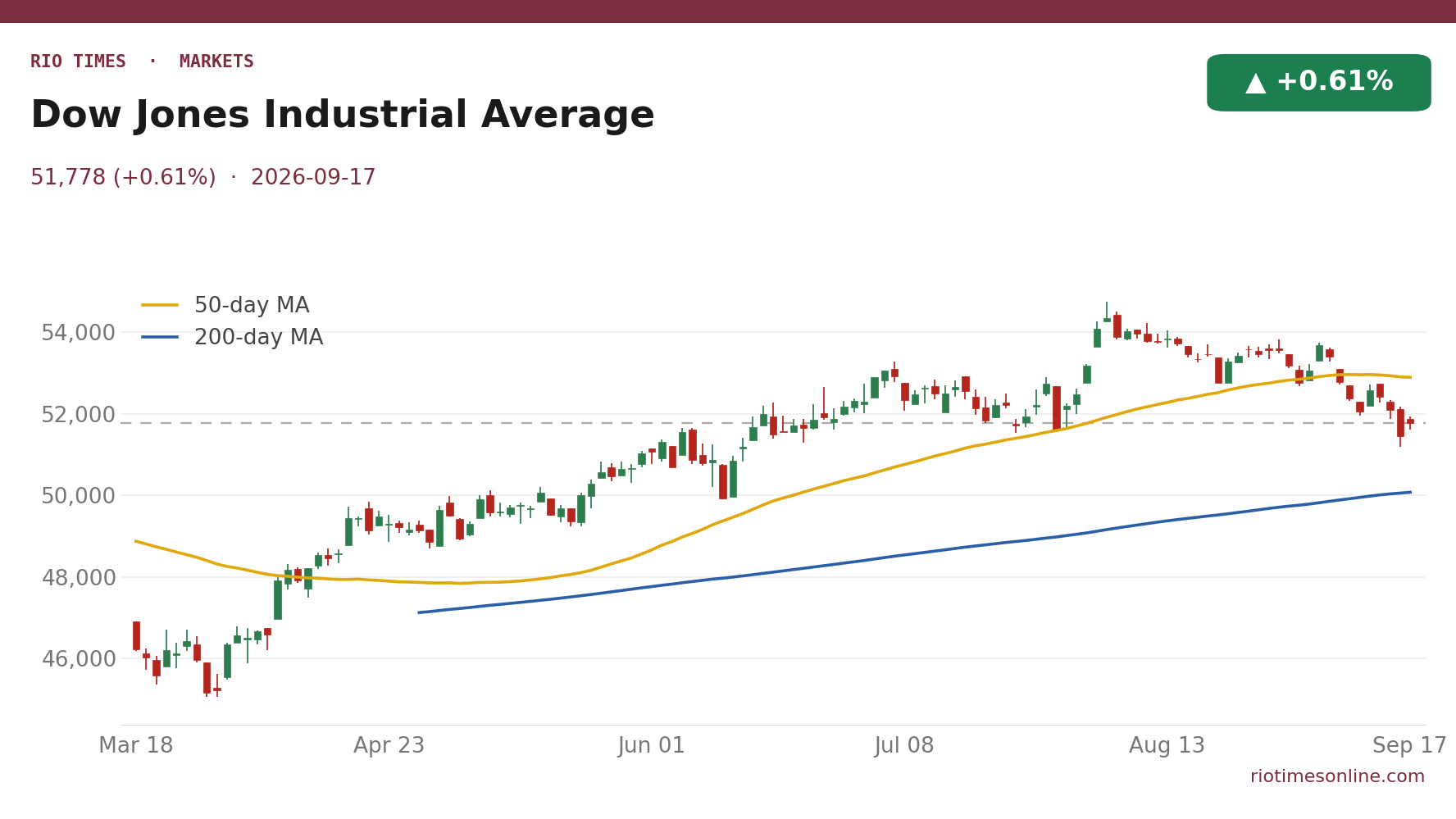
- Wall Street reversed the Fed-day selloff in a single session. The S&P 500 rose 1.14% to 7,637.76, the Nasdaq Composite 1.69% and the Dow 0.61%. The volatility index fell 12.82% to 15.44 and the ten-year Treasury yield eased to 4.947% from 5.006%.
- Three central banks have now moved in one week and only Brazil cut. The Federal Reserve raised to 3.75-4.00%, the Bank of Japan to 1.25%, and Brazil’s Copom cut the Selic to 13.75%. For Latin America that combination narrows the interest-rate cushion that has supported regional currencies all year.
Today’s Economic Calendar — Friday, September 18, 2026 (times UTC)
| Time | Country | Event | Consensus | Prior |
|---|---|---|---|---|
| 00:00 | CL | National Day | — | — |
| 02:30 | JP | Monetary Policy Statement | — | — |
| 03:00 | JP | BoJ Interest Rate Decision | 1.25 | 1 |
| 06:00 | DE | Producer Price Index | 0.4 | 1.1 |
| 06:00 | DE | Producer Price Index | 4.1 | 3 |
| 06:30 | JP | BoJ Press Conference | — | — |
| 09:00 | CN | FDI | -5.8 | -6.2 |
| 12:00 | MX | Private Spending | 3 | 2.2 |
| 12:00 | MX | Aggregate Demand | 0.9 | 0.3 |
| 12:00 | MX | Aggregate Demand | 6 | 5 |
| 12:00 | MX | Private Spending | 1.1 | -0.8 |
| 13:15 | US | Manufacturing Production | 0.3 | 0.2 |
| 13:15 | US | Industrial Production | 0.3 | 0.2 |
| 13:15 | US | Capacity Utilization | 76.4 | 76.3 |
| 13:15 | US | Manufacturing Production | 1.1 | 1.2 |
| 13:15 | US | Industrial Production | 1 | 1.1 |
| 13:30 | US | Fed Bowman Speech | — | — |
| 14:00 | US | Leading Index | 0.1 | 0.2 |
| 15:00 | CO | ISE Economic Activity | 2.9 | 3.5 |
| 15:45 | US | Fed Schmid Speech | — | — |
| 17:00 | US | Baker Hughes Oil Rig Count | — | 450 |
| 18:39 | AR | Budget Balance | — | 2960 |
| 19:00 | AR | Balance of Trade | 2055 | 2115 |
| 19:30 | BR | CFTC BRL speculative net positions | — | 66.1 |
| 19:30 | MX | CFTC MXN speculative net positions | — | 94.7 |
01 Tokyo joins the tightening side
The Bank of Japan raised its policy rate to 1.25% from 1.00% on Friday morning in Asia. That is the highest Japanese benchmark rate in thirty-one years.
The decision had been expected and the market treated it accordingly. The Nikkei rose 1.38% to 65,024 points on the day.
What makes the move consequential is not its size but its direction. Cheap yen borrowing has funded investment in higher-yielding markets for a generation, and that funding now costs more.
The stated reason was inflation pressure from higher oil prices. The conflict affecting Gulf shipping has fed straight into Japanese import costs.
Japan spent decades trying to generate inflation and is now managing it. The policy rate has moved from below zero to 1.25% in a little over two years.
02 The week of three decisions
The Federal Reserve raised its target range to 3.75-4.00% on Wednesday, its first increase since 2023. The vote was unanimous and Chair Kevin Warsh said inflation had been too high for too long.
Brazil’s Copom cut the Selic to 13.75% the same evening, its fifth consecutive quarter-point reduction. The two decisions were taken within hours of each other and in opposite directions.
The Bank of Japan then completed the set on Friday morning. Two of the three moved up and one moved down.
For emerging markets the arithmetic is unforgiving. Every tightening step abroad reduces the reward for holding local currency assets at an unchanged domestic rate.
03 What the rebound says about positioning
Markets fell on Wednesday and recovered everything on Thursday. That pattern usually means the selling was position-squaring rather than a change of view.
The volatility index is the clearest evidence. It fell 12.82% to 15.44, which is a low reading by any historical standard.
Gold behaved the same way, dropping about 1.2% on the decision and rising 1.74% the next day. Silver gained 3.44%.
The dollar did not join the recovery in either direction. It closed at 100.22, essentially unchanged, though it is up roughly 1.1% over the week.
That weekly gain is the more important number for emerging markets. A dollar rising steadily against every major currency tightens conditions everywhere at once.
04 The Latin American read
Every major regional index rose on Thursday. Chile’s IPSA gained 1.30%, Argentina’s Merval 1.08%, Mexico’s IPC 0.58% and Brazil’s Ibovespa 0.24%.
The currencies told a different story. The Colombian peso weakened by more than one percent while the Brazilian and Mexican currencies firmed.
Commodities were mixed in a way that suits the region. Copper rose for a third session on Chinese buying while oil fell for a second as Saudi exports found a workaround.
Chile’s exchange is closed today and tomorrow for Fiestas Patrias. That removes one of the region’s four main equity markets from the session.
Brazil’s position is the most exposed to this week’s decisions. It is the only major regional economy cutting rates while its main funding markets raise them.
The real has nonetheless held its level through the week. Equity inflows have so far done more work than the interest-rate arithmetic.
05 Today’s data
The American industrial production and capacity utilisation figures are the main scheduled release. Consensus points to a monthly gain of 0.3% in output and utilisation of 76.4%.
Two Federal Reserve officials speak during the session. Governor Michelle Bowman and Kansas City Fed President Jeff Schmid both appear before the American close.
Colombia publishes its July economic activity index with a consensus of 2.9% against 3.5% in June. Individual analyst forecasts run from 0.2% to 2.3%.
Argentina reports August trade figures at seven in the evening, London time. The consensus is a surplus of US$2.055 billion against US$2.115 billion in July.
German producer prices open the European session with a consensus of 0.4% on the month. That would be a sharp slowing from the previous reading of 1.1%.
Mexico publishes second-quarter private spending and aggregate demand at midday. Neither series usually moves the peso, but both feed the growth debate before Banxico meets on 24 September.
What to watch today and this week
- The yen after the decision: A thirty-one-year high in Japanese rates raises the cost of the funding behind many emerging-market positions.
- American industrial production: Consensus is a monthly gain of 0.3% with capacity utilisation at 76.4%.
- Bowman and Schmid: Two Federal Reserve speakers in one session, with another increase expected before December.
- Colombia’s activity index: Forecasts range from 0.2% to 2.3% against a June reading of 3.5%.
- Argentina’s trade balance: Consensus of US$2.055 billion, published at seven in the evening London time.
Frequently Asked Questions
What did the Bank of Japan decide on 18 September 2026?
It raised its policy rate to 1.25% from 1.00%, the highest Japanese benchmark in thirty-one years. The Nikkei rose 1.38% to 65,024 points on the decision.
What did the Federal Reserve do this week?
It raised its target range to 3.75-4.00% on 16 September, its first increase since 2023. The vote was unanimous and further increases are expected before year-end.
How did Wall Street close on 17 September?
The S&P 500 rose 1.14% to 7,637.76, the Nasdaq Composite 1.69% and the Dow 0.61%. The volatility index fell 12.82% to 15.44.
What is the gold price?
Gold closed at about US$4,346 an ounce, up 1.74%, recovering the ground lost on the Federal Reserve decision. Silver rose 3.44% to roughly US$65.43.
Did Brazil raise or cut rates?
Brazil cut. The Copom lowered the Selic to 13.75% on 16 September, its fifth consecutive quarter-point reduction, the same day the Federal Reserve raised.
What data is published today?
American industrial production and capacity utilisation, Colombia’s July activity index and Argentina’s August trade balance. Two Federal Reserve officials also speak.
Sources: Bank of Japan monetary policy statement of 18 September 2026; Federal Reserve implementation note of 16 September 2026; Copom statement of 16 September 2026; RT end-of-day series and economic calendar; exchange data from B3, BMV, BYMA, the Bolsa de Santiago and the Bolsa de Valores de Colombia.
This article was produced by The Rio Times’ automated newsroom system. How we use AI · Report an error
LatAm Markets: Live Signals → — real-time movers, turnover leaders and FX across Latin America.