Global Economy Briefing — August 6, 2026
Global economy: Wall Street cools from records, gold jumps 5.03% to US$4,277.69, and Brazil’s Copom delivers a fourth straight Selic cut to 14.00%.
Rio Times Global Economy Briefing
The Big Three
- Wall Street cools from record highs The S&P 500 closed at 7,724, down 0.17%, slipping from recent records as investors balanced Middle East war risks with resilient US growth and a still-data-dependent Fed. The move matters for Latin America because high US equity valuations and a firm dollar keep risk premia elevated in EM assets, including Brazil’s Ibovespa and local credit.
- Fed path in focus as US data stay resilient Recent BEA data show US GDP growing at a 2.1% annualised pace in Q1 2026, reinforcing the slow but solid backdrop that allows the Fed to stay cautious on rate cuts. For Brazil and the wider region, a slower-than-hoped Fed easing keeps US yields and the dollar supportive, constraining how fast Copom can cut the Selic without destabilising the real.
- Brazil delivers a Selic cut with markets watching the real Brazil’s central bank cut the Selic rate to 14.00% from 14.25% on 5 August, a fourth straight cut that extends a cautious easing cycle. The decision is critical for investors in Latin America: it will shape carry trade dynamics, the USD/BRL path and local-currency bond demand at a time when global growth forecasts for 2026 have been nudged down by war-related energy shocks.

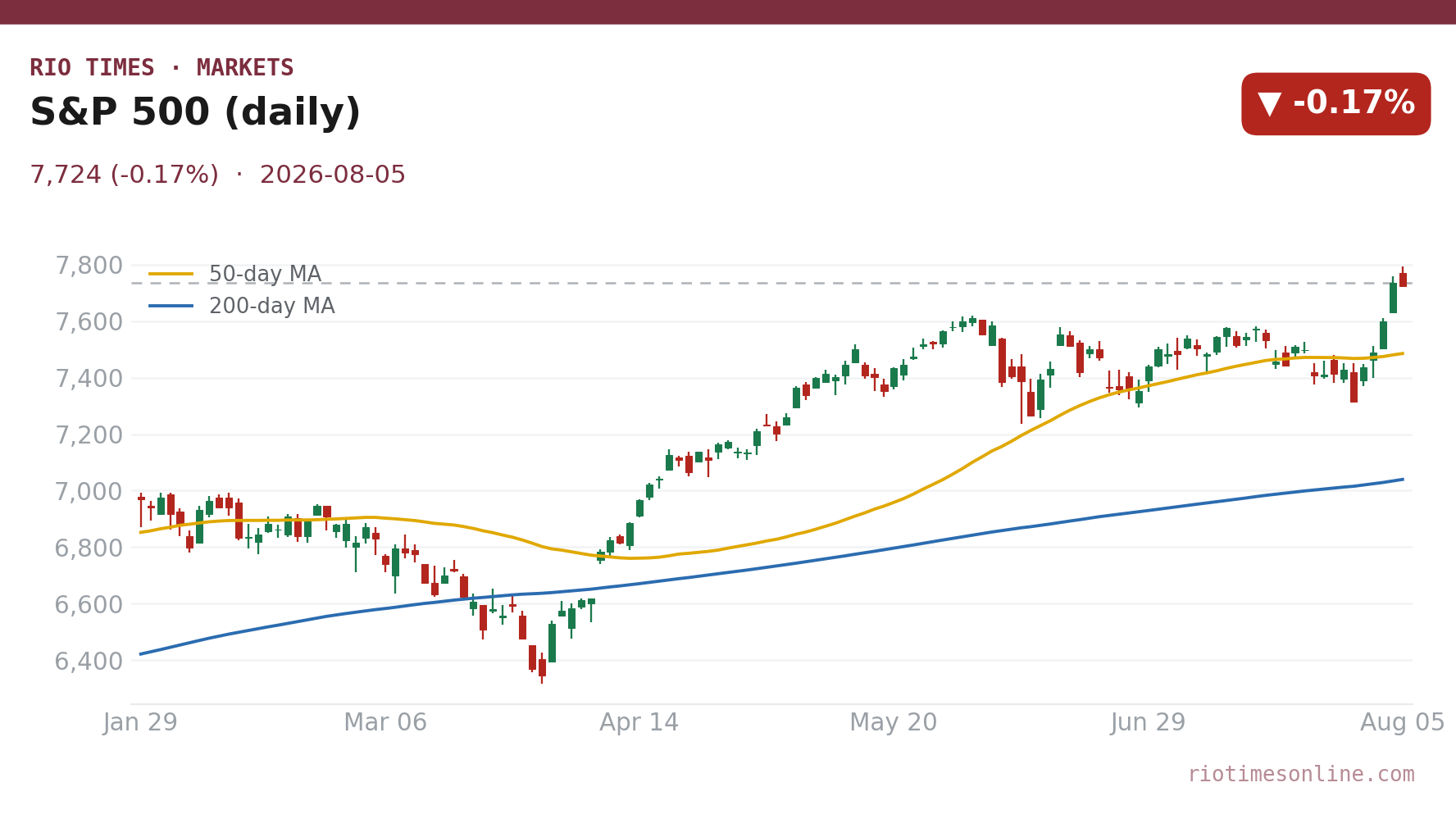
United States
| Indicator | Actual | Prior | Verdict |
|---|---|---|---|
| S&P 500 | 7,724 | -0.17% | Record pullback as tech stumbles |
| Dow Jones Industrial Average | 54,349 | +0.49% | Value rotation lifts industrials |
| Nasdaq Composite | 26,363 | -0.83% | Big Tech drags the tape lower |
| US Dollar Index (DXY) | 99.662 | -0.20% | Softens ahead of payrolls data |
| US 10-Year Treasury Yield | 4.617% | -0.04% | Safety flows nudge yields down |
Europe & United Kingdom
| Indicator | Actual | Prior | Verdict |
|---|---|---|---|
| Global Growth (World Bank June 2025) | 2.5% (2025) | 2.9% (2024) | War and inflation weigh on Europe |
Asia-Pacific & Emerging Markets
| Indicator | Actual | Prior | Verdict |
|---|---|---|---|
| Latin America Growth 2026 (IMF) | 2.3% | 2.2% (prior) | Slight upgrade, still below global pace |
| Global Growth Forecast 2026 (IMF) | 3.1% | 3.3% (prior) | Energy shocks trim EM funding room |
| Instrument | Level | Session |
|---|---|---|
| S&P 500 (US) | 7,724 | -0.17% |
| Ibovespa (Brazil) | 177,726 | -0.09% |
| USD/BRL | 5.1206 | -0.15% |
Global economy — Source: RT close, 2026-08-05. Figures rendered directly from the feed.
Today’s Economic Calendar — Thursday, August 6, 2026
| Time | Country | Event | Consensus | Prior |
|---|---|---|---|---|
| 03:35 | JP | 30-Year JGB Auction | — | 3.993 |
| 03:35 | JP | 6-Month Bill Auction | — | 1.0118 |
| 06:00 | DE | Factory Orders | 0.3 | 1.9 |
| 07:30 | DE | S&P Global Construction PMI | 45 | 44.8 |
| 09:30 | US | Challenger Job Cuts | 59 | 45.849 |
| 12:30 | US | Initial Jobless Claims | 202 | 197 |
| 12:30 | US | Nonfarm Productivity | 0.6 | 0.3 |
| 12:30 | US | Unit Labour Costs | 2.1 | 1.8 |
| 12:30 | US | Jobless Claims 4-Week Average | 198 | 202.75 |
| 12:30 | US | Continuing Jobless Claims | 1790 | 1782 |
| 14:00 | US | Wholesale Sales | — | 3.4 |
| 14:30 | US | EIA Natural Gas Stocks Change | 30 | 28 |
| 15:30 | US | 8-Week Bill Auction | — | 3.675 |
| 15:30 | US | 4-Week Bill Auction | — | 3.63 |
| 16:00 | US | 30-Year Mortgage Rate | — | 6.66 |
| 16:00 | US | 15-Year Mortgage Rate | — | 6.04 |
| 18:00 | BR | Balance of Trade | 8.4 | 9.76 |
| 19:00 | CO | Producer Price Index | 3.4 | 3.3 |
Live Market IntelligenceGlobal Markets — Live Board
Rio Times · Live Market Intelligence
Global Markets — Live Board
| Instrument | Last | Change | YoY | Prev. | High | Low | Volume |
|---|---|---|---|---|---|---|---|
| SPX | 7,751 | +0.29% | — | — | — | — | — |
| NDX | 29,799 | +0.93% | — | — | — | — | — |
| DJI | 53,810 | +0.03% | — | — | — | — | — |
| RUT | 3,041 | +0.46% | — | — | — | — | — |
| US10Y | 4.6760 | -0.17% | — | — | — | — | — |
| VIX | 14.60 | -4.45% | — | — | — | — | — |
| DAX | 26,331 | -0.23% | — | — | — | — | — |
| FTSE | 10,833 | -0.10% | — | — | — | — | — |
| CAC | 8,675 | -0.46% | — | — | — | — | — |
| STOXX | 659.48 | -0.16% | — | — | — | — | — |
| NIKKEI | 67,524 | +0.83% | — | — | — | — | — |
| HSI | 25,440 | -0.83% | — | — | — | — | — |
| KOSPI | 6,579 | +3.68% | — | — | — | — | — |
| CSI300 | 4,691 | +0.58% | — | — | — | — | — |
| NIFTY | 24,436 | -0.15% | — | — | — | — | — |
| TSX | 36,619 | +0.39% | — | — | — | — | — |
| GOLD | 4,461 | +1.78% | +33.20% | 4,383 | 4,503 | 4,421 | 139,824 |
| SILVER | 65.59 | +1.26% | +73.05% | 64.77 | 66.98 | 64.81 | 46,406 |
01 Risk trades exhale after Wall Street’s sprint
Wall Street has eased off the throttle after its latest surge, with the S&P 500 closing at 7,724, down 0.17%, as the tech-heavy Nasdaq slumped 0.83% to 26,363, its heaviest drag in a week. The Dow Jones Industrial Average managed a 0.49% gain to 54,349 in a classic rotation from growth to value, while the VIX slipped 4.18% to 15.81, signalling that investors see this as a pause rather than a panic. For Latin America, and Brazil in particular, a cooling US equity market plus a steady dollar index at 99.662 keeps risk premia embedded in local assets, making Copom’s rate signals and Brasília’s fiscal anchors the decisive factors for foreign capital.
Global growth expectations underpin this more cautious tone: the World Bank now sees global expansion slowing to 2.5% in 2025, the weakest since the pandemic, largely on Middle East conflict spillovers into energy prices, inflation and borrowing costs. The IMF’s latest World Economic Outlook trims global growth to around 3.1% in 2026 from earlier estimates, while a separate McKinsey analysis flags energy prices at their highest since 2022 and food costs rising on the back of crude and fertiliser. For Brazil-focused investors, these projections translate into tighter external financing, more volatile commodity terms of trade and a premium on credible monetary and fiscal anchors to maintain confidence in the real and local bonds.
In equity space beyond the US, recent Rio Times data showed the Ibovespa at 177,726, down 0.09% on a recent risk-off day, with USD/BRL around 5.1174, showing how global shocks can compress Brazilian valuations when the dollar strengthens and hedging costs rise. The broader message from the overnight moves is that while global risk appetite remains intact, the war-driven energy squeeze and uneven disinflation have turned markets more tactical. Foreign investors are willing to own Latin American cyclicals and carry trades, but only with an eye on US yields, the oil tape and domestic reform signals in Brasília.
02 Fed patience and the Brazilian balancing act
On the macro side, the latest BEA release confirms US real GDP grew at an annual rate of 2.1% in Q1 2026, a pace that shows resilience but not overheating. Reuters’ recent labour-market coverage points to job growth slowing more than expected in June, even as the unemployment rate ticks down to 4.2% and weekly jobless claims drift lower, fitting a slow-hire, slow-fire pattern rather than a sudden downturn. For the Fed, this mix of steady output and still-tight employment argues for patience: it gives room to keep rates elevated to ensure inflation continues to cool without rushing into cuts that could reignite price pressures or asset bubbles.
Global inflation dynamics complicate this stance. McKinsey notes that energy prices across major commodities are at their highest since 2022, with vegetable oils and food prices up sharply and gold prices softening as yields rise and the dollar stays strong. The IMF’s and World Bank’s warnings about war-related energy shocks and financial tightening feed directly into the Fed’s risk assessment: a renewed spike in oil or a further strengthening of the dollar would push imported inflation higher and tighten conditions for emerging markets, even if US domestic demand holds up. For Brazil, a higher for longer Fed and robust US dollar reinforce pressures on the real, increasing the cost of external debt and narrowing the margin for aggressive Selic cuts without risking capital outflows.
Against this backdrop, Brazil’s Copom cut the Selic rate to 14.00% from 14.25% on 5 August, its fourth straight 25-basis-point move that signals caution rather than a surge towards neutral. Prior local data, including deep wholesale-level deflation in the IGP-M index at around -1.09%, suggest room for easing, but the strong dollar and global risk premium force Copom to calibrate cuts carefully. For foreign investors in Latin America, the key read-through from the Fed is straightforward: until US inflation is firmly back at target and the dollar index retreats, the region’s carry trades and duration bets will depend as much on Washington’s data prints as on Brasília’s policy messaging.
03 A slower world and a sharper Latin American lens
The broader global backdrop has turned more demanding for emerging markets. The World Bank’s June Global Economic Prospects warns that global growth is projected to slow to 2.5% this year, the weakest since the pandemic, with nearly two-thirds of countries seeing forecasts cut, mainly because of the Middle East conflict, inflation and higher borrowing costs. In parallel, the IMF’s latest updates show global growth easing to around 3.1% in 2026, while its April Latin America outlook nudges regional growth up to 2.3%, a marginal upgrade that still leaves the region trailing global averages. For Brazil-focused investors, that means a world in which capital is scarcer and risk premia for commodity-exposed economies are structurally higher, yet the country’s relative story inside Latin America has improved.
Energy and commodity dynamics sharpen the focus on the region. McKinsey’s global economics intelligence highlights that energy prices across all major commodity classes are at their highest since 2022, with food prices following closely as vegetable oils, crude and fertiliser costs stay elevated. The World Bank notes that the Middle East conflict and potential disruptions to oil flows near the Strait of Hormuz could further lift commodity prices, heighten inflationary pressures and strain public finances in developing economies. For Brazil and its neighbours, the double edge is sharp: higher export revenues from commodities can support growth and tax receipts, but imported inflation and tighter global financing raise the bar for credible monetary and fiscal anchors.
Gold’s 5.03% surge to $4,277.69 per ounce and the US 10-year Treasury yield’s modest dip to 4.617% confirm that safe-haven flows are still circulating even as risk assets digest recent records. This dynamic matters for the real and other Latin American currencies because it shows that capital is rotating more frequently between risk-on and risk-off positions, rather than committing to a durable carry-trade cycle. After Copom’s 5 August cut, the message is clear: a carefully worded statement alongside a 25-basis-point cut to 14.00% can sustain local-currency demand, but any sign of a rushed easing cycle will be punished by a bond market that remains highly sensitive to the global inflation and rate picture.
What to watch today and this week
- Thursday: US weekly jobless claims, any fresh Iran war headlines and Brazil’s local inflation prints for clues on Copom’s Selic path and EM risk appetite.
- Friday: Global PMI releases and any revisions to World Bank or IMF growth views that could shift expectations for commodity demand and Latin American funding conditions.
- Ahead: the September Copom meeting, Fed speakers and US data surprises, all of which will feed directly into USD/BRL, local bond yields and regional carry trades.
- Ongoing: Middle East conflict impacts on oil and freight, the evolution of global disinflation, and the balance between AI-driven investment and geopolitical fragmentation for EM exporters.
Background: our mexico economy guide.
Frequently Asked Questions
How did the S&P 500 trade overnight and why does it matter for Brazil?
The S&P 500 closed at 7,724, down 0.17%, easing from a record earlier in the week as investors balanced war-driven energy risks with resilient US growth and a cautious Fed. For Brazil, this matters because US equity valuations and dollar strength shape global risk appetite: when Wall Street consolidates and volatility spikes, foreign flows into Ibovespa, Brazilian credit and local-currency debt tend to become more selective and sensitive to policy signals from Copom and Brasília.
What is the latest signal from US growth and the labour market?
The BEA reports US real GDP grew at a 2.1% annualised pace in Q1 2026, confirming moderate but resilient expansion. Reuters notes that job growth slowed more than expected in June but the unemployment rate fell to 4.2%, while weekly jobless claims have been edging down, supporting the view of a labour market in a slow-hire, slow-fire mode rather than a sharp deterioration.
How are global growth forecasts evolving and what is the impact on Latin America?
The World Bank now projects global growth at 2.5% in 2025, down from 2.9% in 2024, citing the Middle East conflict, inflation and higher borrowing costs as key drags. The IMF’s recent outlook trims global growth to about 3.1% in 2026 while upgrading Latin America and the Caribbean slightly to 2.3%, reflecting a modestly better regional narrative but a tougher external environment, with higher energy prices and tighter financial conditions weighing on currencies and sovereign funding.
What did Brazil’s central bank do with the Selic rate?
Rio Times’ recent Global Economy Briefing reports that Brazil’s Copom cut the Selic rate to 14.00% from 14.25% on 5 August, with markets having largely priced a 25-basis-point move as it extends a cautious easing cycle. This comes against a backdrop of wholesale-level deflation in the IGP-M index and a firm dollar; investors see the decision as a key test of Copom’s ability to balance domestic disinflation with external vulnerabilities and support the real without overburdening fiscal policy.
How do war-driven energy shocks feed into the Brazil and Latin America story?
McKinsey’s global economics intelligence work highlights that energy prices across major commodity classes are at their highest since 2022, while food prices have risen on the back of vegetable oils, crude and fertiliser. The World Bank warns that the Middle East conflict and potential disruptions to oil flows could further lift commodity prices, heighten inflationary pressures and strain public finances, particularly in developing economies. For Brazil and its neighbours, this combination offers both upside and risk: higher export revenues from commodities can support growth, but imported inflation and tighter global financing raise the bar for credible monetary and fiscal anchors to keep currencies and local markets stable.
This article was produced by The Rio Times’ automated newsroom system. How we use AI · Report an error