Latin America Defense Monitor — September 12–19, 2026
Weekly Edition · Sunday, 20 September 2026 · Issue #22
Executive Summary
The Big Picture: This week’s Latin America Defense Monitor opens in Caracas. On 16 September, Washington removed Venezuela from its list of countries that “failed demonstrably” to fight drug trafficking. A day later, the interim government and the opposition opened a second round of US-backed transition talks. On 18 September, the White House confirmed that President Trump will meet acting president Delcy Rodríguez at the UN General Assembly next week — the first such meeting since US forces captured Nicolás Maduro in January. Eight months after the operation, Venezuela has moved from target to partner.
In Colombia, the war met a harder test. The ELN confirmed it holds four people kidnapped on 17 August — an army major, two police patrol officers and a civilian — and proposed an exchange. President de la Espriella refused. He demanded unconditional release and ordered operations reinforced. A strike killed a senior ELN commander. On 18–19 September, chairing a security council in Cartagena, he moved the DIMAR maritime authority from Bogotá to the coast and named the commanders his forces will hunt in Bolívar.
Ecuador produced the week’s quiet landmark: the first institutional pushback against the US presence. President Noboa removed the air force chief by decree after the general asked for legal rules covering US flights at Taura air base. Days earlier, Ecuadorian courts had freed 56 crew members of vessels seized in US operations.
Latin America Defense Monitor: Where Things Stand
| Country | Status | What’s Happening |
|---|---|---|
| Venezuela | High | Removed from the US “failed demonstrably” drug list (16 September); second round of transition talks opened (17 September); Trump–Rodríguez meeting set for UNGA week; TotalEnergies deal signed; some censored news sites unblocked. |
| Colombia | High | ELN holds four hostages since 17 August and proposed an exchange; government refuses and reinforces operations; senior ELN commander killed in a strike; Cartagena security council names targets in Bolívar; DIMAR moves to the coast. |
| Ecuador | Elevated | Air force chief removed after requesting legal rules for US flights at Taura; courts freed 56 crew members of seized vessels; US$45 million security package still pending in Washington. |
| US (SOUTHCOM) | Elevated | Boat-strike campaign continued with lethal strikes on 16 and 19 September; cumulative toll uncertain — public tallies differ and no official count exists. |
| Peru | Active | UNITAS LXVII in its second week at Callao — amphibious and live-fire phases with US Marines; exercise closes 24 September. |
| Argentina | Watch | Falklands dispute quiet this week; four US-approved Black Hawks in the pipeline; Tierra del Fuego naval-base funding stands. |
| Brazil | Watch | Election season dominates; Tamandaré batch-2 frigates and Gripen assembly proceed without announcements. |
| Mexico | Watch | On the US major-transit list but not designated as failing; no new border incidents reported. |

On 15 September, the White House sent Congress its annual determination on major drug-transit countries. Venezuela stays on that list, alongside Colombia, Mexico, Peru, Ecuador and Bolivia. But the decisive line came a day later: Venezuela is no longer designated as having “failed demonstrably” to meet counternarcotics obligations. The document cites “positive steps taken under interim President Delcy Rodríguez,” including the June operation that killed Niño Guerrero, the Tren de Aragua leader. Only Afghanistan, Bolivia, Burma and Colombia keep the failed designation.
The diplomatic sequence moved fast after that. On 17 September, government and opposition opened a second round of US-backed transition talks in Caracas, with Jorge Rodríguez leading the government side. On 18 September, the telecoms regulator unblocked 17 news sites that had been censored for years, and the White House confirmed that Trump will meet Rodríguez in New York during the UN General Assembly, which runs 22–26 September. On 19 September, Rodríguez signed an agreement with the French oil company TotalEnergies.
Money frames all of it. Washington says it secured majority control of more than 65 billion barrels of Venezuelan reserves in August. Trump said on 13 September that Venezuelan revenue has “paid for the war many times,” referring to Iran. A US$4 billion gold reserve is leaving the Bank of England for a US Treasury account. Reuters reports that Washington now wants access to gold, bauxite and nickel. What is not known: the legal basis of Rodríguez’s presidency (the constitution’s 180-day caretaker limit passed in July, unpublished), and whether any election date exists at all.
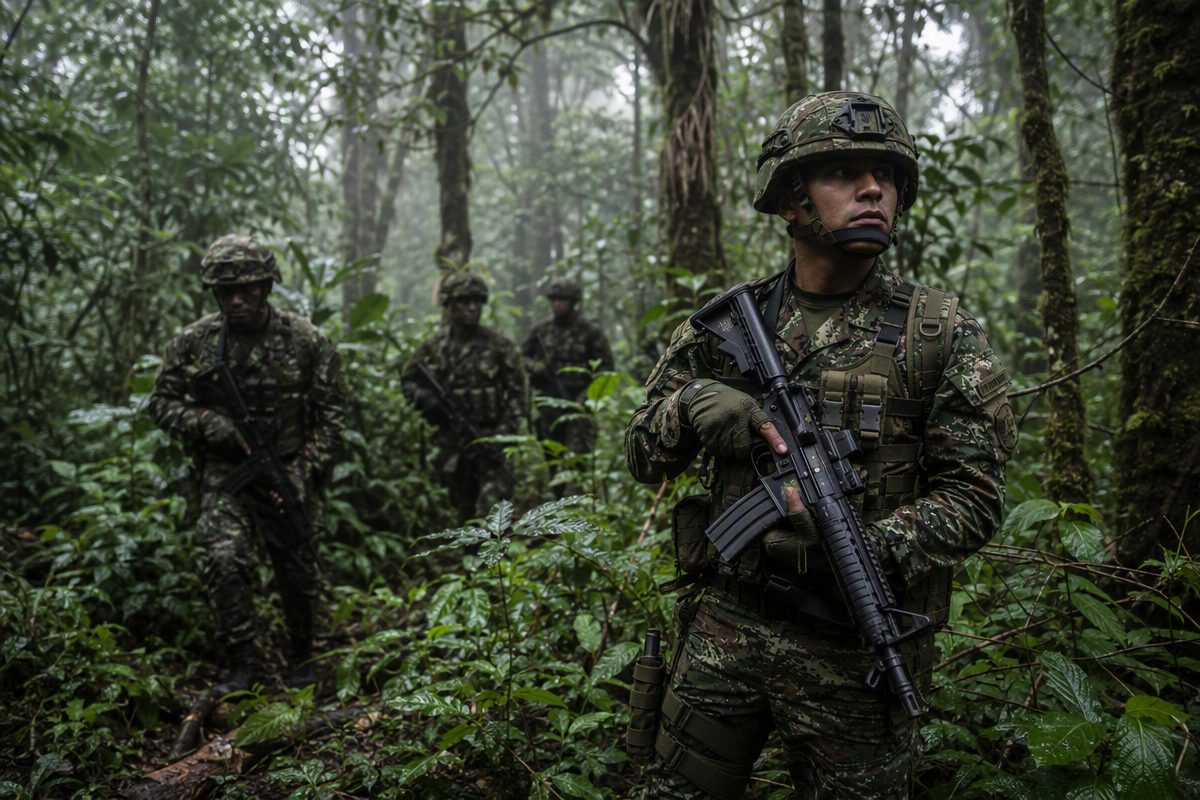
The ELN confirmed it holds four people kidnapped on 17 August: army major Fredy Alexis Russi González, police patrol officers Erika Tatiana Monroy Hurtado and Edinson Yesid Medina Traslaviña, and civilian Angi Jácome. The guerrilla group proposed what it called a hostage exchange. On 17 September, President de la Espriella rejected the idea publicly. The four must be released unconditionally, he said, and operations to find them will be intensified.
The same week brought the offensive’s continued rhythm. A strike killed a senior ELN commander, after which the president warned remaining fighters they would be pursued. On 18–19 September, in Cartagena, he chaired a security council and announced two things: the DIMAR maritime authority will move from Bogotá to Cartagena, and operations in Bolívar will target named commanders of the ELN, the Segunda Marquetalia, the Estado Mayor de Bloques and the Clan del Golfo — their financial networks included. His words to them: surrender or face an expiration date.
Around the hard line, the accountability debate continues. A judge ordered the presidency’s corpse videos hidden temporarily pending a final ruling. Congress is weighing a submission-law framework for criminal groups without political status: reduced sentences for full confessions and asset forfeiture. And the 2027 budget — roughly 635 trillion pesos, about US$204 billion — has opened a public fight with former president Petro over who owns the deficit.
On 10 September, President Noboa removed the air force chief, General Salazar, by decree. The dismissal became public knowledge this week, along with its cause: the general had asked for legal rules governing US military flights at Taura air base. Two days before the decree, an Ecuadorian court in the Galápagos had freed 28 crew members of vessels seized in US counter-drug operations. Another 28 had been freed in Manta the previous weekend.
The sequence matters. US special forces operate inside Ecuador with 180-day visa-free entry. Two US warships are expected. A US$45 million security package is pending in Washington, along with a Coast Guard cutter and five interceptor boats for Ecuador’s navy. Inside that expanding presence, Ecuador’s own institutions have now asked, twice in one week, what the legal limits are — one through a general’s letter, one through judges’ rulings.
US forces struck suspected drug boats on 16 September, killing three people, and again on 19 September, killing two, according to US Southern Command. A further strike was reported on 20 September, killing four. The campaign has now run for over a year across the Caribbean and the eastern Pacific.
The cumulative toll is genuinely uncertain. This publication reported more than 230 dead across at least 75 strikes earlier this month, based on open-source tracking. Some wire reports this week cited a figure near 180. The difference reflects method, not necessarily error: trackers disagree on which incidents to include, and no official public count exists. What is also not public: the identities of most of the dead, the evidence against each vessel, and the legal review behind individual strikes.
UNITAS LXVII continued at Callao through its second week. The 67th edition of the Americas’ longest-running multinational naval exercise involves 24 countries, more than 5,700 personnel, 26 ships and three submarines. This week moved from harbor and classroom phases to live fire: Peruvian marines on pistol ranges, US Marines training alongside Peruvian and Bolivian personnel, amphibious work at the naval infantry base. The littoral combat ship USS Minneapolis–Saint Paul is among the US participants. The exercise closes on 24 September.
| Country | The Deal | Where It Stands | Why It Matters |
|---|---|---|---|
| Venezuela | US control of 65bn+ barrels; TotalEnergies agreement; US$4bn gold transfer | Signed/moving; terms partly unpublished | The security relationship is financed through resources, not appropriations |
| Ecuador | US$45m security package, one Coast Guard cutter, five interceptors | Pending in Washington | Funds the US presence; first delivery will test the Taura legal question |
| Argentina | Four UH-60 Black Hawks (US approval) | Approved; delivery pending | First US rotorcraft in years; arrives mid-Falklands tension |
| Brazil | Tamandaré batch-2 frigates; Gripen assembly | Proceeding quietly | The region’s only serious naval-industrial program keeps building |
| Venezuela (legacy) | Russian air-defense systems (S-300VM, Buk, Pantsir) | Neutralized in January; no replacement announced | The gap in Venezuelan air defense is now a US planning assumption |
Eight months ago, US forces captured a sitting president in Caracas. This week, his successor prepared to meet the US president in New York — removed from the failed-states list, signing with a French oil major, unblocking news sites. Whatever one thinks of the method, the speed of that arc has no recent precedent in the hemisphere.
The same week showed the costs of the harder track. In Colombia, four kidnapped people wait while their government refuses the exchange their captors proposed. In Ecuador, a general lost his job for asking what rules govern US flights, and judges keep quietly releasing the crews that US interdictions deliver. In the Caribbean, boats keep sinking, and the public record cannot say exactly how many people have died.
Alignment, last week’s theme, now has its invoice. The Latin America Defense Monitor will keep counting both sides of it.
Background: Venezuela Opens Transition Talks With Its Leader’s Legal Basis Unclear.
Background: Ecuador Military Shake-up: Noboa Removes Air Force Chief After Base Letter.
Previous edition: Latin America Defense Monitor — September 5–11, 2026.
This article was produced by The Rio Times’ automated newsroom system. How we use AI · Report an error