Oil Wrap: Hormuz Risk Lifts WTI, Petrobras Lags
Key Facts
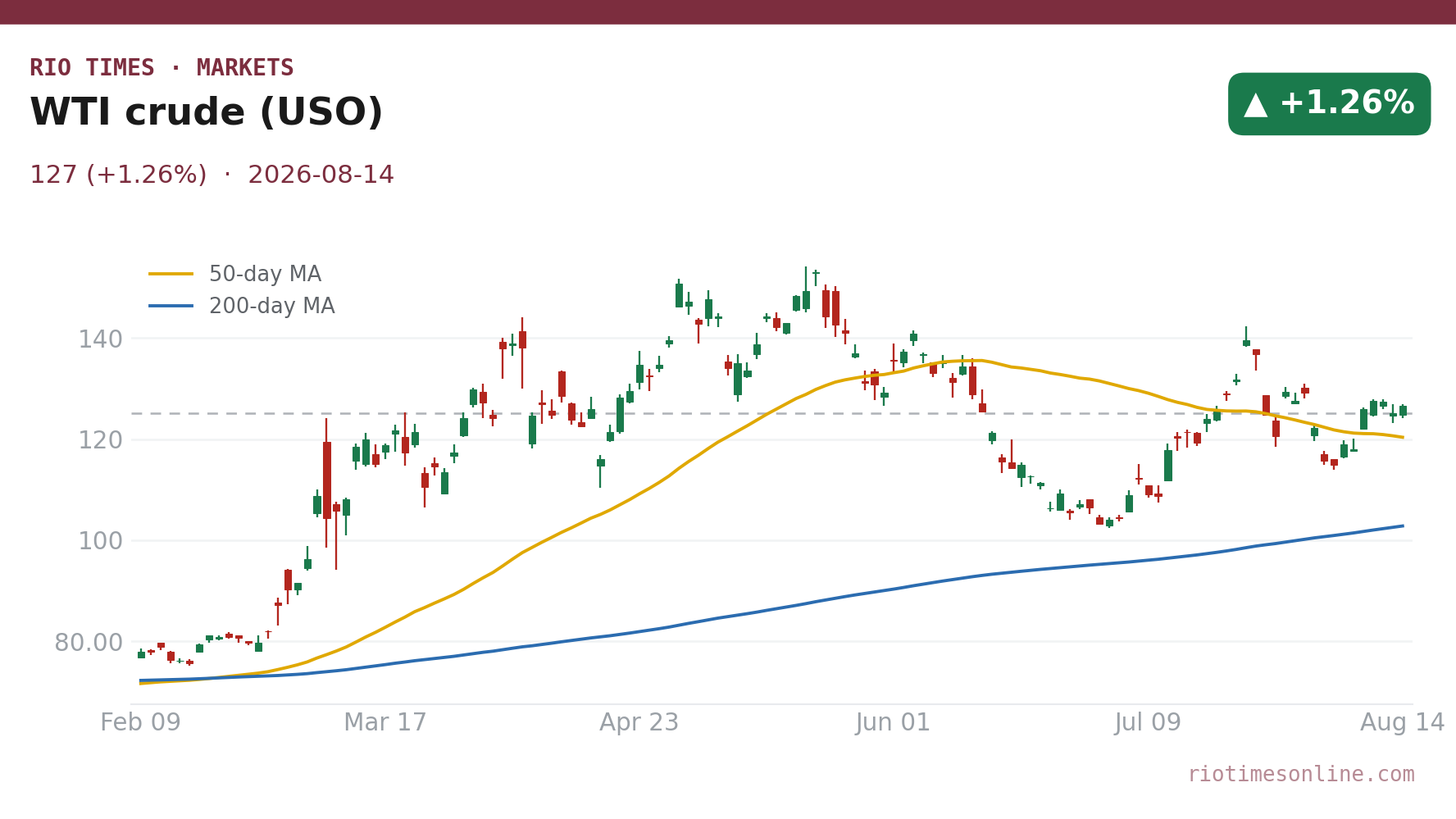
- WTI tracked fund rose the United States Oil Fund ended Friday at US$126.60, up 1.26%, while the underlying futures contract settled up 1.4% at US$82.40 a barrel.
- Brent outpaced WTI the international benchmark climbed 1.7% to US$88.52 a barrel as Middle East shipping angst outweighed the prior session’s demand worries.
- Tanker traffic slowed reports of further disruption to flows through the Strait of Hormuz kept a floor under crude, even as official US figures claimed export volumes had rebounded.
- Petrobras missed the move Petrobras common ADRs closed at US$17.88, down 0.06%, while the preferred line slipped 0.34% to US$16.08 in New York.
- YPF rose with crude Argentina’s YPF ended Friday at US$50.05, up 1.21%, making it the region’s clearest beneficiary of the session’s bullish crude tone.
- Ecopetrol lagged Colombia’s Ecopetrol slipped 0.23% to US$17.17, showing that not every Latin American energy name tracked the oil rally.
Today’s Focus
Crude proxies rose on Friday, August 14, 2026 because traders paid more attention to the Strait of Hormuz than to the previous day’s weak demand signal. The United States Oil Fund, which tracks WTI futures, closed at US$126.60, a gain of 1.26% on the session.
The physical WTI contract settled at US$82.40 a barrel, up 1.4%, while Brent closed at US$88.52, up 1.7%. That spread shows the market pricing more risk into seaborne crude than into the US inland benchmark.
Latin American equities did not all follow. Petrobras ADRs were flat to lower in New York, Ecopetrol slipped, but Argentina’s YPF rose 1.21% to US$50.05, the strongest regional proxy on the day.
For investors, the session was a reminder that a geopolitical oil rally does not automatically lift every state-controlled producer in Latin America.
What matters today. Hormuz risk is back as the dominant crude driver, and the market is rewarding shale-heavy names over integrated state producers.
01 The session in one read
Oil’s Friday session was a geopolitical trade. Crude proxies rose because reports of slowing tanker traffic through the Strait of Hormuz revived fears of a genuine supply bottleneck, overriding the demand concerns that had knocked prices lower a day earlier.
The United States Oil Fund ended Friday at US$126.60, up 1.26%, while the underlying WTI contract settled at US$82.40 a barrel, up 1.4%. Brent did better, rising 1.7% to US$88.52, a sign that the market is pricing more danger into seaborne barrels than into US landlocked supply.
C
r
u
d
e
e
n
d
e
d
t
h
e
w
e
e
k
f
i
r
m
l
y
d
e
s
p
i
t
e
a
T
h
u
r
s
d
a
y
d
r
o
p
,
w
i
t
h
W
T
I
a
n
d
B
r
e
n
t
b
o
t
h
r
e
b
o
u
n
d
i
n
g
m
o
r
e
t
h
a
n
1
%
o
n
F
r
i
d
a
y
a
s
s
h
i
p
p
i
n
g
a
n
x
i
e
t
y
a
r
o
u
n
d
t
h
e
S
t
r
a
i
t
o
f
H
o
r
m
u
z
r
e
t
u
r
n
e
d
t
o
t
h
e
f
o
r
e
g
r
o
u
n
d
.
T
h
e
m
a
r
k
e
t
i
s
c
a
u
g
h
t
b
e
t
w
e
e
n
t
w
o
n
a
r
r
a
t
i
v
e
s
:
o
f
f
i
c
i
a
l
U
S
c
l
a
i
m
s
t
h
a
t
M
i
d
d
l
e
E
a
s
t
e
x
p
o
r
t
v
o
l
u
m
e
s
h
a
v
e
r
e
c
o
v
e
r
e
d
,
a
n
d
v
e
s
s
e
l
–
t
r
a
c
k
i
n
g
r
e
p
o
r
t
s
t
h
a
t
s
u
g
g
e
s
t
t
a
n
k
e
r
t
r
a
f
f
i
c
i
s
s
t
i
l
l
c
o
n
s
t
r
a
i
n
e
d
.
T
h
e
v
a
r
i
a
b
l
e
t
o
w
a
t
c
h
i
s
w
h
e
t
h
e
r
v
e
r
i
f
i
e
d
t
a
n
k
e
r
m
o
v
e
m
e
n
t
d
a
t
a
n
e
x
t
w
e
e
k
c
o
n
f
i
r
m
s
t
h
e
s
l
o
w
d
o
w
n
o
r
s
u
p
p
o
r
t
s
W
a
s
h
i
n
g
t
o
n
‘
s
m
o
r
e
r
e
a
s
s
u
r
i
n
g
e
x
p
o
r
t
f
i
g
u
r
e
s
.
02 The board
The board tells a split story. The WTI-tracking fund and Argentina’s YPF both rose more than 1%, YPF closing at US$50.05 with a 1.21% gain. Petrobras common ADRs ended at US$17.88, down 0.06%, while the preferred line slipped 0.34% to US$16.08.
Colombia’s Ecopetrol fell 0.23% to US$17.17. The pattern is clear: producers with heavy state involvement and local political noise did not capture the crude rally, while the more market-sensitive names did.
| Asset | Level | Change |
|---|---|---|
| WTI crude (USO) | US$126.60 | +1.26% |
| Petrobras | US$17.88 | -0.06% |
| Ecopetrol | US$17.17 | -0.23% |
| YPF | US$50.05 | +1.21% |
Source: RT close, 2026-08-14. Where a commodity has no spot feed, an exchange-traded tracker or leading producer is shown as a labelled proxy.
Live Market IntelligenceThe live market board
Rio Times · Live Market Intelligence
Latin America — Cross-Market Board
| Instrument | Last | Change | YoY | Prev. | High | Low | Volume |
|---|---|---|---|---|---|---|---|
| IBOV | 166,934.20 | -0.10% | +21.85% | 167,100.95 | 168,310 | 167,142 | — |
| IPSA | 11,042.67 | +0.39% | — | 11,000.07 | 11,210 | 10,984 | 1,513,213,483 |
| IPC MEX | 64,397.45 | -0.66% | +12.17% | 64,826.39 | 66,121 | 65,405 | 108,886,187 |
| MERVAL | 2,947,349 | -1.77% | +30.51% | 3,022,485 | 3,042,365 | 2,991,150 | — |
| COLCAP | 2,452.46 | +0.84% | — | 9.04 | 9.05 | 9.02 | 4,133 |
| BVL PERÚ | 58,104.31 | +0.40% | — | — | — | — | — |
| USD/BRL | 5.16 | +0.01% | -5.13% | 5.16 | 5.18 | 5.14 | — |
| EUR/BRL | 5.95 | +1.01% | -5.83% | 5.89 | 5.98 | 5.94 | — |
| USD/MXN | 17.06 | -0.24% | -8.58% | 17.10 | 17.08 | 17.01 | — |
| USD/CLP | 913.98 | +0.04% | -5.67% | 913.65 | 915.11 | 906.68 | — |
| USD/COP | 3,140 | +0.03% | -22.04% | 3,139 | 3,141 | 3,105 | — |
| USD/PEN | 3.36 | -0.66% | -4.82% | 3.38 | 3.38 | 3.35 | — |
| USD/ARS | 1,493 | +0.10% | +12.96% | 1,491 | 1,494 | 1,480 | — |
| USD/UYU | 40.27 | +1.24% | +1.80% | 39.77 | 40.27 | 40.23 | — |
| USD/PYG | 5,939 | +1.68% | -19.54% | 5,841 | 5,939 | 5,925 | — |
| USD/BOB | 11.64 | -0.76% | +72.04% | 11.73 | 11.72 | 11.64 | — |
| USD/DOP | 58.34 | +1.25% | -3.44% | 57.62 | 58.34 | 58.04 | — |
| USD/CRC | 445.92 | +0.89% | -9.71% | 441.97 | 448.50 | 445.92 | — |
03 What moved it
The Strait of Hormuz was the session’s engine. Reports that tanker traffic had slowed further over the weekend kept a premium in crude, even as US Energy Secretary Chris Wright claimed Middle East exports had rebounded to 15 million barrels per day and even topped the pre-war average on Sunday.
The conflict between official export numbers and vessel-tracking evidence left the market leaning towards caution. Brent’s 1.7% gain to US$88.52 shows traders were willing to pay more for seaborne crude, which is most exposed to any disruption in the strait.
The move also capped a strong week. Both benchmarks advanced more than 5% for the week, recovering from Thursday’s drop of more than 2% on weak demand data and a hefty US crude inventory build.
04 The Latin American read
Brazil’s Petrobras did not enjoy the oil rally. The common ADR closed at US$17.88, down 0.06%, and the preferred line at US$16.08, down 0.34%, suggesting that local politics, dividend policy or regulatory concerns mattered more to New York traders than the headline crude move.
Argentina’s YPF was the region’s clear winner, rising 1.21% to US$50.05. That fits the Vaca Muerta narrative: shale-heavy producers with export ambitions benefit most directly when global crude prices climb.
Guyana’s offshore boom continues to attract foreign capital, even without a session-specific price to quote. Mexico’s Pemex remains a domestic political story as much as an oil story, while Venezuela’s sector stays constrained by sanctions and chronic under-investment.
05 The names to watch
Petrobras is the bellwether for Brazil’s pre-salt province, and its failure to follow crude higher is a warning that company-specific factors can override the commodity price. Watch whether that discount persists into next week’s sessions.
YPF is the purest listed proxy for Argentina’s Vaca Muerta shale push. Its 1.21% rise to US$50.05 shows foreign investors still treat it as a leveraged bet on global crude direction.
Ecopetrol’s 0.23% slip to US$17.17, despite firm crude, underlines that Colombia’s fiscal and political backdrop can weigh on otherwise strong energy fundamentals. Guyana remains the regional growth story investors watch through the major operators rather than a dedicated local listing.
06 The outlook
The outlook hinges on whether Hormuz shipping data confirms a lasting slowdown or supports official claims of recovering export volumes. Until that question is resolved, expect crude to trade with a risk premium and Latin American energy equities to diverge based on local politics and cost structure.
07 What to watch
- Strait of Hormuz tanker flows: Vessel-tracking data versus US export claims will set the next leg of crude direction.
- Petrobras discount: Whether the ADR’s failure to follow crude persists will signal the weight of local political and regulatory concerns.
- YPF leverage: How tightly YPF tracks WTI will show whether investors still treat Vaca Muerta as a high-beta oil play.
- Ecopetrol’s divergence: A continued slide despite firm crude would point to Colombia-specific fiscal or political pressure.
Frequently Asked Questions
Why did oil rise on Friday?
Reports of slower tanker traffic through the Strait of Hormuz revived supply-risk fears, lifting WTI 1.4% and Brent 1.7%.
Did Petrobras follow crude higher?
No. Petrobras common ADRs fell 0.06% to US$17.88, showing local factors outweighed the oil rally.
Which Latin American energy name gained most?
Argentina’s YPF rose 1.21% to US$50.05, the clearest regional beneficiary of the session’s bullish crude tone.
What is the biggest risk to the oil rally?
If official US data showing recovering Middle East exports is confirmed, the Hormuz risk premium could deflate quickly.
This article was produced by The Rio Times’ automated newsroom system. How we use AI · Report an error
LatAm Markets: Live Signals → — real-time movers, turnover leaders and FX across Latin America.
Read More from The Rio Times